On the edge of a forgotten New England town, a narrow bridge once spanned the Merrin River—a place travelers crossed in haste. No one lingered there after dark, for it was said the wind beneath the planks could speak a person’s name before they reached the other side.
The locals called it Widow’s Bridge, and every child in the county knew its tale.
Long before the bridge was built, there had been a ferry crossing run by a man named Jonas Pike and his wife, Eliza. They were poor folk but honest, and their ferry carried soldiers and farmers alike. One bitter autumn, a storm swept down the valley. Jonas went out to guide the last passenger across, but the ropes snapped, and the river swallowed them both.
When the villagers found Eliza waiting by the shore the next morning, she was still clutching the ferry’s signal bell—the little iron chime she used to call her husband home. The boat was gone, the rope gone, and her voice gone too.
Eliza never spoke again. Each evening she walked to the water’s edge and rang the bell three times, hoping the river might return what it had taken. Winter came; ice sealed the current; still she came.
By spring thaw, the people built a wooden bridge, saying it would spare others from such loss. They called it Widow’s Bridge in her honor. But Eliza’s grief was not buried with her name.
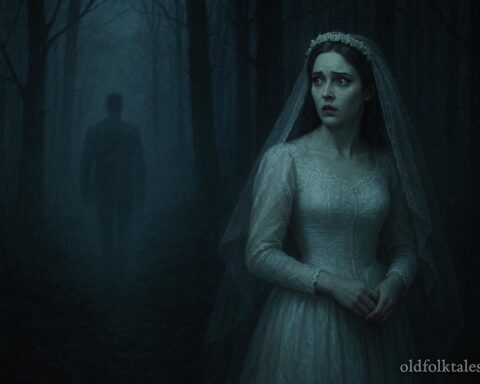
Years passed. Travelers began hearing the bell when no one was near—three slow tolls beneath the wind. Horses balked; torches guttered. Some claimed they saw a woman in gray walking the railing, her skirts trailing frost. Others said she whispered warnings before floods.
Then came the night of the freight wagon.
A merchant from Portsmouth, young and proud, decided to cross despite the warnings. He laughed at talk of spirits. “A widow’s tears never broke timber,” he said.
Halfway over, his horses froze. Their eyes rolled white; their breath steamed in terror. Then came the bell—clang… clang… clang—from beneath the boards. The wagon shuddered. The merchant cracked his whip, cursing, but the horses bolted backward, snapping the traces.
The bridge shook once, twice—and the center gave way. His wagon plunged into the flood, swallowed like the ferry before it. Only one thing surfaced downstream: his lantern, still burning inside its glass, circling like an eye.
At dawn, the townsfolk found a wet mark on the far post: the print of a woman’s hand and a single word traced in mud—“LISTEN.”
Since then, the story says, anyone crossing Widow’s Bridge must pause and listen before stepping on. On quiet nights, you can hear three soft notes beneath the current. Sometimes they ring clear as truth; other times faint as memory. But those who mock them are said to meet misfortune before the next moon.
A farmer who once sneered at the tale lost his best cow to the swollen river that very week. A courting couple who lingered too long at the railing were found safe but half-frozen, whispering that the bridge “breathed.”
And yet, not all who hear the bell fear it. Some say it guards travelers now—that Eliza Pike’s sorrow turned to warning, her love stretched into eternity so no other wife would wait by the water with empty arms.
Every spring, when the river runs high, townsfolk hang garlands by the bridge and strike a small bell in her name. They say if you bow your head as it rings, you’ll never drown nor lose what you hold dear while crossing life’s darker waters.
Sometimes, on the anniversary of the storm, a faint figure appears at dusk—barefoot, carrying a lantern. She walks halfway across, pauses, and looks downstream, as if expecting an old ferry to return. Then the bell rings once, twice, thrice—and she fades with the mist.
And always, the wind seems to echo her final plea: “Listen.”
Moral of the Story
Grief, when rooted in love, can become protection. The past only haunts those who refuse to listen to its warnings.
Knowledge Check
1. Who were Jonas and Eliza Pike?
A ferryman and his wife who operated the crossing before the bridge existed.
2. What happened during the storm?
Jonas and a passenger drowned when the ferry ropes broke.
3. What did Eliza do afterward?
She rang her ferry bell nightly, hoping her husband would return.
4. How did the haunting begin?
Travelers began hearing the bell tolling when no one was there.
5. What fate befell the mocking merchant?
He ignored the warning and was lost when the bridge collapsed.
6. What is the story’s lasting message?
Respect the echoes of the past; some hauntings are acts of love, not malice.
Origin: New England ghost legend (19th-century river towns)