Long ago, when the Pine Barrens of southern New Jersey were still wilder and darker than they are today, when the twisted pines grew so thick that even midday sun could barely penetrate their canopy, and when settlers lived scattered and isolated in rough cabins carved from the wilderness, there lived a woman named Deborah Leeds.
Her home was a lonely, weathered shack deep among those gnarled trees, miles from the nearest neighbor. The walls were rough-hewn logs chinked with mud, the roof leaked when it rained, and the wind whistled through gaps in the boards like the moaning of lost souls. It was a hard place for a hard life, and Deborah Leeds had known nothing but hardship for as long as she could remember.
Click to read all American Cryptids & Monsters — creatures of mystery and fear said to inhabit America’s wild landscapes.
She was poor, desperately poor, with twelve hungry mouths to feed. Twelve children, ranging from a babe barely walking to near-grown young men and women, all dependent on her and her husband to scratch a living from the unforgiving soil of the Barrens. Her husband worked himself to exhaustion, and still it was never enough. There was never enough food, never enough warmth in winter, never enough rest. The years of struggle and want had worn away at Deborah’s spirit like water wearing away stone, until her heart had turned bitter and hard.
The harsh winters of the Pine Barrens were especially cruel. Snow would pile high against the cabin walls, and the wind that howled through the pines carried a cold that seeped into your very bones. Many winters, the family would huddle together for warmth, their bellies hollow with hunger, wondering if they would survive to see spring.
One stormy night in the year 1735, when thunder cracked like cannon fire over the black forest and lightning illuminated the twisted shapes of the ancient pines in brief, terrifying flashes, Deborah Leeds learned she was with child once more. A thirteenth child. Another mouth to feed when they could barely feed the twelve they already had.
Something broke inside her in that moment. All the accumulated years of exhaustion, poverty, hunger, and despair came crashing down upon her like a wave. Standing in the doorway of her miserable shack, watching the storm rage across the dark Barrens, she felt a fury rise up from deep within her soul.
She raised her fist to the roiling sky and cried out to the heavens in a voice raw with rage and desperation, “Let this one be a devil! I can bear no more! Let this cursed child be a devil!”
The words hung in the air even after the thunder faded, and Deborah felt a chill that had nothing to do with the wind. But the curse was spoken, and words, once released into the world, cannot be called back.
The months passed slowly and heavily. Deborah’s belly grew, and with it grew a sense of dread that she could not shake. She had terrible dreams of wings and claws, of screaming that was not quite human. She tried to tell herself it was only the anxiety of another pregnancy, the fear of another child to somehow keep alive. But deep down, she knew it was something more.
When her time finally came on another stormy night, with rain lashing the cabin and wind making the walls groan, the midwife was summoned. She was an old woman who had delivered half the babies in the Pine Barrens, her hands skilled and her manner calm. Several neighbor women came too, as was the custom, to help and to keep Deborah company through the long hours of labor.
They gathered in the flickering light of the hearth, where a meager fire cast dancing shadows on the rough log walls. Candles were lit and placed around the room, their flames guttering in the drafts that found their way through every crack. The wind outside howled like a pack of wolves, and thunder rumbled in the distance.
The labor was long and difficult. Deborah screamed and wept, and the women tried to comfort her, wiping her brow with cool cloths and holding her hands. Finally, as midnight approached and the storm reached its peak, the baby came into the world.
At first, it seemed like any other child. The midwife caught it in her experienced hands and saw a baby, small and wrinkled and pink, letting out the strong, healthy cry that signaled life. She smiled with relief and turned to clean the infant and wrap it in the soft cloth she had prepared.
But before she could lay the cloth around it, the baby’s cry changed. The normal wail of a newborn suddenly deepened, became something else, a sound that raised the hair on every neck in the room. It was a shriek, high and piercing, that did not come from a human throat.
Then, before the horrified eyes of everyone present, the child began to change.
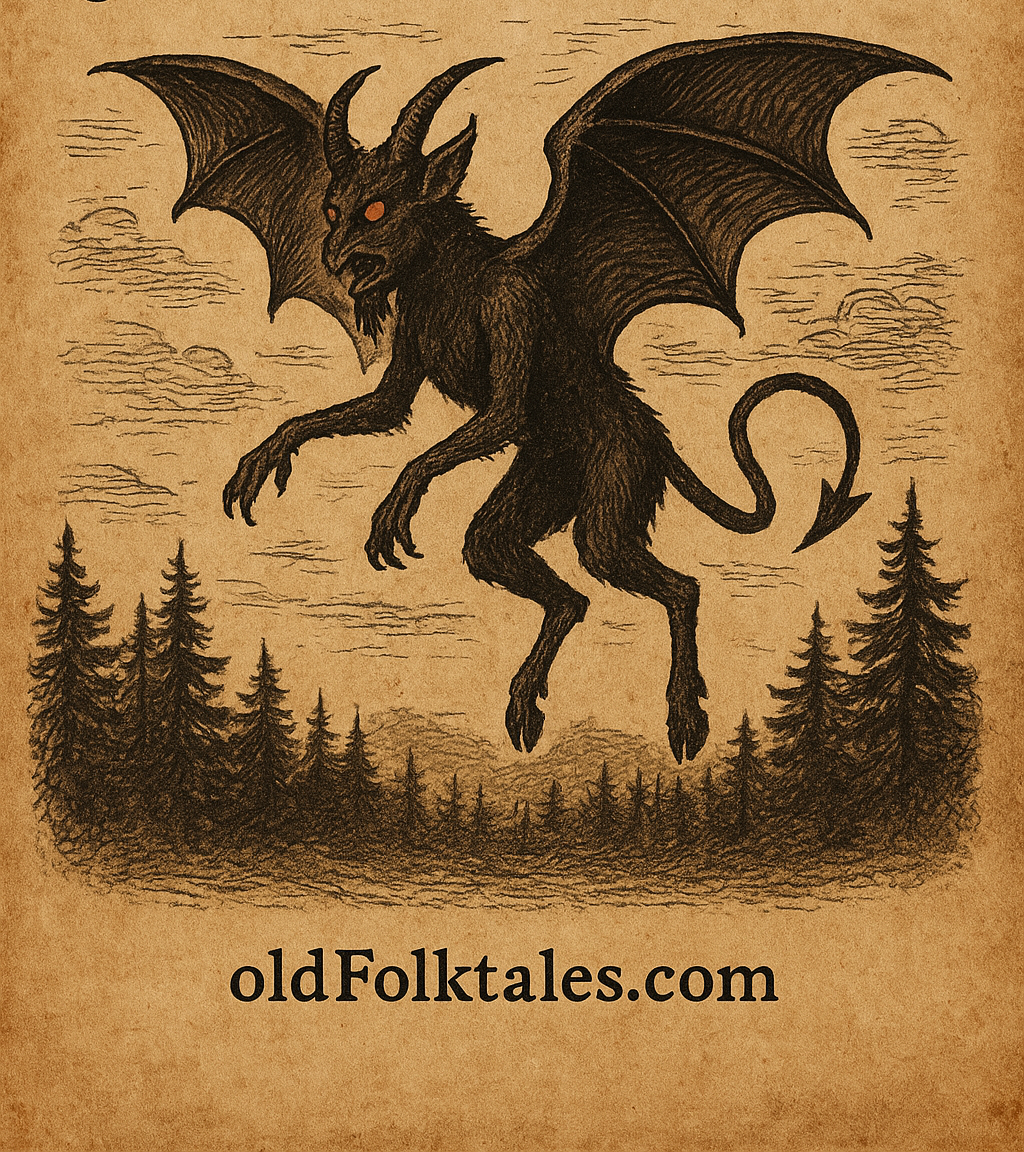
Its tiny limbs twisted and stretched, bones cracking and reforming with sounds that made the women gasp and back away. The body elongated, grew, became something grotesque and unnatural. From the baby’s back, wings erupted, tearing through the soft pink skin. They were not the wings of a bird, but leathery and bat-like, growing larger and larger until they stretched from wall to wall of the small cabin.
The infant’s smooth skin darkened and hardened, taking on a rough, scaled texture like that of a reptile. Its tiny hands and feet twisted into cloven hooves that clicked against the wooden floor. The small round head elongated horrifically, the skull reshaping itself into something that resembled a goat or horse, but was neither. The mouth opened to reveal rows of sharp teeth, and its eyes, which had been the cloudy blue of all newborns, began to glow with a hellish red light, like embers burning in the darkness.
The transformation took only moments, but to those watching it seemed to last an eternity. The midwife stood frozen in shock, still holding the creature that had been, just seconds before, an innocent baby. Then the thing in her arms lashed out with its terrible claws, striking her across the chest with such force that she was flung backward. She crumpled to the floor, dead before her body stopped moving, her eyes wide with terror.
The creature, now fully transformed and grown to the size of a large man, threw back its grotesque head and let out a scream that shook the very rafters of the cabin. It was a sound of rage and anguish, of something neither human nor animal but caught between worlds, belonging nowhere.
The women scattered in panic, trampling over each other in their desperate attempt to reach the door. Deborah herself lay on her birthing bed, too weak to move, watching in horror as the monster her curse had created turned its burning red eyes toward her. For a moment, mother and child, if it could still be called that, stared at each other across the blood-spattered room.
Then, with a powerful beat of its leathery wings, the creature launched itself upward. It crashed through the chimney, sending brick and mortar cascading down into the fireplace, extinguishing the fire and plunging the cabin into darkness lit only by occasional flashes of lightning. Through the hole in the roof, they could see it silhouetted against the storm-dark sky for just an instant before it vanished into the howling wind and driving rain, its terrible screech echoing across the Pine Barrens.
From that night forward, the people of the Pine Barrens spoke in hushed, frightened voices of a winged beast that haunted the woods. They called it the Leeds Devil, or simply the Jersey Devil, and they claimed it still prowled the dark forests and lonely roads of southern New Jersey.
Farmers would wake to find their livestock dead, chickens with their necks twisted, cows and pigs mutilated in ways that suggested neither wolf nor bear, but something else, something that killed not for food but from rage. Travelers swore they’d seen a shadow gliding between the ancient pines at dusk, a shape too large to be a bird, moving with purpose and intelligence through the darkening woods.
Hunters would find strange hoofprints in the sand and mud, tracks that looked like they might have been made by a horse, except they appeared in places no horse could go, on rooftops, along narrow tree branches, in clearings accessible only by flight. The prints would appear and then simply stop, as if whatever made them had taken to the air.
On stormy nights, when thunder rolled across the Barrens and wind bent the pines nearly double, people would hear screams in the darkness, screams that were not quite animal, not quite human, but something in between, something that spoke of eternal torment and rage.
Deborah Leeds lived only a few more years after that terrible night. Some say she died of grief and guilt, haunted by what her moment of anger had unleashed upon the world. Others claim she went mad, wandering the Pine Barrens calling for her child, before she was found frozen to death one winter morning. Her remaining twelve children scattered to other places, wanting no part of the cursed name of Leeds.
Generations came and went. The original settlers died and their children and grandchildren took their place. The Pine Barrens slowly became less wild as more people arrived, cutting down trees and building towns. But the forest remained vast and dark in many places, and the legend endured and grew.
Throughout the 1700s and 1800s, reports of the Jersey Devil continued. Entire towns claimed to have seen it. In 1909, there was a week-long panic when hundreds of people across multiple towns reported encounters with the creature, leading to schools closing and workers refusing to leave their homes after dark.
Even today, in the twenty-first century, people still report sightings in the lonely places of the Pine Barrens. Hikers claim to hear its scream in the night. Drivers see something massive and winged cross the road in their headlights. Campers find strange tracks around their tents come morning.
Some say the Jersey Devil still flies on stormy nights, drawn by the thunder and lightning that accompanied its cursed birth. They say it is the eternal punishment of Mother Leeds, that her thirteenth child wanders forever through the dark forests where it was born, neither alive nor dead, neither human nor beast, but something caught between, a living reminder that some curses, once spoken, can never be undone, and that words spoken in anger can have consequences that echo through centuries.
And on nights when storms roll across the Pine Barrens and the wind screams through the pines, the old-timers still warn: lock your doors, bring in your animals, and pray that the thirteenth child of Mother Leeds passes over your home without stopping.
Explore Native American beings, swamp creatures, and modern cryptid sightings across the country.
The Moral Lesson
This dark tale serves as a powerful warning about the consequences of words spoken in anger and desperation. Mother Leeds’ curse, uttered in a moment of exhaustion and rage, had consequences far beyond what she could have imagined, creating a monster that would haunt generations. The story teaches us that our words carry power, especially when laden with strong emotion, and that we must be careful what we wish for, even in our darkest moments. It also reflects on how poverty and desperation can drive people to breaking points, and how moments of weakness can have lasting consequences. Most profoundly, it reminds us that curses and negative words, once released into the world, cannot be recalled, and their effects ripple outward through time in ways we cannot predict or control.
Knowledge Check
Q1: Who was Deborah Leeds and why did she curse her unborn child?
A: Deborah Leeds was a desperately poor woman living in the Pine Barrens of New Jersey with twelve children already. When she learned she was pregnant with a thirteenth child, the accumulated years of poverty, hunger, and exhaustion caused her to cry out in anger and desperation, “Let this one be a devil!” Her curse was born from the breaking point of too much hardship and too little hope.
Q2: What happened during the birth of the thirteenth child?
A: The baby was initially born appearing normal, but moments after birth it began to transform horrifically. Its limbs twisted and stretched, wings erupted from its back, its skin darkened and scaled, its hands and feet became cloven hooves, its head elongated into a goat-like shape, and its eyes glowed red. The transformed creature killed the midwife, screamed, and escaped through the chimney into the stormy night.
Q3: What is the Jersey Devil and where does it come from in this folktale?
A: The Jersey Devil is the name given to the creature that Deborah Leeds’ thirteenth child became after her curse took effect. It is described as a large, winged beast with a goat or horse-like head, leathery bat wings, cloven hooves, scaled skin, and glowing red eyes. According to the legend, it has haunted the Pine Barrens of southern New Jersey since 1735.
Q4: What evidence of the Jersey Devil do people in the story report?
A: People reported finding livestock killed and mutilated in unnatural ways, strange hoofprints in impossible places (on rooftops, along tree branches, in clearings accessible only by flight), shadows gliding between trees at dusk, terrible screams on stormy nights that sounded neither human nor animal, and direct sightings of a large winged creature. The 1909 sightings were so widespread that schools closed and workers refused to leave home after dark.
Q5: What happened to Deborah Leeds after the birth?
A: Deborah Leeds lived only a few more years after the cursed birth. According to different versions of the story, she either died of grief and guilt from what she had unleashed, or went mad and wandered the Pine Barrens calling for her child before being found frozen to death one winter. Her remaining twelve children scattered to other places, wanting no association with the cursed Leeds name.
Q6: What American regional and cultural elements are present in this folktale?
A: The story is deeply rooted in New Jersey regional culture and history, featuring the Pine Barrens (a vast wilderness area), colonial-era poverty and hardship, the isolation of frontier life, the harsh realities of large families in subsistence conditions, American folklore traditions of cursed creatures, and the blending of European witch-curse traditions with American wilderness settings. The tale also reflects themes common in American Gothic literature: civilization versus wilderness, the consequences of desperation, and places where the normal rules don’t apply. The Jersey Devil has become a cultural icon of New Jersey, appearing in local sports team names and regional identity.
Source: American folktale, United States (New Jersey)