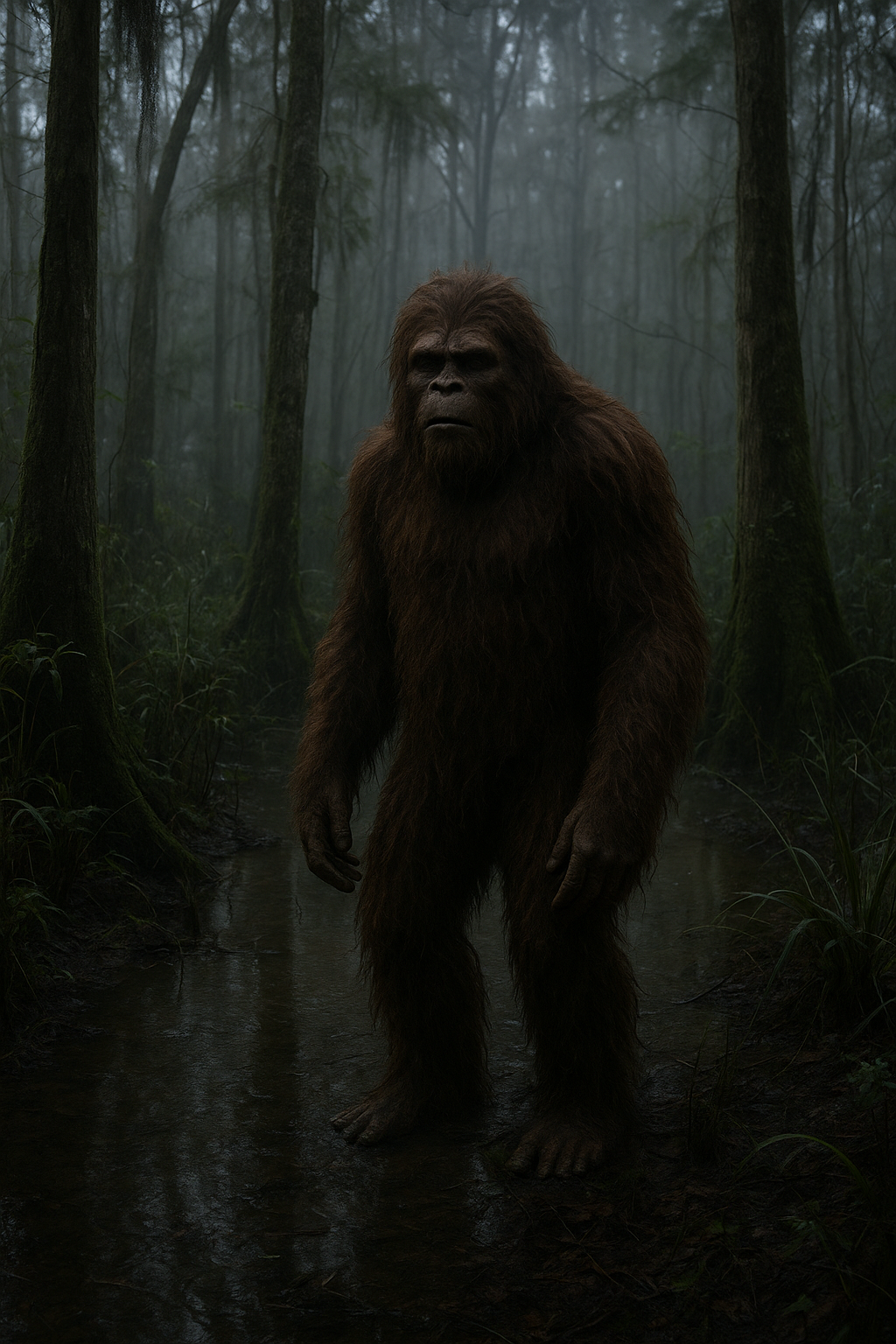
Deep in the humid heart of southern Florida, where endless sawgrass stretches toward the horizon like a golden-green ocean and the air hangs thick with moisture and the constant hum of mosquitoes, locals tell stories of a strange creature said to roam the swamps. They call it the Florida Skunk Ape, and for decades, people scattered across the vast wilderness of the Everglades have reported unsettling encounters with a large, ape-like being covered in dark reddish-brown hair and reeking of a pungent, overwhelming odor reminiscent of a skunk’s spray mixed with something far worse.
Unlike the famous Bigfoot legends of the misty Pacific Northwest forests or the Sasquatch tales whispered around campfires in the mountain ranges of the West, the Skunk Ape’s legend is uniquely rooted in the distinct ecology and atmosphere of the American South. Florida’s dense, impenetrable mangrove forests, its vast marshlands that seem to stretch forever, and its maze-like waterways provide an ideal refuge for elusive wildlife and perhaps, some say, for creatures that exist in the shadowy spaces between documented science and enduring mystery.
Click to read all American Cryptids & Monsters — creatures of mystery and fear said to inhabit America’s wild landscapes.
The Everglades themselves are a world apart from the rest of Florida. This is a place where alligators glide silently through dark water channels, where panthers still prowl despite their dwindling numbers, where the boundary between land and water blurs into something neither solid nor liquid. The cypress trees rise from the swamp like ancient sentinels, their knees jutting from the water, draped with Spanish moss that hangs like tattered curtains. At night, the swamp comes alive with strange sounds the bellowing of gators, the screech of night birds, the splash of unseen creatures moving through the shallows. It’s a landscape that breeds mystery naturally, where the imagination can run wild and where the line between real and unreal becomes uncertain.
The earliest modern sightings of what would become known as the Skunk Ape date back to the 1950s, a time when the Everglades were even wilder and more remote than they are today. Hunters venturing deep into the swamps and park rangers patrolling the vast wetlands began reporting strange occurrences that couldn’t be easily explained. They heard bizarre howls echoing through the night, sounds that didn’t match any known animal in Florida’s ecosystem. They found large, human-like footprints pressed deep into the soft mud along riverbanks and trails, footprints far too big to belong to any person and with a stride length that suggested something massive.
The reports were sporadic at first, dismissed as tall tales or the products of overactive imaginations fueled by isolation and the eerie atmosphere of the swamp. But then came 1974, a year that would cement the Skunk Ape in Florida folklore. The Dade County Sheriff’s Office received an anonymous photograph that sent ripples through both the local community and the wider world of cryptozoology enthusiasts. The photograph showed what appeared to be a tall, powerfully built, shaggy creature moving through a stand of cypress trees. The image was grainy and indistinct as such photographs always seem to be with the subject partially obscured by vegetation and shadows, but it was compelling enough to spark a wave of intense curiosity, media attention, and, inevitably, skepticism.
From that point forward, the sightings multiplied. Motorists driving the lonely backroads that cut through the Everglades at dusk reported catching glimpses of something huge and bipedal crossing the pavement ahead of them, moving with surprising speed before vanishing into the dense vegetation. Campers spending nights in the wilderness told of hearing heavy, deliberate footsteps circling their tents in the darkness, the sound of something large moving on two legs rather than four, breathing heavily just beyond the thin fabric walls. Fishermen casting lines in remote channels claimed to have smelled the creature before they saw it, a warning that something unnatural was near.
That smell became the creature’s most consistent and disturbing characteristic. Witnesses describe it with remarkable similarity: a nauseating combination of rotten eggs, wet dog, swamp decay, and something sharper like a skunk’s defensive spray but magnified tenfold. It’s an odor that makes eyes water, that turns stomachs, that clings to clothing and hair. Many who claim encounters say the stench lingers in the area long after the creature itself has disappeared back into the mangroves, as if marking its territory or leaving a warning for intruders.
The descriptions of the creature itself vary somewhat, as eyewitness accounts always do, but certain details remain consistent. Most witnesses describe something standing between six and seven feet tall, massively built with broad shoulders and long, powerful arms. The body is covered in matted, reddish-brown or dark brown hair, often described as appearing wet or oily, clumped together with mud and vegetation. The face, glimpsed briefly by the fortunate or unfortunate few who got close enough, appears somewhat ape-like but with features that some insist show an unsettling hint of something almost human. The eyes, witnesses say, reflect light at night like an animal’s, glowing with an amber or reddish tint.
Scientists, wildlife biologists, and park officials naturally offer more grounded, rational explanations for the sightings. Some believe that witnesses are encountering escaped exotic animals particularly orangutans or chimpanzees that were released or escaped from private collections back in the 1960s and 1970s when Florida’s exotic pet trade was largely unregulated. Such primates, they argue, could potentially survive in Florida’s warm climate and might exhibit behaviors that would seem mysterious to untrained observers. Others suggest more prosaic explanations: misidentified sightings of Florida black bears, which, though typically moving on all fours, can and do walk short distances upright on their hind legs, especially when curious or trying to get a better view of something. Bears wandering into swampy areas searching for food, standing upright in the half-light of dusk or dawn, covered in mud and vegetation, could certainly create an impression of something more mysterious.
Yet despite these rational explanations, despite the lack of concrete physical evidence, despite the skepticism of the scientific community, the legend not only endures but continues to grow. Perhaps it’s the Florida climate itself that keeps the legend alive, the thick morning fogs that roll across the wetlands, obscuring vision and transforming familiar landscapes into alien territory. The strange, echoing noises that carry for miles across open water. The way lights from distant highways or fishing boats can seem to dance and move through the mist. The very real sense of isolation one feels in the deep Everglades, where cell phone signals vanish and help might be hours away. All of these elements combine to create an atmosphere where the unknown feels close, where the impossible seems just barely possible.
Whether the Skunk Ape is a remnant population of an unknown primate species that somehow crossed into Florida in prehistoric times, a group of escaped exotic apes that adapted and survived in the wild, simply misidentified black bears and other known animals seen under poor conditions, or purely the creation of folklore and imagination, it has undeniably become an integral part of Florida’s cultural landscape. The creature represents something essential about the American experience, the persistence of wilderness and mystery even in our modern, mapped, and monitored world. It’s a symbol of the untamed spaces that still exist, the wild heart of the Everglades that refuses to be fully known or conquered.
Even now, in the twenty-first century, with satellites mapping every inch of the planet and cameras everywhere, locals who live along the edges of the Everglades sometimes pause when they hear rustling in the mangroves at night. They stop what they’re doing and listen carefully to the darkness. They take a deep breath of the humid night air and if that air carries an unmistakable, unforgettable stench, a smell that makes the hair on the back of the neck stand up they whisper the same two words, half in jest, half in genuine warning, half hoping it’s just imagination: “Skunk Ape.”
Explore Native American beings, swamp creatures, and modern cryptid sightings across the country.
The Moral Lesson
The Skunk Ape legend teaches us about the enduring power of mystery and the unknown in the modern world. It reminds us that even in an age of science and technology, there remain wild spaces that resist our complete understanding and control. The story encourages us to respect nature’s vastness and complexity, acknowledging that our knowledge, while extensive, is not absolute. It also reflects the human need for wonder and the attraction to mysteries that cannot be easily explained or dismissed. Whether the Skunk Ape exists or not matters less than what it represents: the wild, untamed aspects of the natural world that persist despite human encroachment, and our relationship with the unknown. The legend also serves as a reminder to approach claims with both open-minded curiosity and healthy skepticism, balancing the desire for mystery with the need for evidence.
Knowledge Check
Q1: What is the Florida Skunk Ape and how does it differ from other cryptid legends?
A: The Florida Skunk Ape is a large, ape-like creature reportedly standing six to seven feet tall, covered in dark reddish-brown hair, and known for emitting a pungent, skunk-like odor. Unlike Bigfoot of the Pacific Northwest, the Skunk Ape legend is uniquely rooted in the ecology of southern Florida’s Everglades, with its dense mangroves, vast wetlands, and swampy terrain. The creature’s most distinctive feature is its terrible smell, described as a mix of rotten eggs, wet dog, and decaying vegetation, which often alerts witnesses to its presence before they see it.
Q2: When and how did the modern Skunk Ape legend begin?
A: The earliest modern sightings date back to the 1950s when hunters and park rangers in the Everglades began reporting strange howls at night and large, human-like footprints in the mud. The legend gained widespread attention in 1974 when the Dade County Sheriff’s Office received an anonymous photograph showing what appeared to be a tall, shaggy creature moving through cypress trees. Though grainy and indistinct, this photograph sparked intense curiosity and media attention, cementing the Skunk Ape in Florida folklore.
Q3: What are the common characteristics reported by witnesses who claim to have encountered the Skunk Ape?
A: Witnesses consistently describe a creature standing six to seven feet tall with a massive, broad-shouldered build and long, powerful arms. It’s covered in matted, reddish-brown or dark brown hair that appears wet or oily and clumped with mud and vegetation. The face is described as ape-like with some almost-human features, and the eyes reflect light at night with an amber or reddish glow. Most distinctively, witnesses report an overwhelming, nauseating odor that combines rotten eggs, wet dog, swamp decay, and a skunk-like spray, which lingers long after the creature has disappeared.
Q4: What scientific explanations do experts offer for Skunk Ape sightings?
A: Scientists and wildlife officials suggest several rational explanations. Some believe witnesses are encountering escaped exotic animals, particularly orangutans or chimpanzees that were released or escaped from private collections in the 1960s and 1970s when Florida’s exotic pet trade was unregulated. Others propose that sightings are misidentified Florida black bears, which can walk short distances upright on hind legs and might appear mysterious when covered in mud and seen in poor lighting conditions at dusk or dawn in swampy areas.
Q5: How does the Florida Everglades environment contribute to the persistence of the Skunk Ape legend?
A: The Everglades’ unique environment naturally breeds mystery and uncertainty. The thick morning fogs obscure vision and transform familiar landscapes. Strange noises echo for miles across open water. Lights from distant sources dance through the mist. The dense, impenetrable mangroves and maze-like waterways provide countless hiding places. The atmosphere of isolation, where cell signals vanish and help might be hours away, creates conditions where the unknown feels close and the impossible seems barely possible. This combination of factors blurs the line between the known and unknown, fueling both imagination and the legend’s persistence.
Q6: What cultural significance does the Skunk Ape hold in American folklore?
A: The Skunk Ape has become an integral part of Florida’s cultural landscape and represents something essential about the American experience the persistence of wilderness and mystery even in our modern, mapped world. It symbolizes the untamed spaces that still exist and the wild heart of the Everglades that refuses to be fully known or conquered. The legend reflects the human need for wonder and attraction to mysteries that cannot be easily explained, while also serving as a reminder of nature’s vastness and complexity. It embodies our relationship with the unknown and the balance between open-minded curiosity and healthy skepticism.
Source: American legend from Florida, United States