Long ago, when the pinewoods of the Carolina coast still whispered with stories and the moss hung heavy from the cypress trees, two men set out together on a long journey. They had been friends since boyhood, yet they could not have been more different in heart and spirit.
One was gentle and generous, content with simple blessings. He shared his food with others, helped the weak, and gave thanks for every small kindness that life offered. The other was proud, sharp-eyed, and greedy. He believed the world owed him more and spent his days chasing after gold, no matter whose back he had to climb to get it.
As they walked beneath the southern sun, the kind man hummed old hymns while his companion grumbled about their luck. “We’ve been walking for hours,” said the greedy one. “No treasure, no fortune, not even a cool breeze!”
His friend smiled. “Patience, brother. A good heart finds its reward in time.”
The greedy man scoffed. “A good heart doesn’t fill an empty belly.”
Click to read all American Traditions & Beliefs — the living folklore of daily life, customs, and superstitions.
The Gourd in the Forest
Toward evening, the men came to a quiet grove. The air was still and sweet, and shafts of golden light pierced through the hanging moss. In the center of the clearing lay a single vine, and upon it grew a large, round gourd, pale as the moon.
The kind man stopped. “That’s a fine gourd,” he said softly. “Let’s rest a while.”
But as he stepped closer, something strange happened. The gourd trembled, and a deep, gentle voice rose from within it.
“Traveler,” it said, “I am hungry. Give me a little food, and I shall repay you kindly.”
The kind man stepped back in surprise, his eyes wide. “A talking gourd?” he whispered.
“Go on then,” said the greedy friend with a sneer. “You feed it if you believe in foolish things.”
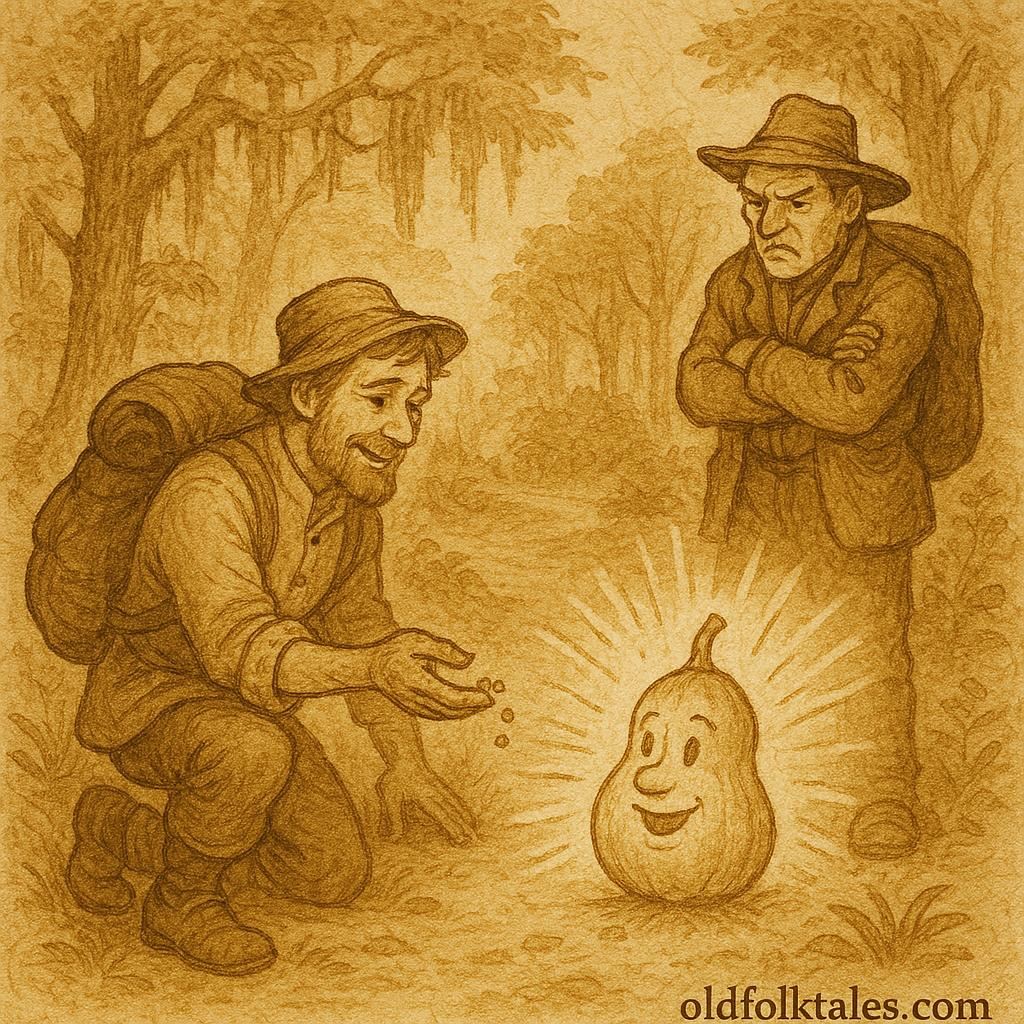
The kind man knelt beside the gourd and broke off a small piece of cornbread from his pack. “It’s not much,” he said, placing it near the gourd’s mouth. “But it’s all I have.”
The gourd made a soft gulping sound. Then it trembled once more, and suddenly gold coins began to spill out from its mouth, shining brighter than the afternoon sun. The kind man gasped and stepped back, but the gourd only said, “Your kindness is your blessing. Take what you need and go in peace.”
The man gathered a small handful of coins, just enough to see him through the rest of his journey. He thanked the gourd sincerely and turned to leave.
But his greedy friend’s eyes were blazing. “That’s it?” he shouted. “You’re walking away from a river of gold?”
The Greedy Man’s Turn
As soon as his companion was gone, the greedy man rushed forward. “Gourd!” he cried. “I’ve come to feed you too!”
The gourd was silent.
He shouted louder. “You hear me? I’ve got plenty of food. I’ll give you whatever you want, just make me rich!”
Finally, the gourd stirred. “Feed me first,” it said, “and I shall repay you.”
The greedy man laughed. “Gladly!” He opened his pack and dumped in everything he had, cornbread, dried fish, and even his water gourd. “There! I’ve given you more than enough. Now, where’s my gold?”
The gourd began to rumble. Coins clinked within it, and the man’s eyes gleamed with hunger. “More!” he demanded. “I want more than that fool got! Give me all the gold you have!”
But the gourd stopped trembling. Its mouth widened, growing larger and darker until it gaped like the entrance of a cave. A strong wind rushed out from within, and before the greedy man could run, the gourd’s mouth opened wide and swallowed him whole.
The forest fell silent again.
The Lesson of the Gourd
Hours later, the kind man returned to check on his friend. He called out but heard no answer, only the rustling of leaves and the faint hum of the wind. The gourd lay still on the forest floor, heavy and quiet.
He sighed, understanding at once what had happened. “The forest tests us all,” he murmured. “Some learn to give; others learn too late.”
He offered a short prayer and left, carrying with him not just gold, but the memory of what pride and greed can do to a man’s soul.
And from that day forward, folks in the Carolina Lowcountry whispered that the woods were full of gourds that tested men’s hearts, some that blessed, and some that devoured. The elders would say, “If you meet a gourd that speaks, feed it with kindness, not greed.”
Discover African American wisdom, Native American spirit stories, and the humor of early pioneers in American Folktales.
Moral Lesson
This African-American folktale from the Gullah people teaches that true wealth lies in humility and kindness. Greed blinds the heart, but generosity fills both hands and spirit. When we share freely, blessings return to us in ways gold never can.
Knowledge Check
1. What is the main theme of “The Two Friends and the Gourd”?
The story teaches that greed leads to destruction, while humility and kindness bring reward.
2. How did the kind man earn the gourd’s favor?
He shared his last crumbs of food without expectation of return.
3. What did the gourd symbolize in the folktale?
It represents moral testing, a spiritual mirror that rewards good hearts and punishes selfishness.
4. What cultural group preserved this folktale?
The Gullah community from the Coastal Carolinas, descendants of enslaved Africans who maintained rich storytelling traditions.
5. Why did the greedy man fail?
Because his greed made him demand more than he deserved, showing no gratitude or restraint.
6. What timeless lesson does the story still teach today?
That character and kindness outlast wealth, and greed devours those who chase it blindly.
Source: Negro Folk Tales from the South, collected by Elsie Clews Parsons (1923, Public Domain).
Cultural Origin: African-American Folklore – Gullah Oral Tradition, Coastal Carolina, USA.