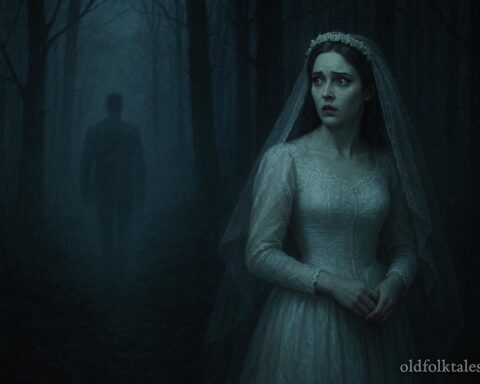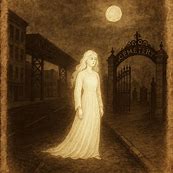
On quiet nights along Archer Avenue, south of Chicago, the road winds between patches of woods and the high stone walls of an old cemetery. Drivers passing through sometimes slow as their headlights sweep across a lone figure walking beside the road. She is slender, dressed in a white gown that glows faintly in the dark, her hair a golden halo beneath the streetlights. When a car stops, she turns with a soft smile and asks for a ride home.
Those who let her in describe the same chilling experience. She speaks gently, giving an address or saying she needs to get home from the dance. The ride is quiet except for the hum of tires against pavement. But when the car nears the gates of Resurrection Cemetery, the girl vanishes. Some say she fades slowly like mist in sunlight, while others claim she disappears in a blink, leaving behind only the faint scent of roses or a lingering chill.
This is the legend of Resurrection Mary, Chicago’s most famous ghost and one of the most enduring tales of American spirit folklore. Her story has haunted Archer Avenue since the 1930s, weaving together love, loss, and the endless longing for home.
Encounter the strange and the unseen — from Bigfoot to regional monsters hiding in America’s forests.
The earliest accounts tell of a young woman who had gone dancing at the O Henry Ballroom, a lively spot on the edge of town. Dressed in white, she was seen laughing with friends and dancing late into the night. But on her way home, tragedy struck. Some say her date lost control of the car on the slippery road. Others believe she left the ballroom after an argument and began walking home alone. Either way, she was struck by a vehicle near Resurrection Cemetery and killed instantly.
Her parents buried her in the very cemetery she had nearly reached that night. Not long after, people began seeing a girl in a white dress walking along the same stretch of Archer Avenue. At first, few believed the stories. But as the sightings grew more frequent and consistent, the legend took root.
Taxi drivers were among the first to speak openly about their encounters. One cabbie reported picking up a pale young woman near the ballroom on a cold night in 1939. She asked to be taken down Archer Avenue. When they reached the cemetery, she shouted, “Stop!” He turned to look at her, but the seat was empty. Others claimed to have seen her dance again at the ballroom, gliding gracefully across the floor before disappearing into thin air.
Over the decades, dozens of similar stories have surfaced. Each retelling follows the same pattern, a lonely road, a kind stranger, a girl in white, and a vanishing act that leaves witnesses shaken and silent. Even the Chicago Police once investigated reports of a girl locked inside Resurrection Cemetery after closing hours, but no one was ever found.
Local historians have tried to match the ghost to real-life tragedies from that era. Several young women were killed in car accidents along Archer Avenue during the 1920s and 1930s, each fitting parts of Mary’s description. One of the most frequently mentioned names is Mary Bregovy, who died in a crash in 1934. Whether she was the true identity of Resurrection Mary remains a mystery, but her story adds another thread to the haunting fabric of the legend.
For Chicagoans, Resurrection Mary is more than just a ghost story. She has become part of the city’s folklore, an enduring symbol of youthful grace and unfulfilled destiny. Her legend speaks to the human longing for closure for a final farewell, a safe return home that never came. Many believe she appears not to frighten but to seek kindness, drawn to those who would have helped her on the night she died.
Those who have seen her describe a haunting beauty. Her dress appears to shimmer as if woven from moonlight, and her eyes seem filled with sorrow. Sometimes she rides silently, gazing out the window toward the cemetery gates. A few claim she speaks softly of her mother waiting for her at home, a home she never reaches.
Even today, locals driving along Archer Avenue after midnight sometimes feel compelled to slow down as they pass the cemetery. The wind rustles through the trees, and for a fleeting second, the figure of a woman appears in the glow of their headlights. Some speed away, too frightened to look back. Others stop, only to find empty pavement and the echo of a fading presence.
Ghost hunters and folklorists continue to visit the area, hoping to capture proof of Mary’s existence. Photographs show streaks of light or vague shapes near the gates, and visitors report cold spots or flickering streetlamps that seem to respond to unseen footsteps. Still, the mystery endures without resolution.
Perhaps the true power of Resurrection Mary’s legend lies not in fear but in empathy. She reminds people of the fragility of life and the ways tragedy can linger in memory. Her story encourages compassion for the forgotten, for the souls still searching for peace. In that sense, she is not only a ghost but a guardian, a spirit who walks the same path again and again, reminding the living to drive carefully, to be kind, and to remember those who never made it home.
Even as the city grows and decades pass, the legend remains unchanged. On Archer Avenue, where streetlights flicker and the air grows cold near the cemetery gates, travelers still tell of a girl in white who waits for a ride that will finally carry her beyond this world. She is both sorrow and hope, both past and present. And as long as people drive those lonely roads, Resurrection Mary will continue her journey.
Step into shadowy legends of restless spirits and ghostly travelers in American Ghost Stories.
Moral Lesson
The legend of Resurrection Mary teaches compassion for the lost and respect for the unseen. Her story reminds us that even in tragedy, kindness and remembrance have the power to bring peace.
Knowledge Check
1. Where does the legend of Resurrection Mary take place?
Along Archer Avenue near Resurrection Cemetery in Chicago, Illinois.
2. What event is believed to have caused Mary’s haunting?
A fatal car accident after leaving a ballroom in the 1930s.
3. How do most witnesses describe their encounters with her?
She asks for a ride home, then disappears near the cemetery gates.
4. What makes the story significant to Chicago’s folklore?
It is one of the city’s oldest and most famous ghost stories, symbolizing love and loss.
5. How do some people interpret Mary’s appearances?
As a plea for kindness and a search for peace rather than an act of fear.
6. What moral message does her story convey?
That empathy and remembrance can transcend death, offering comfort to restless spirits.
Source:
Adapted from Chicago Haunts: Ghostlore of the Windy City by Ursula Bielski, 1997.
Cultural Origin:
United States (Illinois / Midwestern spirit folklore)