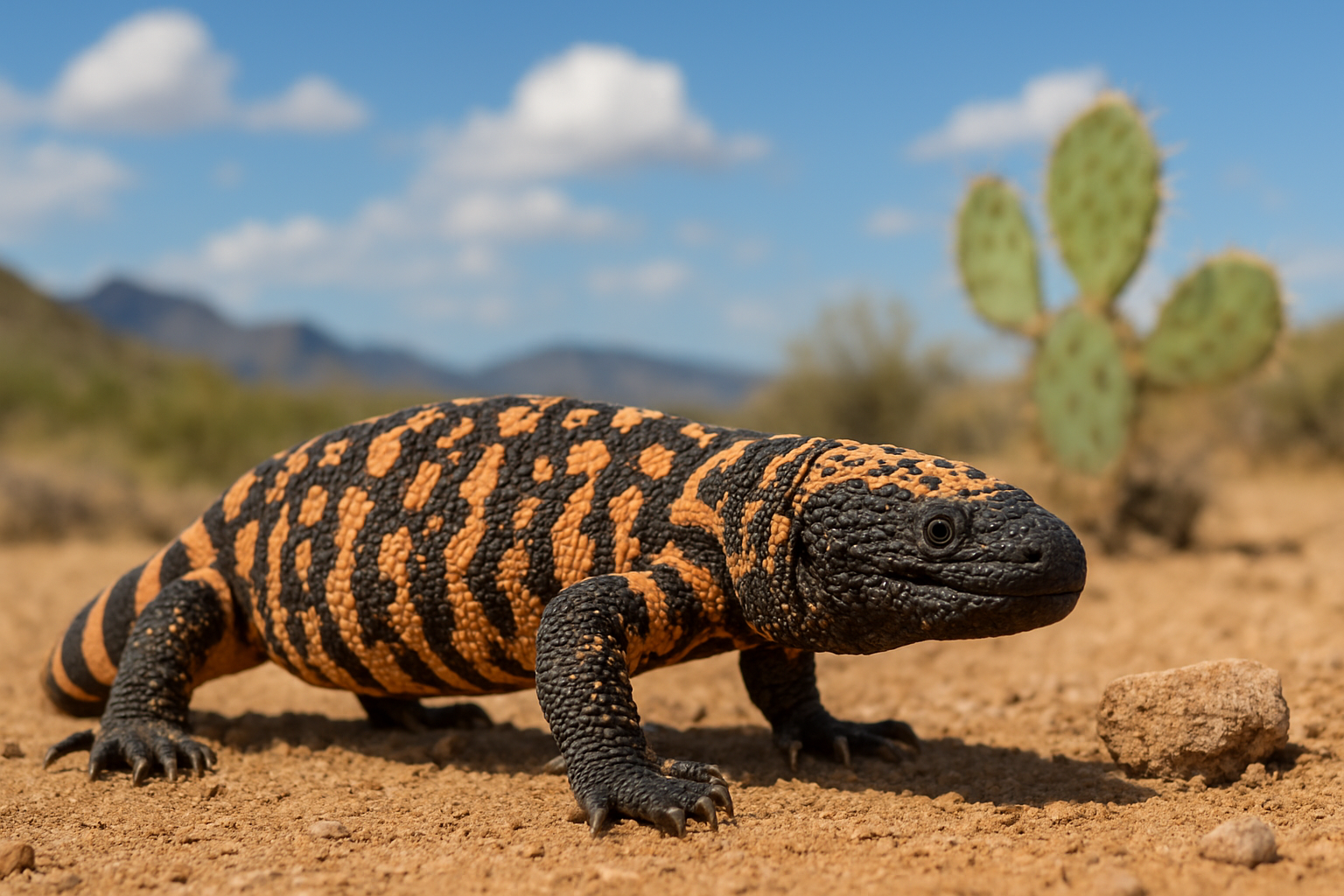
The desert stretched endlessly beneath the blazing sun, a vast, unforgiving land of sand, stone, and silence that seemed to extend to the very edge of the world. Here, where the earth cracked into puzzle pieces beneath the relentless heat and the horizon shimmered with waves of rising air, life clung to existence through cunning and adaptation. In this harsh world where few dared to wander during the scorching daylight hours, a creature moved with patience and purpose through the shadows of creosote bushes and beneath the thorny arms of saguaro cacti. His name was Toka, the Gila Monster.
Toka was no ordinary lizard. His skin shimmered in intricate patterns of black and brilliant orange, like embers glowing against the pale desert floor, each scale a tiny bead of armor that caught the light when he moved. The colors weren’t merely decoration they were a warning written in the ancient language of the desert, telling all who saw him: I am here, I am powerful, approach with respect. Each bead on his thick, muscular hide told a story of endurance of surviving long days without a single drop of water, of nights when the cold bit harder than the midday sun ever burned, of seasons when food was scarce and only the patient survived.
Explore Native American beings, swamp creatures, and modern cryptid sightings across the country.
His body was low and heavy, built not for speed but for stability and strength. His legs splayed outward from his sides, giving him a distinctive waddle when he walked, and his thick tail as long as his body served as a storehouse for fat that would sustain him through the lean times. His tongue, forked and black, flicked out regularly, tasting the air for scents carried on the desert breeze.
While other animals rushed about in frantic pursuit of food or shade, roadrunners darting between bushes, jackrabbits bounding across open ground, desert mice scurrying from shadow to shadow, Toka lived by a different rhythm entirely. He spent much of his life below ground, deep inside the cool, dark safety of burrows carved beneath the gnarled roots of mesquite trees, beneath ancient rocks, or in abandoned tunnels left by other creatures. Down there, where the earth’s temperature remained constant regardless of the inferno above, he could rest for weeks or even months, his metabolism slowing to a whisper, his heart beating just often enough to keep him tethered to life.
When the desert quieted after a rare rain those precious moments when the air smelled of wet creosote and the earth turned briefly soft and dark Toka would emerge from his sanctuary. Slow, steady, and watchful, he moved through a transformed landscape where dormant seeds had burst into sudden bloom and puddles reflected the sky like scattered mirrors. During these brief windows of abundance, he would feed on bird eggs discovered in ground nests, or young rodents that had grown careless in their joy at the momentary plenty, or the nestlings of quail hidden beneath brittlebush. He ate deliberately, methodically, storing energy for the long fasts ahead.
Though feared by many his reputation whispered from campfire to campfire, from village-to-village Toka had no interest in harm for harm’s sake. His venom, produced in glands along his lower jaw and delivered through grooved teeth when he bit and chewed, was indeed powerful, causing intense pain and sickness in those unlucky enough to provoke him. But it was a tool, not a weapon used carelessly, a reminder that power could dwell in silence and restraint, that the deadliest creatures need not be the most aggressive. Toka had no desire to waste his energy on unnecessary conflict. He gave warnings: his bright colors, his steady gaze, his refusal to flee like prey animals did. Those who heeded these signs passed safely. Those who didn’t learned respect the hard way.
Even the coyotes, those clever and opportunistic hunters who tested everything for weakness, kept their distance when they encountered Toka on his evening walks. They sensed instinctively that beneath his sluggish grace was a strength honed by centuries of evolutionary survival, a lineage that stretched back millions of years, making him one of the few venomous lizards in all of North America. The coyotes would circle at a distance, ears forward and eyes cautious, before deciding that easier meals existed elsewhere in the desert’s endless buffet.
As the years passed, measured not in human time but in the slow turning of seasons the brief winters when frost sometimes painted the rocks white, the springs when wildflowers exploded across the bajadas, the brutal summers when nothing moved at midday, the autumns when the light turned golden the desert changed around Toka. Storms grew less frequent, each one more precious than the last. The earth cracked deeper during droughts that lasted years instead of months. And increasingly, travelers began crossing Toka’s land humans with cameras and notebooks, marveling at the strange, beautiful lizard that seemed untouched by time, unchanged by the forces that drove other species to extinction or adaptation.
Still, he endured. When the sun rose, painting the eastern sky in shades of pink and orange that rivaled his own coloring, he would emerge from his burrow to bask on a flat rock, absorbing the warmth into his cold-blooded body, his eyes half-closed in contentment. When the sun climbed too high and the heat became dangerous even for him, he retreated to shade. When it set, bleeding red across the western horizon and leaving the sky bruised with purple and indigo, he returned to the cool embrace of the earth, to dream whatever dreams creatures of patience dream.
Toka’s life was not one of speed or spectacle, of dramatic hunts or fierce battles. It was a life of balance of knowing when to move and when to rest, when to eat and when to fast, when to defend and when to simply be. It was a lesson carved in scales and sand, written in survival across millennia: that endurance outlasts aggression, that patience defeats haste, that those who work with the desert rather than against it will be the ones who remain when the storms pass.
He was the quiet guardian of the desert, a living echo of endurance and calm in a world that never stopped testing those who called it home. While flash floods carved new arroyos and fierce winds reshaped dunes, while empires of ants rose and fell and generations of cactus wrens raised their young, Toka simply was constant, present, surviving.
And so, when you walk the arid trails of the Southwest through the Sonoran Desert of Arizona, across the Mojave’s edge, through the thorny landscapes of New Mexico and see the shimmer of orange and black among the stones, or catch a glimpse of a thick, beaded tail disappearing beneath a palo verde tree, know that you have crossed paths with the Keeper of the Desert. The Gila Monster, whose every slow, deliberate step carries the accumulated wisdom of survival, whose patience is power, whose very existence is a testament to the strength that lies not in fighting the world, but in understanding it deeply enough to endure.
Click to read all American Cryptids & Monsters — creatures of mystery and fear said to inhabit America’s wild landscapes.
The Moral of the Story
This tale teaches us that true strength is found not in aggression or speed, but in patience, restraint, and the wisdom to conserve energy for when it truly matters. Toka embodies the principle that survival both in nature and in life requires balance and respect for the rhythms of one’s environment. His venom represents power held in check, used only when necessary, reminding us that the strongest among us are often those who choose restraint over recklessness. In a world that often celebrates constant motion and immediate action, the Gila Monster shows us the profound strength in patience, stillness, and living in harmony with rather than in opposition to our surroundings.
Knowledge Check
Q1: Who is Toka in this American Southwest folktale?
A: Toka is a Gila Monster, one of only two venomous lizards in North America, who lives in the desert Southwest. He represents ancient wisdom, patience, and the power of restraint, serving as the “Keeper of the Desert” who embodies survival through balance rather than aggression.
Q2: What do Toka’s orange and black colors symbolize in the story?
A: Toka’s bright orange and black pattern serves as a warning to other creatures, a natural sign of his venomous capability and a statement of his power. The colors symbolize that true strength doesn’t need to hide, but instead announces itself clearly, giving others the chance to show respect and keep distance.
Q3: How does Toka’s lifestyle differ from other desert animals?
A: Unlike animals that rush about seeking food and water, Toka lives by patience and conservation. He spends much of his life underground in cool burrows, emerging only when conditions are favorable, and can survive for long periods without food or water by storing fat in his thick tail.
Q4: What lesson does Toka teach about power and venom?
A: Toka’s venom represents power held with restraint, it’s a tool of defense, not aggression. He teaches that true strength lies in having power but choosing not to use it unnecessarily, demonstrating that the most dangerous creatures need not be the most aggressive ones.
Q5: How does Toka respond to the changing desert environment?
A: As storms become less frequent and the desert grows harsher, Toka endures through his patient, balanced approach to survival. He doesn’t fight against the changes but continues his ancient rhythm of basking, resting, and feeding when opportunities arise, proving that adaptation through patience outlasts resistance.
Q6: What is the cultural significance of the Gila Monster in Southwest Native American traditions?
A: In Native American cultures of the Southwest, particularly among the Tohono O’odham and other desert peoples, the Gila Monster is respected as a powerful medicine animal representing survival, healing, and the wisdom of the desert. Its ability to store resources and thrive in harsh conditions made it a symbol of endurance and balance with nature.
Cultural Origin
This tale originates from the American Southwest, specifically the Sonoran and Mojave Desert regions of Arizona, New Mexico, Nevada, and Utah, where the Gila Monster (Heloderma suspectum) has lived for millions of years. The story reflects both Native American respect for this venomous lizard as a powerful desert guardian and the ecological wisdom embedded in indigenous desert cultures that understood survival required patience, respect for natural rhythms, and living in balance with harsh environments.