In the misty hills of Pennsylvania, in the year 1734, a child was born who would one day carve a path through the heart of an untamed land. His name was Daniel Boone, and though he began life as the son of a farmer, his destiny was written in the forests, rivers, and mountains of the American frontier.
Even as a boy, Daniel preferred the whisper of the woods to the noise of the village. He learned to track deer, read the wind, and move silently beneath the towering oaks. By his teens, his marksmanship was so precise that local hunters called him the best shot in the valley. But Daniel’s spirit was too restless for the farms of his youth, he longed to see what lay beyond the mountains that shadowed the horizon.
Explore the heart of America’s storytelling — from tall tales and tricksters to fireside family legends.
Crossing the Appalachians
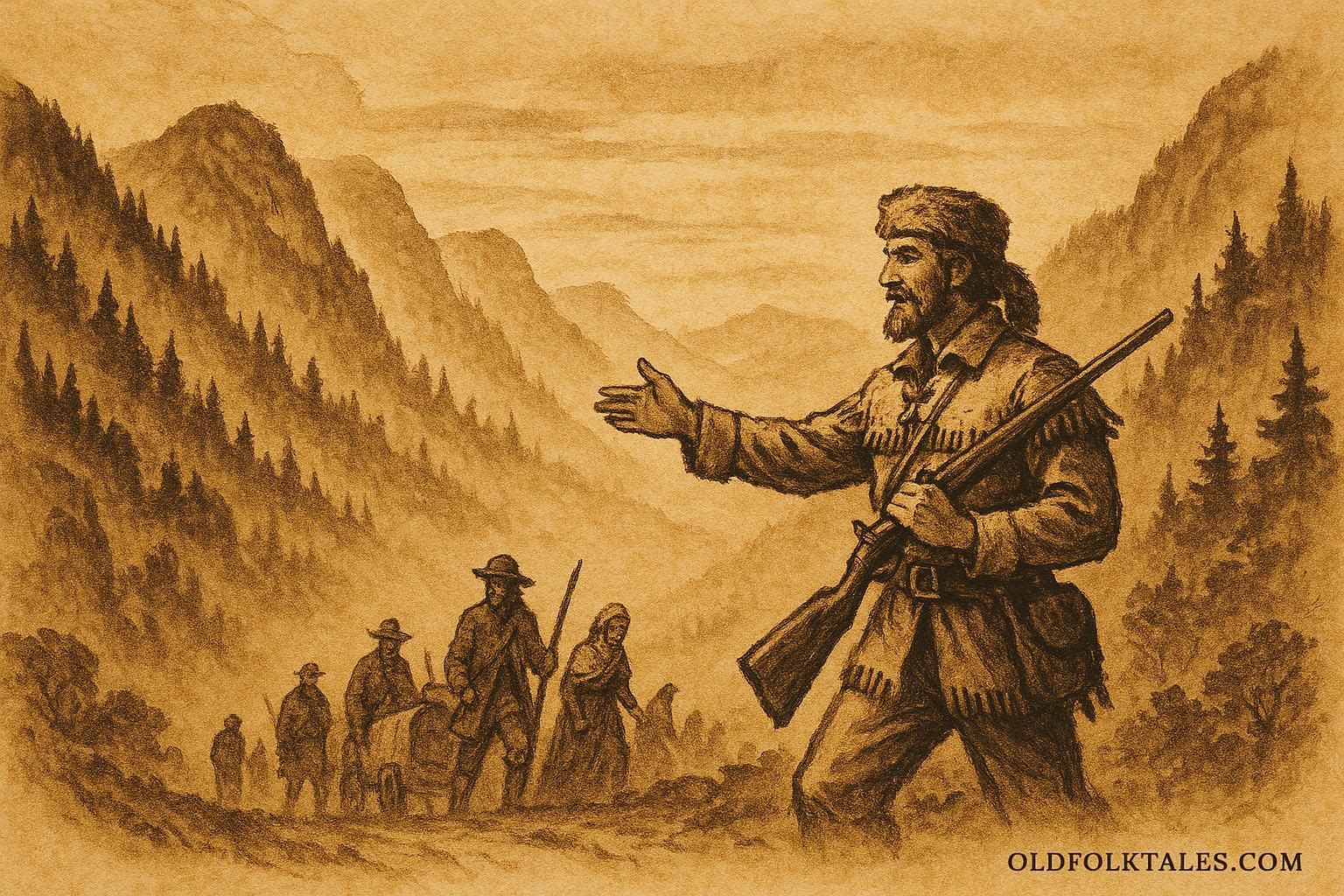
In 1769, Boone gathered his rifle, a few provisions, and a heart full of daring, setting off with a small band of companions toward the Appalachian Mountains. Beyond them lay a place few settlers had ever seen, a vast and beautiful wilderness known to Native peoples as Kentucky.
The journey was perilous. The forests were dense, the rivers swift, and danger waited at every turn. Yet Boone pressed on, guided by instinct and an unshakable sense of purpose. He crossed through a narrow mountain pass later called the Cumberland Gap, stepping into a land of rolling meadows and endless game. Buffalo herds thundered across the plains, deer moved like shadows through the trees, and rivers sparkled like silver threads in the sun.
To Boone, it was paradise, wild, free, and boundless.
The Call of Kentucky
For two years, Boone explored the Kentucky wilderness, mapping trails, hunting, and learning the lay of the land. He was often alone, surviving by his skill and intuition. But solitude never frightened him. The woods spoke to him in rustling leaves and birdcalls, and he felt at peace beneath the open sky.
In time, he led others along his paths, showing settlers the way through the Cumberland Gap. The route he opened became known as the Wilderness Road, and through it, thousands of pioneers poured westward, seeking new homes and a new life.
Daniel Boone had become more than an explorer, he was a bridge between the known and the unknown, a man who turned dreams of the frontier into reality.
Captured and Escaped
But the land he explored was not empty. It was home to Native American tribes who rightly fought to protect their territories from encroaching settlers. Boone understood this struggle and respected his opponents’ courage. Yet the conflicts were fierce and often deadly.
In one fateful encounter, Boone was captured by a Native American war party. Instead of despair, he showed calm and dignity. He watched, listened, and waited for the right moment. When he realized his captors planned a raid on his settlement, he cleverly pretended to join their hunt, earning their trust.
At the first opportunity, he escaped, traveling for days through forests and rivers to warn his people of the coming attack. Thanks to his courage and quick thinking, the settlement was prepared, and many lives were saved.
A Man of Quiet Courage
Boone never saw himself as a hero. He sought no riches, no fame, only freedom. He loved the land not for conquest but for its beauty and challenge. To him, every trail was a promise, every horizon a mystery waiting to be discovered.
Even as age caught up with him, he continued to wander, settling eventually in Missouri. There, he lived simply, still happiest under open skies, with the call of the wild in his ears.
Though his days as a pathfinder ended, his legend only grew. To generations that followed, Daniel Boone became the symbol of America’s pioneering spirit, a man who opened the wilderness with courage, skill, and respect for the land and its people.
Legacy of the Wilderness Pathfinder
When stories of Boone’s adventures spread through John Filson’s 1784 book, The Adventures of Colonel Daniel Boone, and later in 19th-century chapbooks, he became a national hero. To settlers, he embodied the virtues of endurance, bravery, and independence. To dreamers, he represented the call of the unknown, the irresistible pull of the frontier.
Daniel Boone’s life remains a testament to the courage it takes to venture where few have gone before, and to live not just for discovery, but in harmony with the natural world.
Explore how American legends shaped the nation — from frontier heroes to Revolutionary War tales.
Moral Lesson
Daniel Boone’s story teaches that courage and endurance are the true keys to exploration. His respect for nature and steadfast spirit remind us that progress and preservation must walk hand in hand.
Knowledge Check
-
Who was Daniel Boone, and why is he remembered in American folklore?
He was an 18th-century frontiersman and explorer who blazed trails through the Appalachian Mountains, opening Kentucky to settlement. -
What was Daniel Boone’s most famous expedition?
His 1769 journey through the Cumberland Gap into Kentucky, where he established routes later known as the Wilderness Road. -
How did Boone escape after being captured?
He pretended to join a Native American hunt, then fled to warn his settlement of an impending attack. -
What values did Daniel Boone represent?
Courage, perseverance, respect for nature, and the pioneering spirit that defined early America. -
What was the significance of the Wilderness Road?
It became one of the main routes through which settlers moved westward into Kentucky and beyond. -
What is the moral of Daniel Boone’s story?
That true heroism lies in exploration guided by courage, wisdom, and harmony with the natural world.
Source: Adapted from The Adventures of Colonel Daniel Boone (John Filson, 1784) and later 19th-century retellings.
Cultural Origin: Frontier folklore of Kentucky and Appalachia, late 18th century.