On a plantation near the edge of a wide river, there lived a man called Isaiah. No one knew the name his mother had whispered to him at birth, because names, like many things, were taken early and never returned. Isaiah worked in the fields from dawn until the stars came out, his days measured by commands and his nights by aching bones. Yet what set him apart was not his strength or speed but his attention. He listened closely to the world, to pauses in speech, to the way certain words were guarded while others were thrown away without care.
Isaiah noticed that the overseer carried a small book in his coat pocket. He noticed how the white children traced symbols on slate boards and laughed when they understood something hidden from others. He noticed that whenever papers were read aloud, decisions followed that reshaped lives, families, and futures. From this, Isaiah learned that power did not always shout. Sometimes it whispered from the page.
At night, Isaiah lay awake imagining what lived inside those books. He believed they spoke, not in sound but in meaning. He thought they carried stories that explained why some men commanded and others obeyed, why the river marked freedom on one side and captivity on the other. When he asked questions, he was told that books were not meant for him. The answers stopped there.
Discover chilling ghost tales and haunted places that echo through America’s towns and countryside.
One evening, Isaiah was sent to the main house to clean. The family was away, and the rooms were quiet. As he swept the floor of the study, his eyes fell upon a shelf lined with books. They stood upright like watchful elders. One had fallen onto the desk, its pages open as if mid sentence. Isaiah froze. The room felt different, as though it was holding its breath.
He approached slowly. He could not read a single word, but he felt something stir inside him. He placed his ear close to the page. At first, there was nothing. Then, faintly, he imagined a murmur. Not a voice exactly, but a pull, a pressure behind the eyes. It felt like standing near a river and knowing which way the water wanted to go.
Isaiah believed the book was speaking, but not in a way meant for ears. It spoke through awareness. It told him that knowledge was being withheld, not because he was incapable, but because he was feared. That night, Isaiah returned the book to its place, but something had already shifted. He had touched the silence and discovered it was full.
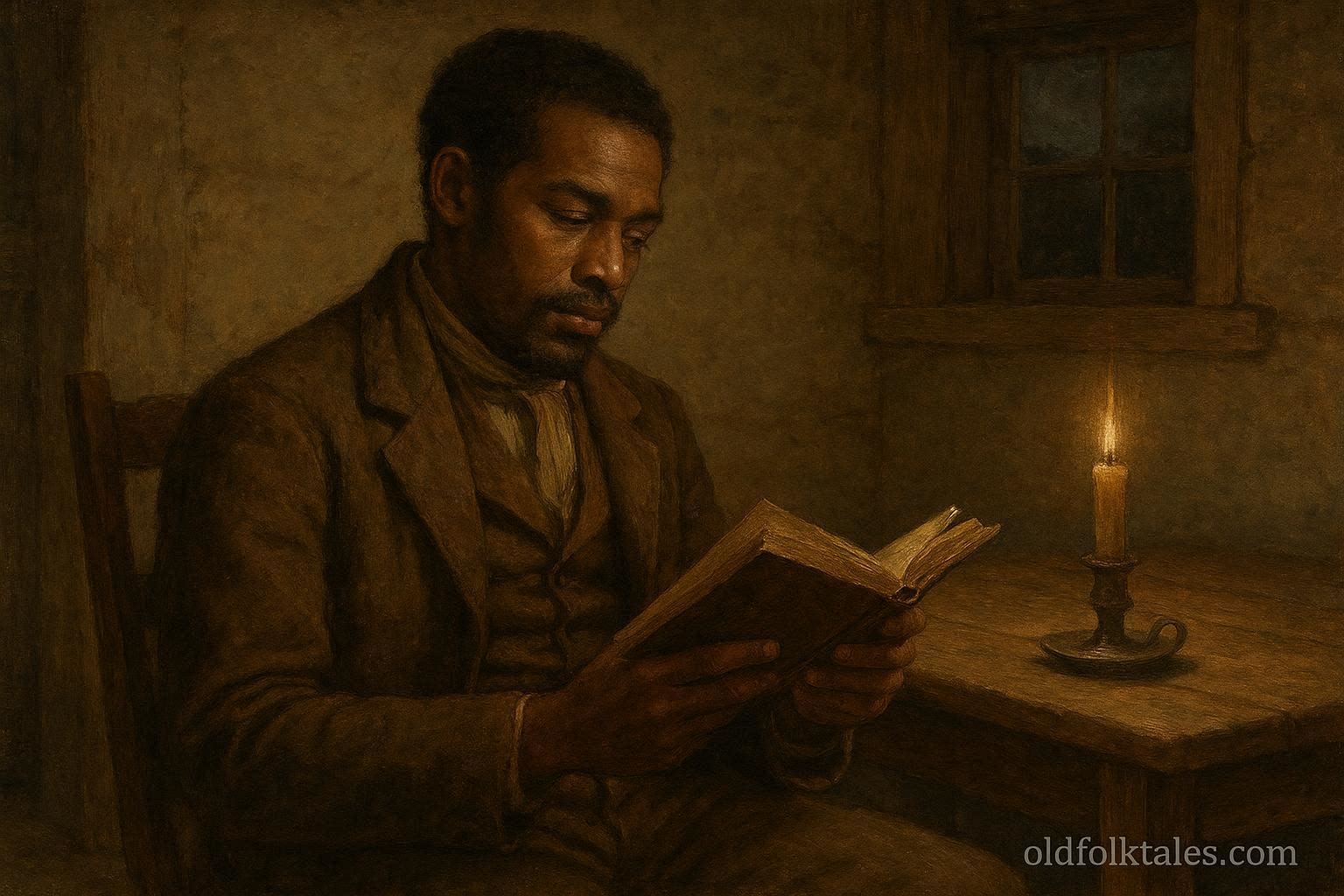
From then on, Isaiah sought moments near printed words. He watched lips carefully when sermons were read. He memorized the shapes of letters he glimpsed on crates and signs. He began to associate symbols with sounds, sounds with meaning. Each small connection felt like a door opening inside him.
Others noticed his change. Some warned him to be careful. Knowledge, they said, could bring punishment as quickly as freedom. Isaiah listened, but the hunger inside him had found its name. He could no longer pretend not to hear the talking book.
One night, an elder named Ruth found Isaiah tracing letters in the dirt behind the quarters. Instead of stopping him, she knelt beside him. She told him she had once been taught secretly, long ago, before being sold south. She said books did speak, but only to those willing to listen with patience and courage. From that night, Ruth became his guide. She taught him letters, then words, then the spaces between words where meaning lived.
Isaiah learned slowly. Each word felt heavy, as though carrying generations within it. He learned about places he had never seen and laws written without his consent. He learned that freedom had been promised on paper even as it was denied in practice. The book did not soften these truths. It sharpened them.
When Isaiah finally read aloud for the first time, it was in a whisper. The sound startled him. It felt as though something long asleep had opened its eyes. He understood then why books were feared. They did not only inform. They awakened.
The day Isaiah was discovered reading came suddenly. An overseer caught him holding a scrap of paper, his lips moving silently. The punishment was swift and brutal. Yet even as pain tore through him, Isaiah did not release what he had gained. Words had taken root. They could not be beaten out.
Afterward, Isaiah was sent back to the fields, watched more closely, spoken to less. But something had changed beyond control. Others came to him quietly, asking questions, seeking understanding. Isaiah did not call himself a teacher, but he shared what he could. Letters passed hand to hand like embers.
Years later, when freedom finally came in name if not in full measure, Isaiah carried no possessions except a small book given to him by Ruth before she died. He could read it now. Yet he still believed it spoke, not because of its words alone, but because of what it had unlocked.
Isaiah spent his later years teaching children to listen to books, not with fear but with respect. He told them that knowledge was not owned by paper or ink. It lived wherever questions were allowed to grow. And he reminded them that the most dangerous books were not those that spoke lies, but those that were never allowed to speak at all.
Click to read all American Folktales — timeless oral stories passed through generations across the United States.
Moral lesson
Knowledge denied becomes power delayed, but knowledge pursued with courage awakens freedom of thought that no chain can silence.
Knowledge check
1 Why did Isaiah believe books could speak?
He sensed they held hidden knowledge and power denied to him
2 What role did the book in the study play in Isaiah’s awakening?
It sparked his awareness that knowledge was intentionally withheld
3 Who helped Isaiah begin to learn secretly?
An elder named Ruth
4 Why were books feared by those in power?
Because literacy could awaken resistance and independent thought
5 What did Isaiah lose and gain through his pursuit of knowledge?
He suffered punishment but gained awareness and purpose
6 What lasting lesson did Isaiah pass on?
That true knowledge awakens freedom and must be shared carefully
Source
Adapted from African American slave narratives archived by the Library of Congress
Cultural origin
African American enslaved communities