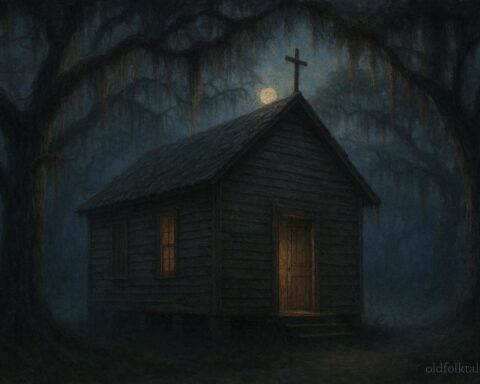
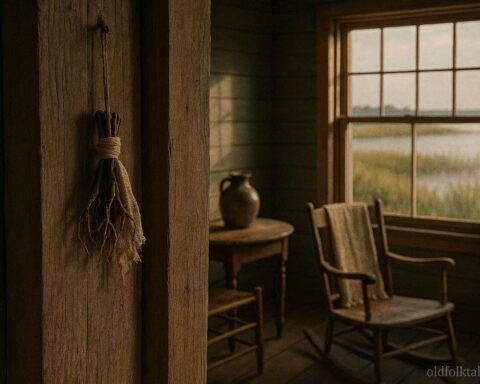
Along the coastal marshlands of the southeastern United States, where Spanish moss draped itself over ancient oak trees and the tide whispered secrets into the reeds, there lived a deep and enduring fear passed quietly from one generation to the next. It was the fear of the Boo Hag. Elders spoke her name only when necessary, never loudly, and never at night. To do so was to invite attention from something that thrived on carelessness and silence.
The Boo Hag was not born like other beings. She was said to be a spirit that had lost her skin long ago, condemned to wander between worlds. Without skin, she could not be seen for what she truly was. Instead, she stole the skin of others, wearing it as a disguise so perfect that even family members might not recognize the danger standing before them.
In the Gullah Geechee communities, people were taught early to watch for signs. Someone who avoided sunlight. Someone who never ate much but always watched others closely. Someone whose voice sounded right but felt wrong. These were warnings, not accusations. The Boo Hag did not attack with claws or teeth. She waited. She studied. She preyed on those who trusted too easily or ignored ancestral wisdom.
Discover chilling ghost tales and haunted places that echo through America’s towns and countryside.
In one small coastal settlement, there lived a young woman named Althea. She was known for her kindness and her open heart. She helped elders carry water, watched children while their parents worked the nets, and never turned away a stranger in need. Her grandmother, Miss Ruth, often warned her that kindness without caution could become a doorway for harm. Althea listened politely but believed goodness alone was enough to keep her safe.
One summer evening, after a long day of work, Althea heard knocking at her door. When she opened it, she saw a woman standing in the fading light. The woman appeared tired, her clothes dusty, her voice soft and trembling. She asked for water and a place to rest. Althea noticed nothing strange at first, though the woman’s eyes never blinked, and her skin seemed unnaturally tight, as if pulled too firmly across her face.
Remembering her grandmother’s warnings only faintly, Althea invited the woman inside. She offered food and water, and the stranger accepted but barely touched either. Instead, she watched Althea with intense focus, asking questions about her family, her routines, and who lived nearby. Althea answered without suspicion, believing honesty was always the right path.
That night, Althea dreamed of suffocating beneath a heavy weight. She felt breath leaving her body as if being pulled away. When she awoke, her limbs were weak, and her chest ached deeply. Outside, the stranger was gone.
Over the following days, Althea grew paler. She tired easily and felt drained no matter how much she rested. Miss Ruth noticed immediately. She examined Althea’s neck and shoulders and shook her head gravely. She said the signs were clear. The Boo Hag had fed.
Miss Ruth gathered protective items passed down through generations. Blue cloth. Salt. Iron. She burned herbs and spoke words taught by her own grandmother, calling on ancestral protection. She explained that the Boo Hag fed on breath and vitality, slipping into homes when people ignored the old teachings.
That evening, they waited. Just before midnight, the Boo Hag returned, wearing the stolen skin of another woman from a neighboring village. Her disguise was flawless, but her shadow moved strangely, lagging behind her steps. When Miss Ruth confronted her, the Boo Hag hissed and shed the skin like a shell, revealing her true form. Skinless. Shining. Terrifying.
The protective charms worked. The Boo Hag fled into the marsh, screaming as the ancestors’ names were spoken aloud. She would not return to that house again.
Althea recovered slowly, changed forever. She became wiser, more observant, and deeply respectful of the teachings she once brushed aside. She later told children that monsters do not always look frightening, and danger does not always announce itself.
From that day forward, the community renewed its vigilance. Doors were watched carefully. Hospitality remained strong, but boundaries were respected. The story of the Boo Hag was told not to spread fear, but to remind people that identity is sacred, protection is necessary, and wisdom survives only when remembered.
Click to read all American Folktales — timeless oral stories passed through generations across the United States.
Moral Lesson
True safety comes from balancing kindness with caution. Respect for ancestral knowledge protects individuals and communities from hidden dangers that disguise themselves as familiarity.
Knowledge Check
1 What is the Boo Hag known for doing?
Answer: Stealing human skin to disguise herself and feed on people
2 Why is the Boo Hag especially dangerous?
Answer: She appears human and preys on trust and carelessness
3 What warning signs did elders teach people to watch for?
Answer: Strange behavior, avoidance of sunlight, and unnatural presence
4 How did Althea first respond to the stranger?
Answer: With kindness but without caution
5 What saved Althea from further harm?
Answer: Ancestral protection rituals and elder wisdom
6 What is the main lesson of the Boo Hag legend?
Answer: Kindness must be guided by awareness and respect for tradition
Source
Adapted from Gullah Geechee folklore collections, University of South Carolina
Cultural Origin
Gullah Geechee people, Southeastern United States