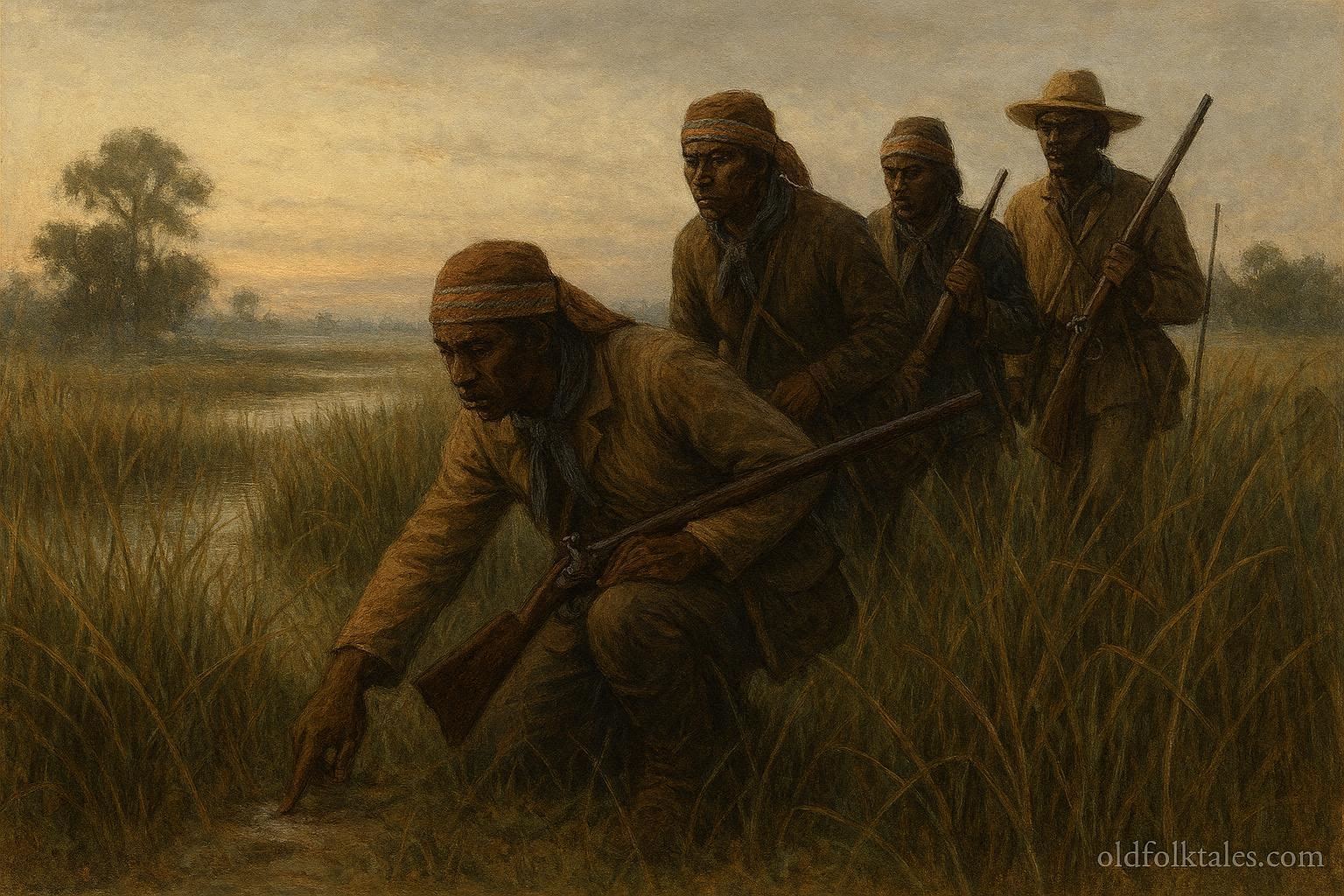
The southern frontier did not reward force alone. It favored those who understood silence, distance, and the language of the land itself. In this contested terrain, where borders shifted and survival demanded precision, a collective of trackers emerged whose influence far exceeded their numbers. Known as the Black Seminole Scouts, they became indispensable guides in landscapes that resisted maps and armies alike.
Along the southern frontier of the United States, a rare alliance formed under pressure rather than design. African-descended people who had escaped enslavement and Seminole communities resisting removal learned that survival demanded cooperation. From that cooperation emerged a group whose reputation would outlast the conflicts that created them: the Black Seminole Scouts.
They were not celebrated at first. Their work was quiet, precise, and dangerous. They moved ahead of armies, not behind them. Their names were rarely recorded correctly. Yet their skill reshaped military outcomes and frontier history alike.
Discover chilling ghost tales and haunted places that echo through America’s towns and countryside.
The scouts grew out of necessity. Black Seminole communities lived in contested spaces where neither safety nor neutrality existed. They understood pursuit because they had lived it. They understood concealment because their lives depended on it. This knowledge, refined over generations, could not be taught quickly to outsiders.
When the U.S. Army struggled to navigate unfamiliar terrain along the Texas–Mexico border and the southern plains, it encountered a problem no amount of manpower could solve. Soldiers marched confidently into landscapes that erased them. Supply lines vanished. Enemies struck and disappeared. Conventional tactics failed.
The scouts did not.
They tracked movement where others saw emptiness. A broken blade of grass, a disturbed stone, a change in bird calls were not details. They were language. The scouts read it fluently.
What made them legendary was not speed alone, but restraint. They knew when not to pursue. They knew when land itself had turned hostile. They guided troops safely through terrain that would have otherwise consumed them, often preventing violence rather than provoking it.
This expertise did not come without cost. Scouts operated between worlds. They served an army that did not always recognize their humanity while protecting communities that remained vulnerable to shifting policies. Loyalty was not simple. It was negotiated daily through action rather than words.
Stories circulated among soldiers about men who could disappear in open ground and reappear miles away. About guides who led units through nights so dark the land itself seemed absent. These accounts grew exaggerated, as folklore always does, but they rested on undeniable truth.
The Black Seminole Scouts were indispensable.
Their collective identity mattered. Unlike singular folk heroes, their legend was shared. One scout’s success belonged to all. Their reputation rested on consistency, not spectacle. In folklore, this made them powerful. They represented what happened when skill outweighed force.
Despite their contributions, recognition came slowly and unevenly. Pay was often delayed. Credit was misattributed. Yet the work continued. For the scouts, survival was not abstract. It was inherited responsibility.
Within their communities, stories emphasized adaptability and mutual dependence. Children learned that no one moved alone. That the land must be respected before it could be crossed. These lessons shaped identity as much as any military engagement.
As the frontier shifted and formal conflicts subsided, the scouts’ role changed, but their legend did not fade. Oral histories preserved details official records ignored. Elders spoke of endurance, not glory. Of choosing alliance over isolation.
Today, historians examine the Black Seminole Scouts as a case study in collective heroism. They challenge the myth that American legends must center on lone figures. Their story proves that cooperation itself can become folklore.
What endures is not a single face or name, but a model of survival rooted in shared knowledge. The scouts remind us that some heroes move quietly, guided by land, memory, and trust rather than applause.
Click now to read all American Legends — heroic tales where truth and imagination meet, defining the American spirit.
Moral Lesson
True strength often lies in cooperation, shared knowledge, and respect for the land rather than individual dominance.
Knowledge Check
- Why were the Black Seminole Scouts uniquely effective trackers?
Answer: They possessed generational knowledge of the land and survival - What historical conditions led to their formation?
Answer: Displacement, frontier conflict, and the need for survival alliances - How did their heroism differ from typical folk heroes?
Answer: It was collective rather than individual - Why was their service morally complex?
Answer: They served an army while protecting vulnerable communities - How was their legacy preserved despite limited recognition?
Answer: Through oral history and folklore - What broader lesson does their story teach?
Answer: Cooperation can be a form of resistance and strength
Source
Adapted from U.S. Army and Smithsonian collaborative folklore archives
Cultural Origin
Black Seminole communities, Southern United States