In the long stretches of forest and farmland that once separated one Southern settlement from another, travel was never taken lightly. Roads were narrow, paths uncertain, and every bend in the trail carried the possibility of danger. Among the many warnings passed from one generation to the next, few inspired as much unease as the mention of the Hoop Snake, a creature spoken of in hushed tones, often followed by a pause, as if saying its name too loudly might invite it closer.
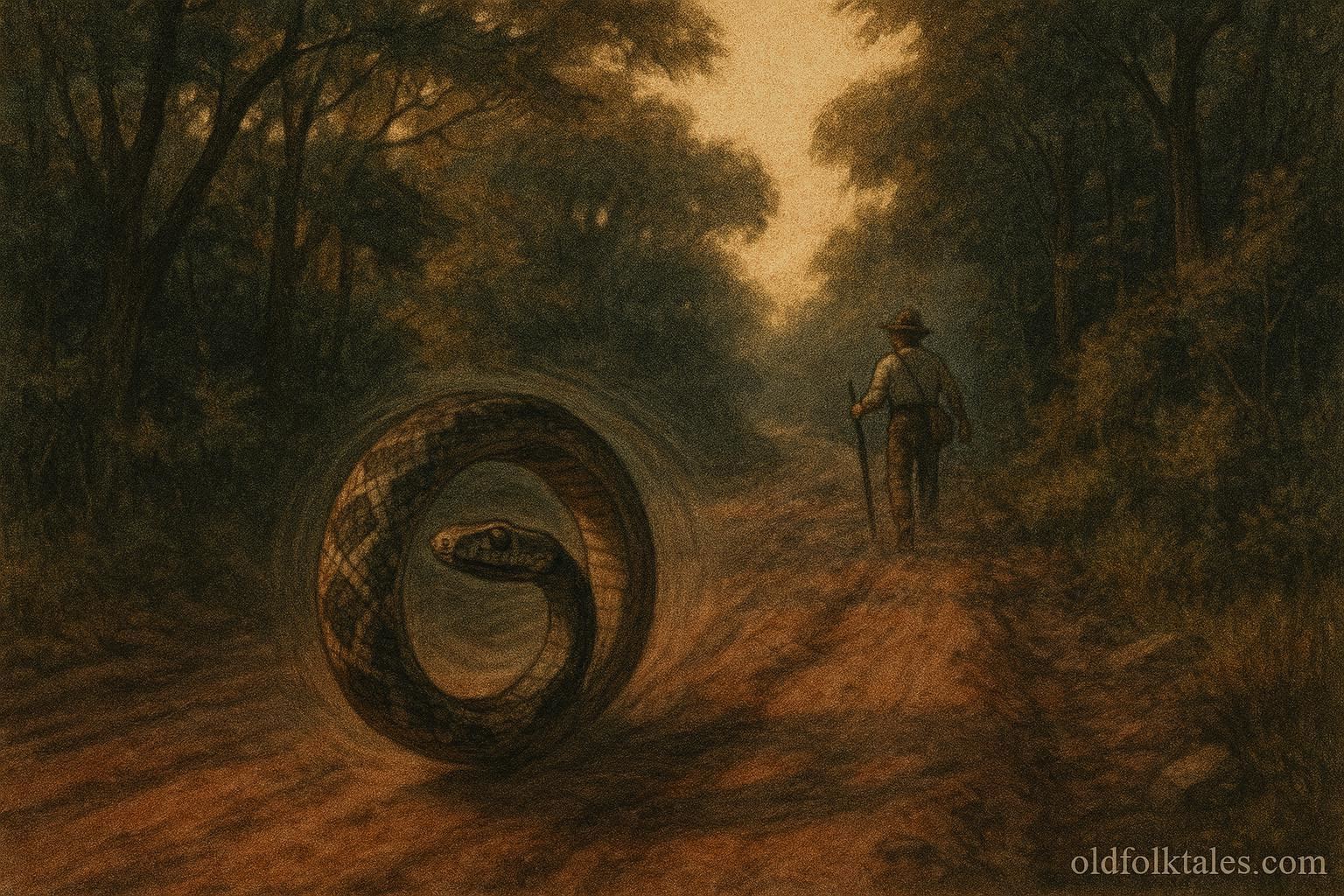
Unlike ordinary snakes that slithered through brush and creek beds, the Hoop Snake was said to move with terrifying intention. It did not crawl. It rolled.
Stories claimed the creature could stiffen its body, seize its own tail in its mouth, and transform itself into a living wheel. Once formed, it would launch downhill or across open ground at astonishing speed, its circular body spinning faster than a man could run. Travelers swore that once the Hoop Snake chose a target, escape depended not on strength, but on wit and luck.
Explore ancient Native American creation myths and the symbolic tales that shaped America’s belief systems.
The legend thrived in rural Southern and Appalachian communities, where isolation made every encounter with nature feel personal. Farmers returning from distant fields, hunters deep in the woods, and wagon drivers guiding tired horses through unfamiliar trails all shared similar accounts. They described hearing a low rustling sound, followed by a rapid thudding like something heavy bouncing over packed earth. Then came the sight no one forgot: a large, dark ring racing toward them, upright and deliberate, its center hollow like an empty eye.
One frequently told story involved a young farmhand named Elias Turner, who traveled weekly between neighboring towns to deliver seed grain. According to local retellings, Elias noticed something strange while crossing a sloping dirt road bordered by tall grass. The birds fell silent. His mule refused to move forward, ears flattened and hooves planted hard against the ground.
Moments later, Elias spotted movement at the top of the rise. What he first thought was a rolling wagon wheel quickly revealed itself as something alive. The ring flexed and adjusted its speed, keeping balance as it descended. In panic, Elias leapt from his mule and ran for the nearest tree, scrambling up its trunk just as the Hoop Snake reached the base.
Witnesses later claimed the creature reared slightly, its body loosening just enough to strike. The tail, hardened and sharp, lashed upward like a spear, embedding itself deep into the bark. Unable to reach Elias, the Hoop Snake dropped back to the ground, re-formed its circle, and rolled away into the undergrowth.
Such stories were not told merely to frighten children. They served as warnings. Elders reminded young travelers never to linger on slopes, never to trust open ground, and never to ignore the instincts of animals. Mules, dogs, and horses were believed to sense the Hoop Snake long before humans could.
Descriptions of the creature varied slightly by region. Some said it bore scales as hard as iron. Others claimed its eyes glowed faintly from within the ring as it rolled. A common detail, however, remained consistent: the tail was its weapon. When fully extended, it could pierce wood, flesh, and even thin metal. Fence posts found split or scarred were sometimes blamed on failed Hoop Snake strikes.
Interestingly, the Hoop Snake was rarely described as hunting out of hunger. Instead, it appeared to attack anything that wandered into its chosen path. This detail reinforced the belief that the creature represented danger born of carelessness rather than malice. Those who stayed alert, moved wisely, and respected the land often escaped unharmed.
By the late nineteenth century, as railroads expanded and forests thinned, reports of Hoop Snake encounters began to fade. Still, the legend endured. It lingered in campfire stories, schoolyard dares, and cautionary tales shared before long journeys. Even skeptics admitted that the story held power not because the creature could be proven, but because it reflected the very real dangers of frontier life.
Traveling alone was risky. Ignoring signs from nature could be fatal. Exaggeration became a teaching tool, transforming ordinary hazards, snakes, steep roads, sudden panic into something unforgettable.
Today, the Hoop Snake survives as one of America’s most distinctive frontier cryptids. It is remembered not just as a monster, but as a symbol of how early communities explained fear, taught survival, and respected the unpredictable forces around them.
Click to read all American Cryptids & Monsters — creatures of mystery and fear said to inhabit America’s wild landscapes.
Moral Lesson
The legend of the Hoop Snake teaches that survival depends on awareness and respect for one’s surroundings. Those who ignore warning signs, rush blindly forward, or underestimate nature place themselves in danger, while those who remain observant and cautious often endure.
Knowledge Check
- What unusual method of movement is the Hoop Snake known for?
Answer: It curls into a wheel and rolls toward its target. - Which regions are most associated with Hoop Snake legends?
Answer: Southern and Appalachian rural communities. - What weapon does the Hoop Snake use to strike?
Answer: Its hardened tail. - Why were Hoop Snake stories often told to travelers?
Answer: To warn them about danger and encourage caution. - What animals were believed to sense the Hoop Snake first?
Answer: Mules, horses, and dogs. - What does the Hoop Snake symbolically represent in frontier folklore?
Answer: The dangers of carelessness and ignoring nature’s warnings.
Source
Adapted from American Folklife Center frontier folklore records
Cultural Origin
Southern and Appalachian rural communities