Mountain camps in Colorado were built on ambition, luck, and borrowed time. Men carved shelters into slopes that had never known permanent footsteps. They believed danger came from above in the form of falling stone or from below in collapsing tunnels. What they did not expect was a creature that treated the mountain itself as a hunting ground.
Miners working the steep ranges of the Rocky Mountains began telling a story that refused to stay contained within a single camp. It moved with prospectors, freight haulers, and surveyors. The story was never told loudly. It was shared in murmured warnings, usually after sunset, when the wind pressed hard against cabin walls and the cliffs loomed like listening faces.
They called it the Slide Rock Bolter.
According to the oldest accounts, the creature was not something that walked or flew. It waited. It clung to sheer mountainsides where stone was worn smooth by centuries of ice and gravity. From a distance it resembled a massive outcropping of rock or a strange fold in the mountain itself. Only those who watched long enough noticed the subtle rise and fall of its body as it breathed.
Explore the heart of America’s storytelling — from tall tales and tricksters to fireside family legends.
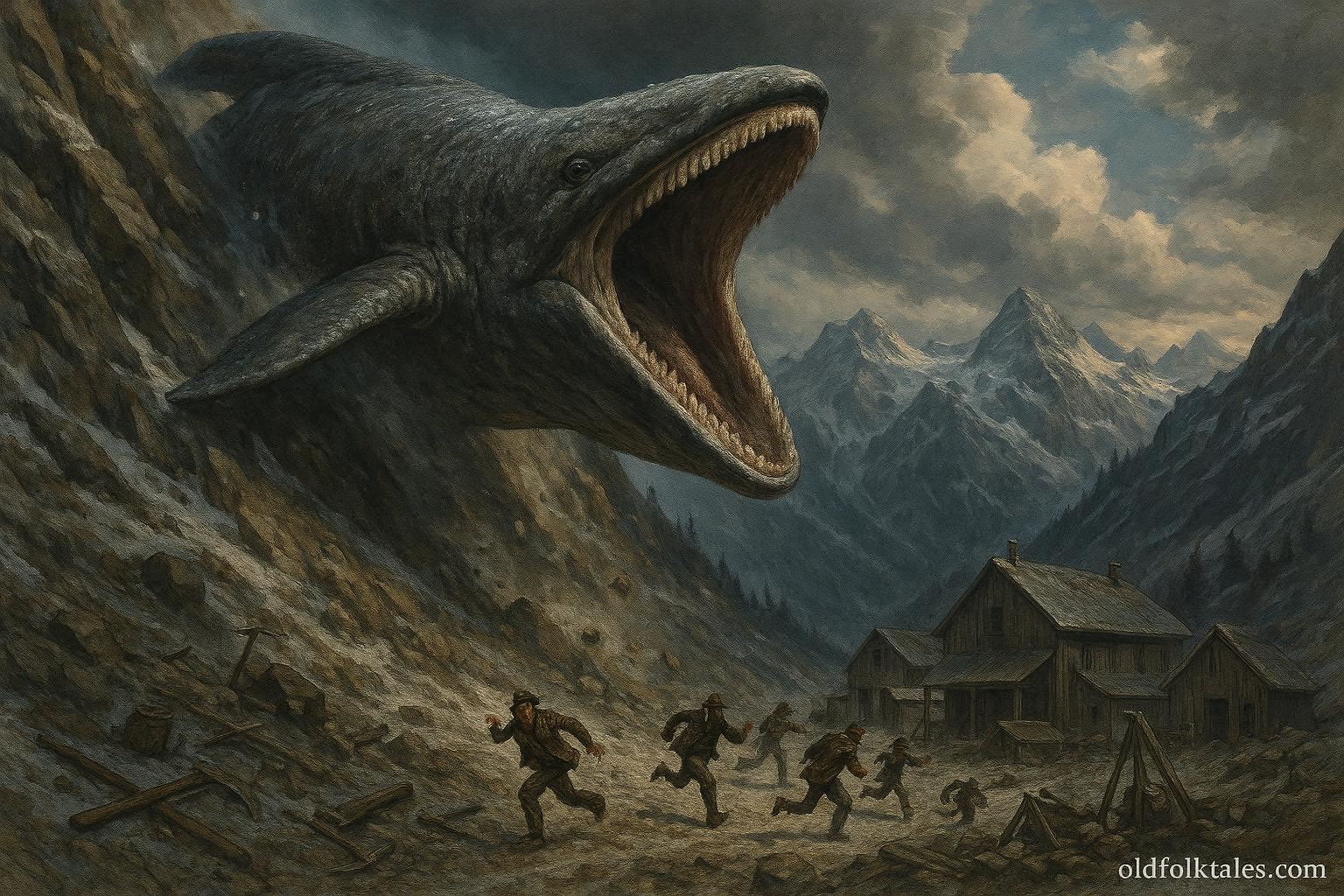
Descriptions varied, but most agreed on its shape. The creature was enormous, longer than a freight train, with a body like a whale and a mouth that opened wider than a mine shaft. Its hide was slick and tough, allowing it to slide effortlessly along stone. Instead of fins or legs, it relied entirely on gravity.
The Bolter hunted by anchoring its powerful tail to the peak of a mountain. When prey appeared below, a herd of animals, a supply caravan, or a cluster of miners, it released its grip. The creature then slid down the slope with unstoppable speed, mouth open, swallowing everything in its path before crashing into the valley floor below. Once its momentum was spent, it hauled itself back up the mountain using its tail and waited again.
At first, disappearances were blamed on accidents. Mining camps were dangerous places. Men fell into ravines. Avalanches buried entire trails. Wagons overturned on narrow paths. But patterns began to form. Camps built beneath certain slopes never lasted. Trails that ran directly below polished cliffs became cursed routes. Supplies vanished without wreckage. Entire mule teams disappeared without trace.
One winter, a camp known as Silver Spur lost three men and a string of pack animals in a single afternoon. Witnesses reported hearing a roar that sounded like thunder rolling uphill. They felt the ground tremble beneath their boots. When the dust settled, the trail was gone. In its place lay a smooth scar carved into the mountain face, ending in a valley littered with shattered stone and silence.
The men who survived refused to return to the site. They packed what remained and left before dawn.
As the legend grew, so did the rules meant to survive it. Never camp below a bare cliff. Never travel single file along steep slopes. Never linger beneath a mountain that looked scraped clean. Most importantly, never mock the warnings.
Those who mocked were said to attract the creature’s attention.
One story told of a geologist sent to survey mineral claims. Educated and confident, he dismissed the Bolter as superstition. He pitched his tent directly below a smooth ridge and spent days studying the strange grooves etched into the stone. On the third night, nearby miners heard a sound like a great breath being drawn in. By morning, the tent, the man, and his equipment were gone. Only a fresh trail of scraped rock marked the slope.
Not all encounters ended in disappearance. A freight driver once claimed to have seen the creature retreat. He described watching the mountain itself move. The rock bulged outward, then slowly slid upward as if pulled by an invisible force. The man abandoned his wagon and ran until his lungs burned. When he returned days later with others, the cliff face looked unchanged, but none of them dared camp nearby.
The Bolter was not described as evil. In the logic of frontier folklore, it was a warning made flesh. The mountain punished those who pushed too far, who carved roads where none should exist, who took without caution. The creature embodied the consequences of unchecked greed.
Some miners believed the Bolter protected the mountains. Others believed it fed on human arrogance. Either way, its presence forced respect.
By the early twentieth century, mining camps dwindled. Railroads bypassed the steepest routes. Modern equipment reduced the need for precarious mountain settlements. As human activity retreated, reports of the Slide Rock Bolter faded.
Yet the legend never disappeared.
Hikers and climbers still report strange grooves on isolated slopes. Hunters speak of valleys where animals refuse to graze. Rangers hear stories of rockslides that move against the wind. The mountain keeps its secrets well.
Those who know the old tales say the Bolter still waits. Not for miners anymore, but for anyone who forgets that the land was never meant to be conquered.
In the high Rockies, the mountains do not chase. They simply let gravity do the work.
And sometimes, gravity has teeth.
Encounter the strange and the unseen — from Bigfoot to regional monsters hiding in America’s forests.
Moral Lesson
The legend of the Slide-Rock Bolter teaches that unchecked greed and disregard for natural warnings invite destruction, and that survival in harsh environments depends on humility and respect for forces beyond human control.
Knowledge Check
1 Where was the Slide-Rock Bolter said to live?
Answer On steep Rocky Mountain slopes
2 What shape was the creature described as having?
Answer A massive whale-like body
3 How did the Bolter attack its victims?
Answer By sliding downhill and swallowing everything in its path
4 What real dangers inspired this legend?
Answer Landslides, avalanches, and mining accidents
5 What human flaw does the Bolter represent?
Answer Greed
6 Why was the story useful to mining communities?
Answer It warned miners to respect terrain and natural signs
Source
Adapted from Colorado School of Mines folklore and mining history archives
Cultural Origin
Rocky Mountain mining camps, United States