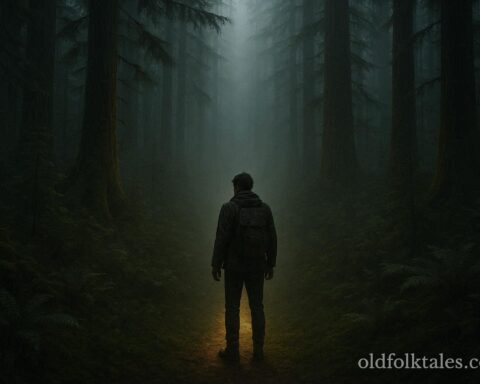
Night settles differently in the lowlands of southern Arkansas. The air thickens, cicadas fall silent in uneven waves, and the swamps seem to hold their breath. In the rural outskirts near the small town of Fouke, residents learned long ago that darkness was not simply the absence of light. It was a condition. A space where something unseen could move, watch, and leave marks behind without ever revealing its full shape.
The Fouke Monster entered local memory not through spectacle but through disturbance. Farmers woke to livestock pens torn open. Chickens vanished without tracks leading away. Heavy footprints appeared in soft mud along Boggy Creek, too large to belong to any known animal and too deliberate to be dismissed as chance. They showed a strange gait, as though whatever made them walked upright but with weight unevenly distributed.
At first, people blamed bears. Arkansas had them, and bears wandered. But the prints were wrong. Five-toed. Deeply pressed. Spaced in a way that suggested long strides. More unsettling were reports of a smell lingering after sightings, a sharp, musky odor that clung to clothing and fences long after the night passed.
Explore ancient Native American creation myths and the symbolic tales that shaped America’s belief systems.
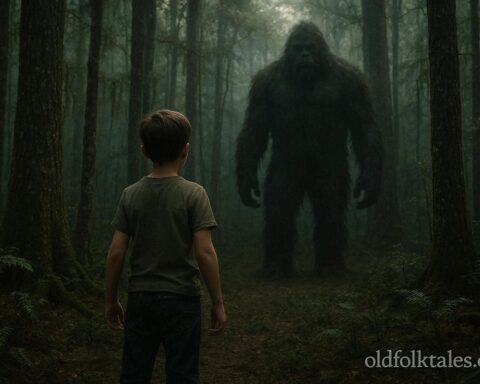
The earliest detailed encounters came from isolated homesteads tucked near the swamp’s edge. Families described something watching from tree lines. A tall figure, broad shouldered, covered head to toe in dark, matted hair. It did not rush or roar. It waited. One family recalled hearing heavy footsteps circle their house for hours, pausing beneath windows, scraping against wooden siding. When dawn came, nothing remained except crushed vegetation and footprints that led back toward Boggy Creek.
Children were warned not to wander near the water alone. Hunters refused to go out at night without companions. Dogs that once roamed freely refused to leave porches after sunset, whining at invisible movement beyond lantern light. The swamp, once a place of work and familiarity, became something watched rather than entered.
What made the Fouke Monster different from ordinary tall tales was its consistency. Descriptions matched across households that had no reason to conspire. Height estimates hovered around seven feet. Arms longer than a man’s. A head that seemed set low between sloping shoulders. Eyes that reflected light briefly before vanishing. No clear facial features, only shadow and hair.
One of the most widely shared encounters involved a young couple whose home sat near a bend in Boggy Creek. Late one evening, their dogs erupted into frantic barking before falling silent. A heavy thud struck the side of the house, followed by another. When the husband stepped onto the porch with a firearm, he saw a large figure retreating into the tree line, moving with surprising speed despite its size. The next morning, claw-like marks were found on the porch railing, and the dogs would not approach the area again.
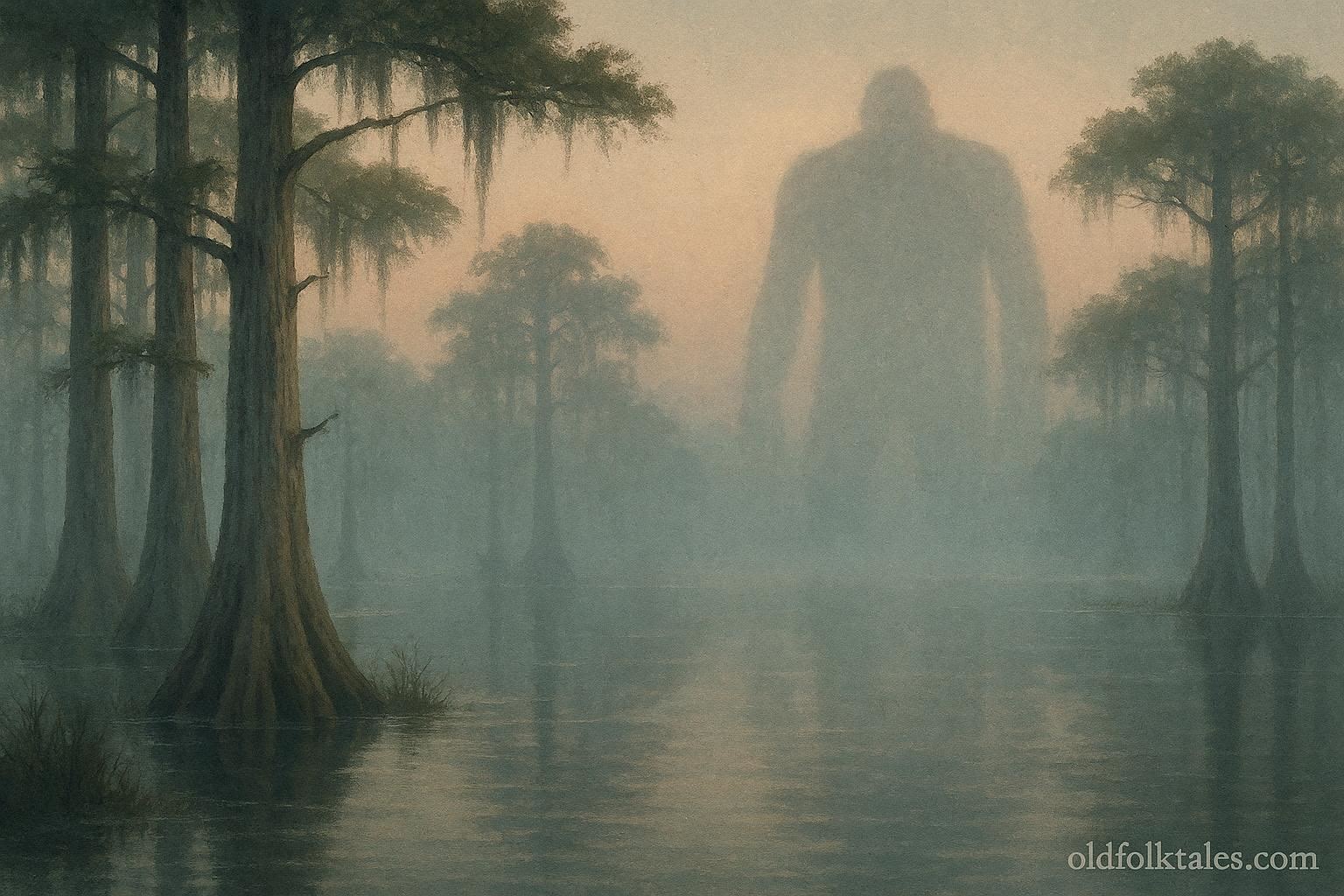
The swamp itself seemed complicit. Fog rolled in thick enough to swallow lantern beams. Sounds carried strangely, making distance impossible to judge. Locals said the monster understood the terrain better than any person could. It appeared where paths narrowed, where water and land blurred, where escape required knowledge passed down through generations.
As word spread beyond Fouke, curiosity arrived alongside fear. Outsiders came searching for proof, armed with cameras and theories. Some treated the creature as entertainment, a novelty born of boredom and isolation. Locals resented this. For them, the monster was not a spectacle. It was a disruption of daily life, a presence that changed behavior, routines, and trust in the familiar landscape.
Despite searches, traps, and patrols, nothing definitive was ever captured. No body. No clear photograph. Only tracks, testimonies, and a pattern of encounters that faded as suddenly as they had begun. Some said the monster retreated deeper into the swamp. Others believed it followed the creek into regions no one dared map.
Over time, the Fouke Monster shifted from immediate threat to inherited warning. Parents told children stories not just to frighten them, but to teach respect for the land. The swamp was not empty. It was not conquered. It remembered those who underestimated it.
In folklore, the creature became a symbol of the unknown spaces left behind as modern life pressed forward. It represented what remained untamed, what refused to be named or controlled. Whether flesh and blood or born from collective fear, the Fouke Monster held power because it existed at the boundary between certainty and imagination.
Even now, long after the loudest sightings have quieted, locals speak carefully about Boggy Creek. They avoid certain trails. They lock doors at night not because they expect an intruder, but because tradition demands it. And when the swamp grows quiet in a way that feels too deliberate, some still listen for footsteps that do not belong to any animal they know.
Encounter the strange and the unseen — from Bigfoot to regional monsters hiding in America’s forests.
Moral Lesson
Fear often grows where understanding ends, but respect for nature and the unknown can protect communities better than denial or ridicule.
Knowledge Check
1. What physical traits were most commonly attributed to the Fouke Monster?
A large upright figure covered in dark hair with long arms and heavy footprints.
2. Why did locals dismiss bears as an explanation for the sightings?
The footprints and behavior did not match known bear movement or anatomy.
3. What role did Boggy Creek play in the legend?
It provided concealment and terrain that allowed the creature to appear and vanish easily.
4. How did the presence of the Fouke Monster affect daily life in nearby communities?
People altered routines, restricted movement at night, and avoided certain areas.
5. Why did locals resist outsiders treating the legend as entertainment?
Because the experiences were tied to real fear and disruption, not amusement.
6. What broader idea does the Fouke Monster represent in American folklore?
The persistence of the unknown in landscapes shaped but not fully controlled by humans.
Source
Adapted from University of Arkansas folklore studies archive and regional ethnography collections
Cultural Origin
Rural Southern United States, Arkansas lowland communities