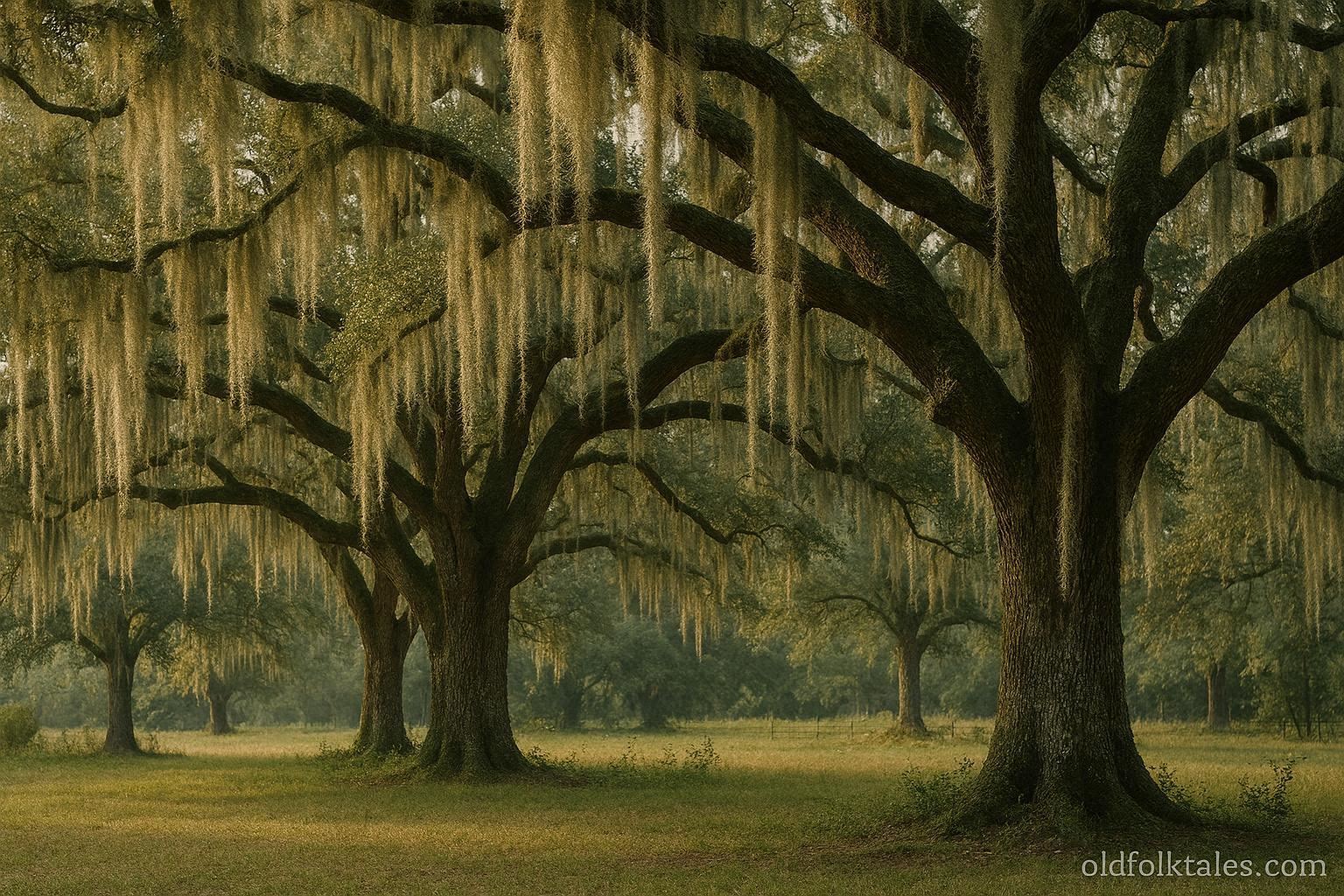
Regional plant based healing practices in the American South were shaped not by abundance, but by attentiveness. People learned to notice what survived heat, storms, insects, and neglect. Spanish moss, hanging silently from oak and cypress trees, became one of the most quietly respected healing materials in Southern communities.
Spanish moss was not considered medicine in the modern sense. It was understood as a helper. Its effectiveness depended on how it was gathered, when it was prepared, and who applied it. Without these elements, it was believed to be inert. With them, it became useful.
The moss itself did not grow from the trees it draped. It lived by absorbing moisture from the air, thriving in humidity and enduring long droughts. This resilience shaped how people interpreted its value. A plant that survived without soil was thought capable of helping bodies recover from strain and injury.
Discover African American wisdom, Native American spirit stories, and the humor of early pioneers in American Folktales.
Gathering Spanish moss followed specific customs. Healers avoided pulling living strands directly from branches. Moss that had already loosened or fallen was preferred. Taking moss aggressively was believed to weaken its effectiveness. Balance mattered, not only ecologically, but spiritually.
Timing was central. Moss gathered in the early morning, before sunlight dried the dew, was used for swelling, inflammation, and heat trapped in joints. Moss gathered in the late afternoon was believed to help stabilize wounds and protect injured skin. These distinctions were taught carefully and remembered precisely.
Preparation was slow. Fresh moss was never applied immediately. It was shaken, cleaned, and laid out to dry completely. Insects and moisture were removed not only for hygiene, but because damp moss was believed to hold restless energy. Only when fully dry was it considered safe.
The drying process could take several days. Moss was spread thinly, turned often, and kept away from harsh heat. Rushing the process was discouraged. Healing that moved too quickly was believed to fail just as fast.
Application varied by need. For inflammation, dried moss was soaked briefly in cool water, then placed gently over the affected area. For wounds, it was wrapped dry, layered with cloth, and secured loosely. Pressure was avoided. The moss was meant to support, not dominate.
Silence accompanied most treatments. Talking during application was discouraged. Observation mattered more than instruction. Healers watched breathing, skin color, and reaction. If discomfort increased, the moss was removed immediately. The cure was cooperative, not forceful.
Spanish moss cures were common for sprains, swollen joints, insect stings, surface cuts, and muscle strain. They were not used for deep wounds or severe illness. Communities understood limits. When something exceeded local knowledge, other help was sought.
Stories reinforced proper practice. One tale told of a man who wrapped damp moss directly on a swollen ankle. The swelling worsened. Elders explained that the failure came from impatience, not from the moss itself. Respect for process was the foundation of success.
Children learned moss knowledge informally. They followed elders during gathering, memorized which trees produced the softest strands, and learned which locations were avoided. Trees near stagnant water or crossroads were often skipped, believed to carry unsettled conditions.
Spanish moss was also symbolic. It represented endurance without ownership. It did not belong to the tree it rested on, yet it survived alongside it. This quality resonated deeply in communities shaped by displacement, hardship, and adaptation.
During times when doctors were distant or unaffordable, moss cures became more visible. They were not described as miracles. They were described as what people knew how to do. Knowledge was practical, not mystical.
As industrial medicine expanded, moss cures moved into the background. Yet the knowledge did not disappear. Elders preserved it quietly, passing it down selectively. Some families kept dried moss stored away, rarely used but never discarded.
Modern ethnobotanical studies have confirmed some practical aspects of moss use. Its ability to retain coolness and act as padding made it useful historically. What science later measured, tradition had already observed through experience.
Spanish moss continues to hang from Southern trees today. Its presence is unchanged. For those who remember its purpose, it remains a reminder that healing once depended not on speed or specialization, but on attentiveness, patience, and respect for the environment.
Explore how American superstitions and rituals still influence modern life and local traditions.
Moral Lesson
Healing knowledge lasts when it is practiced with patience, respect, and careful attention rather than haste.
Knowledge Check
1. Why was Spanish moss rarely pulled directly from trees?
Because taking it forcefully was believed to weaken its healing usefulness
2. How did gathering time influence the moss’s purpose?
Morning moss was used for cooling inflammation, while later moss stabilized wounds
3. Why was moss dried before use?
To remove insects, moisture, and unstable conditions
4. What role did silence play during treatment?
It allowed focused observation of the body’s response
5. Why were some trees avoided during gathering?
Certain locations were believed to affect the moss’s stability
6. What did Spanish moss symbolize beyond its physical use?
Resilience, adaptation, and balance with the environment
Source
Adapted from University of Georgia Southern ethnobotany folklore archives
Cultural Origin
Southeastern United States communities