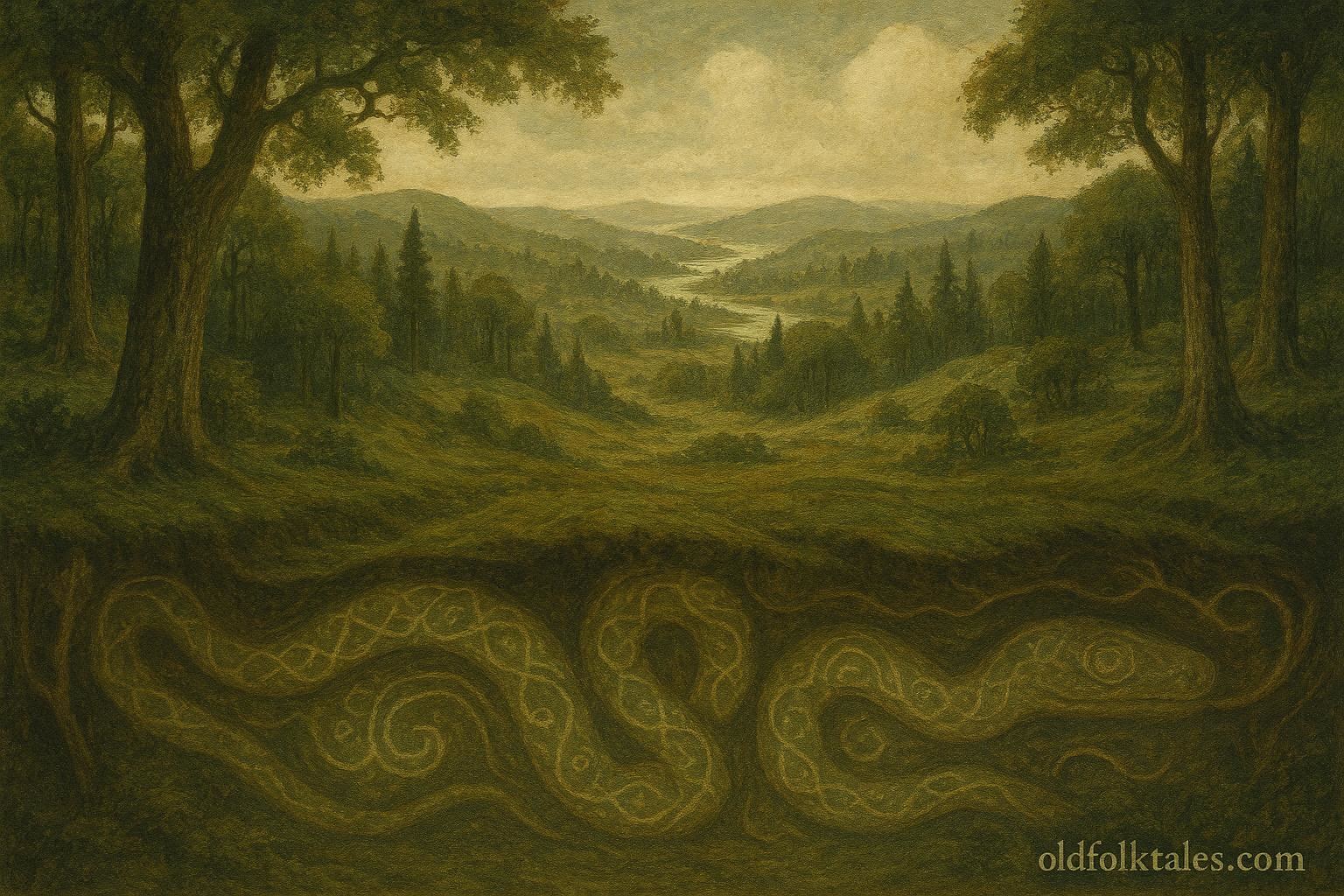
Long before human footprints marked the soil and before rivers learned their winding courses, the land rested upon something unseen yet alive. The earth was not believed to float freely in emptiness. It was supported, shaped, and steadied by a force dwelling far below the surface. Elders spoke of this force in careful language, calling it the Great Serpent, a being older than mountains and quieter than stone.
Among Southeastern tribal nations, the universe was understood as layered rather than flat. The upper world carried the sky, stars, and the movement of winds. The middle world held humans, animals, forests, and rivers. Beneath them lay the lower world, dark, heavy with water and pressure, and full of power that demanded respect. It was there that the Great Serpent lived.
The serpent was described as vast beyond measure. Its body curved through underground chambers and waterways, its coils forming the hidden foundation of the land above. Where its back rose, hills and mountains appeared. Where it shifted, valleys formed. Rivers followed paths pressed into the earth by its ancient movements. Nothing on the surface existed without its silent support.
Discover African American wisdom, Native American spirit stories, and the humor of early pioneers in American Folktales.
The Great Serpent was not an enemy. It was not a creature of rage or chaos. Its purpose was balance. When it rested undisturbed, the land above remained steady. Seasons arrived on time. Crops grew. Game followed familiar trails. Life unfolded in harmony because the weight placed upon the earth remained within limits.
From childhood, people were taught that walking upon the land meant walking upon a living foundation. Every action carried consequence. Digging into soil, cutting trees, lighting fires, and building shelters all pressed downward. Because of this, care was woven into daily life. Words were spoken before breaking the ground. Fires were lit only when needed. What was taken was balanced by gratitude and restraint.
For many generations, this understanding shaped behavior. The serpent lay still beneath them. Tremors were rare and brief. When they happened, they were reminders rather than disasters. People paused, reflected, and adjusted their actions.
Over time, memory softened.
As villages grew, the rhythm of restraint weakened. Trees were cleared faster than they could return. Hillsides were carved deeper in search of stone and clay. Fires burned longer and wider than before. Songs once offered to the land became fewer. Elders spoke warnings, but urgency drowned wisdom.
At first, the signs were quiet. Springs shifted away from settlements. Fish abandoned familiar waters. Animals traveled farther into the forest. Some noticed and worried. Others dismissed these changes as coincidence.
Then one night, the ground itself spoke.
Homes trembled as the earth rolled beneath them. Clay walls cracked. Pots fell. Trees swayed without wind. A low sound moved through the soil, not a roar but a deep shifting breath. When stillness returned, fear settled among the people.
They knew what had happened.
The Great Serpent had moved.
At dawn, a council gathered. Elders explained that the serpent was not angry. It did not punish. It responded. Too much weight had been placed upon the land. Balance had shifted. The serpent adjusted its body, and the world above felt that adjustment as shaking.
The tremor was not a threat. It was a message.
Understanding this, the people did not seek to conquer what lay beneath them. They sought correction. Digging ceased. Fires were reduced. Hunting slowed to allow renewal. Hillsides were left untouched. Ceremonies were held near caves and rivers where the presence of the lower world felt close.
Songs were sung not to command the serpent, but to acknowledge it. Offerings took the form of restraint rather than objects. Silence replaced excess. Observation replaced haste.
Gradually, the land responded. Springs returned to their paths. Animals came back. The earth grew still once more. The serpent settled beneath the world, carrying its burden in quiet strength.
Children were taught this story so they would understand that stability was not guaranteed. It was maintained. When the ground trembled in later generations, people did not panic. They reflected. What had changed. What needed to be corrected.
The Great Serpent endured as a symbol of foundational power. True strength was not loud or violent. It was patient. It supported life without recognition. Without it, the world would collapse.
Even now, elders say the serpent remains beneath the earth. When the ground trembles, it is not chaos. It is communication.
Balance survives only when what lies unseen is respected as deeply as what stands in plain sight.
Click to read all American Traditions & Beliefs — the living folklore of daily life, customs, and superstitions.
Moral Lesson
Respect for the unseen foundations of life ensures stability. When restraint is abandoned and balance ignored, consequences follow. Harmony is preserved through humility, awareness, and care for forces greater than oneself.
Knowledge Check
1. Where does the Great Serpent live according to the story?
The Great Serpent lives beneath the earth in the lower world, coiled through underground chambers and waterways.
2. What role does the serpent play in the world’s structure?
It supports and shapes the land, forming mountains, valleys, and stability through its resting position.
3. What causes the serpent to move?
Disrespectful actions such as excessive digging, burning, and exploitation of the land create imbalance.
4. How are earthquakes explained in this myth?
Earthquakes occur when the serpent shifts to rebalance the weight placed upon it.
5. Why are earthquakes considered messages rather than punishments?
They serve as warnings that harmony has been disrupted and behavior must change.
6. What lesson are future generations taught through this story?
That stability depends on restraint, respect, and awareness of unseen forces.
Source
Adapted from University of Tennessee Indigenous Southeastern cosmology records
Cultural Origin
Southeastern tribal nations of the United States