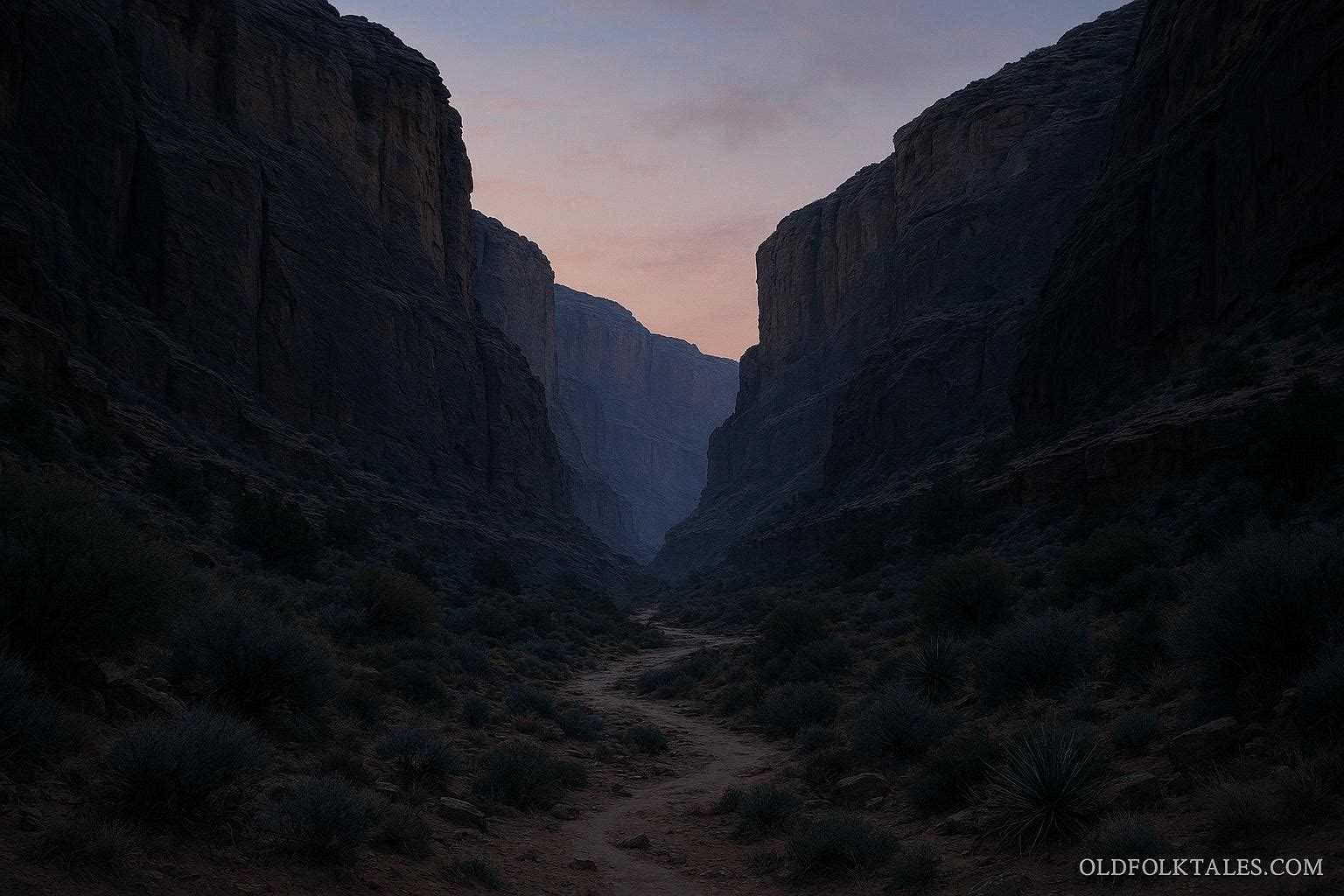
Slaughterhouse Canyon cuts through the high desert of northeastern Arizona, its walls rising steeply from a narrow, winding floor. During the day, the canyon appears stark but calm. Sunlight strikes the rock faces, casting long shadows that shift slowly with the hours. Juniper and scrub dot the landscape, and the wind carries dust along the canyon floor. It is a place that feels remote, but not threatening. Travelers often underestimate how deeply quiet it can become.
As evening approaches, the canyon changes character. Sound behaves differently between the rock walls, lingering longer than expected. Footsteps echo even when the ground is soft. Voices seem to travel farther than they should. Locals say this is when the canyon begins to speak back. Not loudly, not clearly, but enough to be noticed by anyone who pauses long enough to listen.
The legend of Slaughterhouse Canyon Voices is rooted in early settler history. Families traveling through the region faced brutal conditions. Water was scarce, weather unpredictable, and isolation absolute. Oral histories collected in Apache County tell of wagons passing through the canyon in desperation, hoping it would provide shelter or a safer route. Instead, it became the site of tragedy. Children fell ill, accidents occurred, and help was days away.
Explore the heart of America’s storytelling — from tall tales and tricksters to fireside family legends.
One frequently told account describes a settler family caught in the canyon during extreme conditions. Conflicting versions exist, but most agree that multiple children died there. Their deaths were not violent in the dramatic sense, but slow and unavoidable. The canyon, silent and unmoving, witnessed grief that had nowhere else to go. Survivors moved on, but the place remained.
Soon after, travelers began reporting strange sounds. At first, they described them as animals. Coyotes crying at unusual hours, wind whistling through cracks in the rock. Over time, the descriptions became more specific. People heard children crying. Others heard faint voices calling out, indistinct but human. The sounds never seemed to come from a single direction, instead shifting along the canyon walls.
What unsettles listeners most is the emotional quality of the voices. They are not loud or aggressive. They carry distress, confusion, and longing. Witnesses often describe an overwhelming sadness rather than fear. Some report stopping involuntarily, unsure why they are listening. Others feel an urge to leave offerings, such as water or small objects, before exiting the canyon.
Local residents advise against shouting back or attempting to follow the sounds. Stories circulate of people who wandered deeper into the canyon chasing echoes, only to become disoriented. While no modern disappearances are directly attributed to the legend, the warnings persist. The canyon is unforgiving terrain, and the voices are believed to distract rather than guide.
Folklorists studying the region note that geographic trauma legends often arise in places where loss occurred without proper ritual or remembrance. In frontier settings, survival took precedence over mourning. Graves were unmarked, stories unfinished. The land itself absorbed what people could not process. Slaughterhouse Canyon became one such vessel.
Environmental explanations exist. The canyon’s acoustics amplify and distort sound. Wind patterns change suddenly. Temperature differences between rock surfaces create movement that carries noise unpredictably. Yet these explanations fail to account for why the voices are consistently described as human and emotional. Nor do they explain why the sounds seem tied to moments of stillness rather than motion.
Apache County residents treat the canyon with respect rather than fear. Hunters, hikers, and ranchers speak quietly when passing through. Some remove their hats. Others pause briefly before entering, acknowledging the place. The legend has shaped behavior subtly, embedding itself into daily interactions with the land.
For Indigenous communities in the region, the canyon is part of a larger understanding of landscape memory. Places hold experiences, and those experiences do not fade simply because people leave. While the settler tragedy is central to current versions of the legend, the belief that land remembers predates it. The voices are not anomalies, but expressions of continuity.
Modern visitors sometimes approach the canyon seeking a supernatural encounter. Most leave having heard nothing unusual. Those who do hear voices often hesitate to share their experiences publicly. The sounds feel personal, as if intended only for the listener. This privacy reinforces the legend’s power. It does not perform on demand.
As development increases elsewhere, Slaughterhouse Canyon remains largely unchanged. Roads skirt its edges, but the interior retains its isolation. At night, the stars above are sharp and unfiltered. In this setting, sound becomes intimate. A whisper carries weight. A cry feels close, even when it is not.
The voices, according to legend, do not ask for rescue. They do not threaten. They exist as reminders. They mark a place where human vulnerability met an indifferent landscape. The canyon does not accuse, but it does not forget.
Those who pass through quietly, acknowledging the weight of the place, report peaceful exits. Those who rush through, distracted or dismissive, often leave unsettled without knowing why. The canyon offers no explanations, only presence.
In Slaughterhouse Canyon, the past is not buried. It echoes.
Click now to read all American Legends — heroic tales where truth and imagination meet, defining the American spirit.
Moral Lesson
When suffering goes unacknowledged, it becomes part of the land itself, asking only to be remembered with humility.
Knowledge Check
- Where is Slaughterhouse Canyon located?
Answer: Apache County, Arizona - What sounds are most commonly reported?
Answer: Crying and human voices - What historical events are tied to the legend?
Answer: Early settler family tragedies - Why do locals advise against following the voices?
Answer: The canyon is disorienting and dangerous - What emotion do witnesses often report feeling?
Answer: Sadness rather than fear - What concept explains the persistence of the legend?
Answer: Landscape memory and unresolved loss
Source
Adapted from Arizona State University Southwest folklore documentation
Cultural Origin
Apache County, Arizona