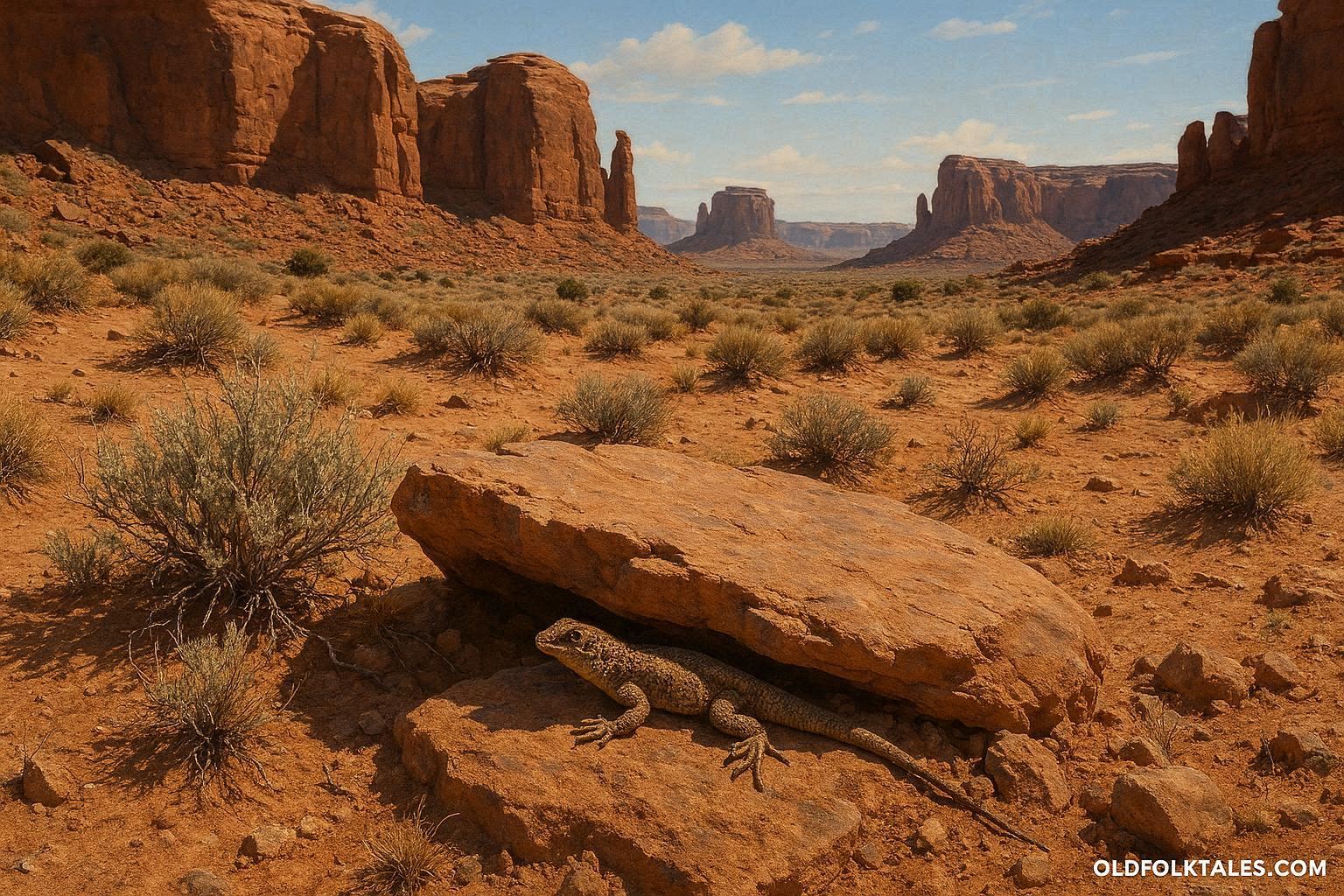
The desert revealed its dangers slowly, pressing down from the sun and rising from the ground until even the air seemed heavy. For the Hopi people, who lived across mesas, valleys, and arid plains, survival depended on understanding these subtle pressures. Strength alone was never enough. Endurance came from observing the land, reading its signs, and moving in harmony with its rhythm. Those who ignored the desert’s lessons quickly learned its quiet but unforgiving rules.
Among the most important teachers of this land was a creature often overlooked: the lizard. Small, agile, and silent, it seemed insignificant compared to larger desert animals, yet it survived in conditions that would defeat others. The lizard did not resist the sun; it moved carefully within it, emerging only when conditions allowed and retreating when danger peaked. Elders said that those who watched the lizard closely could learn the rhythms of the desert itself.
In the early hours of the morning, lizards emerged to bask on stones still cool from night. They absorbed warmth slowly, never too much at once. As the sun climbed higher, they moved deliberately, slipping between light and shadow to avoid overheating. By midday, when the heat was most intense, they disappeared entirely, retreating to crevices, burrows, or under rocks where the ground remained cool. Their survival depended on timing, observation, and respect for their environment.
Click to read all American Folktales — timeless oral stories passed through generations across the United States.
Stories say that long ago, humans did not understand this rhythm. Early travelers believed that constant movement was the key to survival. They pushed forward under the scorching sun, ignoring warnings to rest or seek shade. Many collapsed on open ground, their strength failing before they could reach safety. The desert claimed them not out of malice, but through indifference to their misunderstanding.
It was during these times of hardship that people began to pay attention to the lizard. Hunters and children observed how it shifted with the sun, rested during extreme heat, and emerged only when the land allowed. Its body pressed lightly against stones or tucked into shadows, teaching humans through its quiet, deliberate movements. The lizard’s day was ruled not by distance, but by the sun and its own rhythm.
One story tells of a young boy sent to fetch water from a distant spring. Eager to prove himself, he set out as the sun rose, believing speed would protect him. Soon, he felt the heat press against him, his legs weakened, his vision blurred. He collapsed beside a rock, convinced he could not continue. When he awoke, a small lizard rested nearby, pressed into the narrow band of shade cast by the rock. The boy noticed how the creature adjusted slightly as the sun moved, always staying protected from the full force of the sun. He waited patiently until evening before returning home.
From that day, elders say, the community began to rethink endurance. Rest was no longer seen as weakness. Waiting became a skill. Shade became a resource as valuable as water. Journeys were planned according to the land’s rhythm rather than distance. Observation replaced brute force as the measure of survival.
In Hopi oral tradition, the lizard symbolizes environmental intelligence. This intelligence is not measured in words or tools, but in understanding and responding to natural cycles. The desert is not conquered; it is survived through respect, patience, and careful timing. The lizard teaches humans that endurance is not just physical strength, but harmony with the land.
During drought years, elders reminded their communities that lizards could survive long periods without visible water. Humans, they said, could learn from this restraint. Survival did not require abundance; it required careful management of energy and resources. The lizard’s calm, deliberate behavior became a model for sustainable living in a harsh environment.
Lizards often remained near human dwellings, unmoved by human presence. Unlike other animals, they neither fled nor demanded attention. Their proximity reinforced their role as teachers. Children learned by watching, noticing how the lizard navigated the land, moved with the sun, and avoided danger. These lessons were incorporated into daily life, guiding travel, farming, and settlement.
In ceremonial art and storytelling, lizard imagery represented endurance, patience, and balance. They were not worshiped but recognized as co-inhabitants of the desert who carried important teachings. Harming a lizard unnecessarily was seen as rejecting the lessons it offered, disrupting the delicate balance humans had to maintain with their environment.
Over generations, these stories shaped the Hopi understanding of survival. The lessons of the lizard were encoded in behavior and observation rather than commands. Children were taught to move with the sun, respect rest, and interpret the subtle signs of the desert. The lizard remained a patient teacher, silently showing that survival depended on awareness, timing, and respect.
Even today, these teachings remain relevant. Heat continues to challenge humans, and water is still scarce. The desert lizard continues its ancient practices, moving between sun and shadow with quiet precision, offering the same lesson it always has: survival comes from cooperation with natural rhythms, not forceful domination.
In the desert, survival is deliberate, patient, and precise. The smallest creatures can teach the greatest lessons, if humans are willing to observe and learn.
Explore ancient Native American creation myths and the symbolic tales that shaped America’s belief systems.
Moral Lesson
Survival and endurance are built on patience, observation, and cooperation with natural rhythms, not force or haste. Respect for the environment and its lessons ensures balance and longevity.
Knowledge Check
- Why is the lizard considered a teacher in desert folklore?
Answer: Because it demonstrates survival through timing, restraint, and awareness of heat cycles. - What mistake did early travelers make in the desert?
Answer: They believed constant movement ensured survival, ignoring the dangers of extreme heat. - How does the lizard manage exposure to the sun?
Answer: By alternating between sun and shade and resting during peak heat. - What does rest symbolize in the story?
Answer: Wisdom, patience, and survival rather than weakness. - Why were lizards not harmed unnecessarily?
Answer: They represented balance and carried lessons about living in harmony with the land. - What broader lesson does the lizard teach humans?
Answer: Survival depends on cooperation with natural rhythms, not domination.
Source
Adapted from Arizona State University Southwest Indigenous ecology folklore research
Cultural Origin
Hopi communities