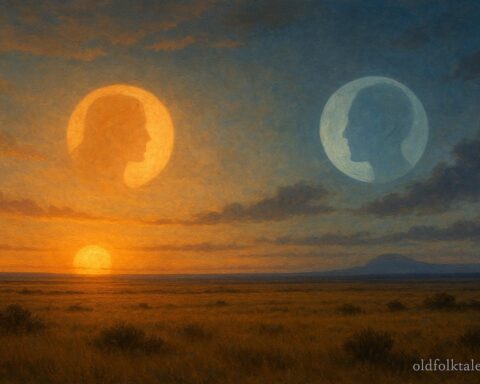
Before the sun ruled the day and the moon guarded the night, there was a time when both walked the earth as human beings. The land was familiar then, shaped by rivers that remembered every footstep and mountains that listened without judgment. People lived close to one another, and the sky was lower, nearer, almost reachable. It was a world where transformation was possible, not as a miracle, but as a consequence.
In one ancient village among the valleys and coastal ranges of what is now called California, two siblings lived whose lives would alter the sky forever. They were not born special, nor were they marked by prophecy. They were known simply for their devotion to their people and for the heavy burden each carried in different ways.
The elder sibling was a woman named Kaatu. She was steady, thoughtful, and known for her willingness to endure hardship without complaint. She gathered food when supplies were low, cared for elders when illness spread, and often went without rest so others could sleep. People trusted her judgment, though few understood how deeply she carried the weight of responsibility.
Discover chilling ghost tales and haunted places that echo through America’s towns and countryside.
Her younger brother was called Hona. He was bright, impulsive, and proud of his strength. He hunted tirelessly and believed that effort alone could solve any problem. Where Kaatu listened, Hona acted. Where she waited, he pushed forward.
For many seasons, balance held. But balance is delicate, and it depends not only on effort, but on restraint.
One year, drought settled over the land. Rivers shrank. Game moved farther away. Hunger crept quietly into the village. Hona believed the answer lay in taking more from neighboring lands. He argued that survival justified any action. Kaatu warned him that taking without permission would disturb agreements older than memory itself.
Hona did not listen.
He led a group beyond the boundaries they had always respected and took what was not offered. When he returned, the village survived, but something unseen shifted. The air grew heavier. The nights stretched longer. Dreams turned restless.
Kaatu sensed it first. She noticed the stars flickering uneasily. She felt the ground resist her steps. She knew that survival purchased through wrongdoing carried a cost that would not wait forever.
As the drought continued, sickness followed. Children weakened. Elders grew quiet. Hona pushed himself harder, believing strength could undo what strength had caused. Kaatu, understanding the nature of consequence, sought another path.
She fasted. She prayed. She listened to the land.
At last, she understood what was required. Balance could be restored, but not without sacrifice.
Kaatu gathered the people and spoke plainly. The land required light and order. Someone must rise beyond the world to guide it again. Someone must carry the burden of constant vigilance so others could live without fear.
Hona realized then the depth of what he had done. He begged to take her place, but Kaatu knew his heart still burned too fiercely. The world did not need more force. It needed steadiness.
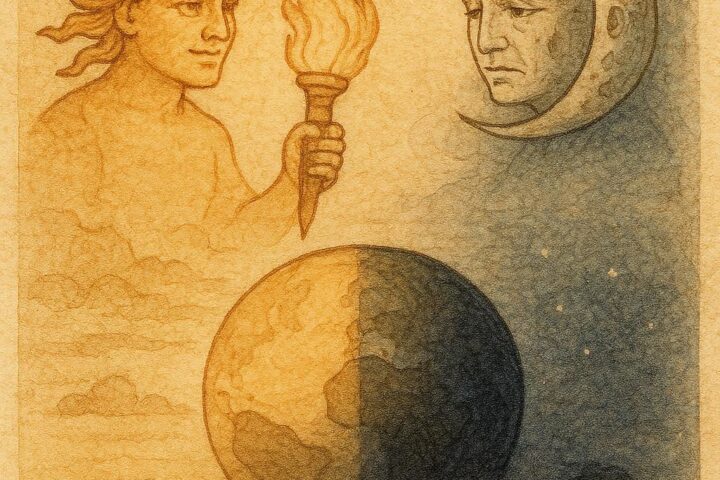
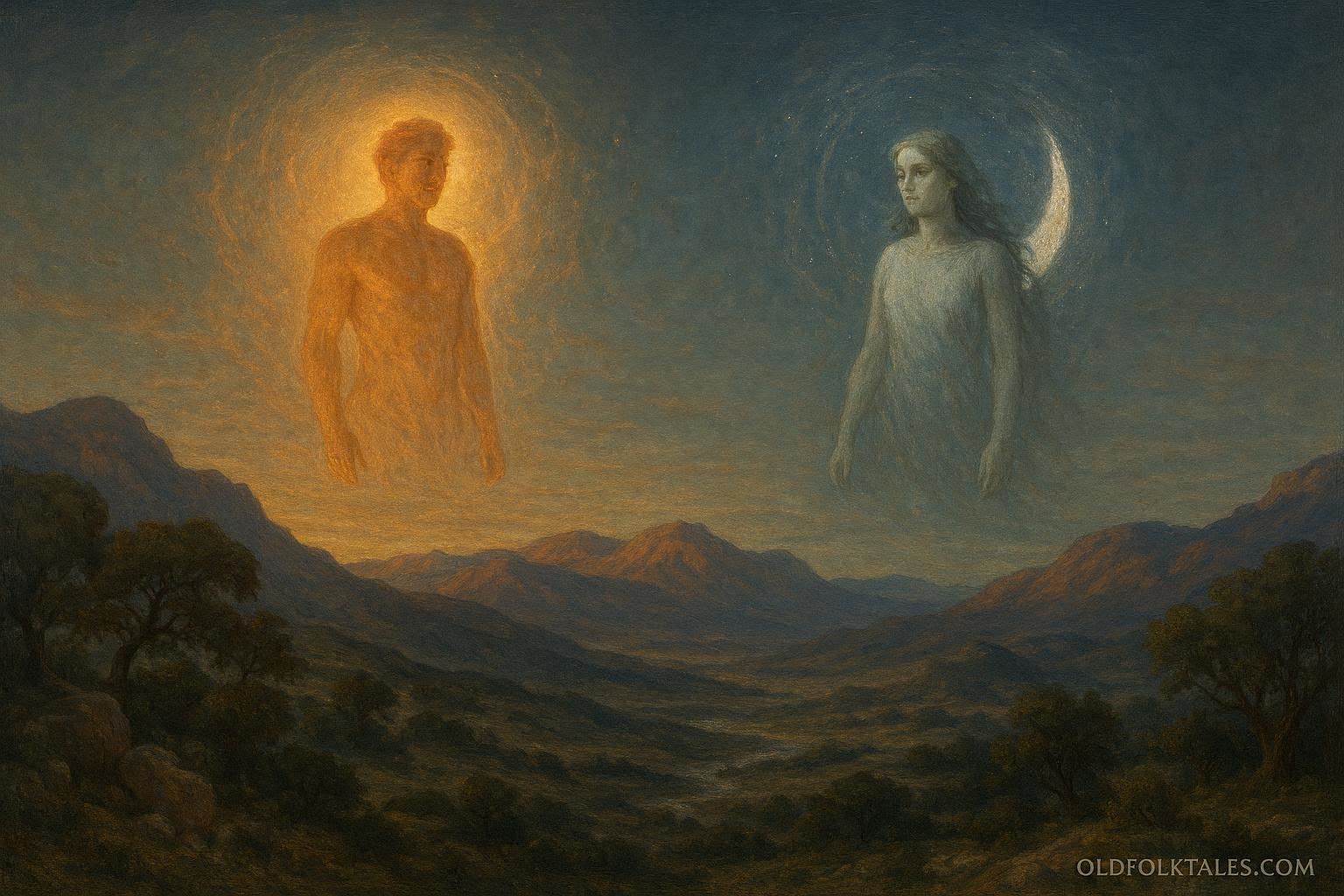
On the morning of the transformation, Kaatu walked to the highest ridge. As the people watched, her body grew radiant, not with fire, but with unwavering presence. She rose slowly, lifted by the agreement between land and sky. When she reached the heavens, she became the sun, destined to give warmth, growth, and clarity, but never rest.
The world brightened again. Crops returned. Rivers swelled. Life resumed.
But transformation is rarely complete with a single act.
Hona lived afterward with unbearable guilt. He watched the sun move endlessly across the sky, never pausing, never turning away. He saw the cost of constancy and understood the weight his sister now bore. He sought forgiveness, but some wrongs cannot be undone. They can only be answered.
When night fell, darkness spread without guidance. People feared it. Shadows lengthened. Dreams became confused. Hona knew then what he must do.
He offered himself not in pride, but in humility.
On a quiet evening, as the sun disappeared beyond the horizon, Hona stepped into the open land and called upon the forces that had lifted his sister. He asked not for power, but for responsibility. He asked to watch when others slept, to reflect light without owning it, to guide without leading.
The transformation came more slowly this time. His body cooled. His brightness softened. He rose into the night sky, becoming the moon, marked forever by the weight of his regret. His face carried the shadows of what he had done, visible reminders that wrongdoing leaves marks even after redemption.
From then on, the siblings ruled the sky together. The sun gave life and direction. The moon offered reflection and caution. One never crossed the path of the other, not out of anger, but out of respect for the balance they maintained.
Elders taught that eclipses occurred when their memories overlapped, when sacrifice and consequence briefly touched again.
Children were told to remember this story when they acted without thought, and when they were asked to give more than they wanted. The sky above them was not distant. It was shaped by human choices, still watching, still responding.
And so the sun and moon remain, not as objects, but as reminders that transformation is born from both wrongdoing and sacrifice, and that the universe remembers who we were before we became what we are.
Moral Lesson
The story teaches that every action carries consequence, and true balance is restored not through force, but through responsibility and sacrifice.
Knowledge Check
- Who were the sun and moon before their transformation?
They were human siblings who lived among their people. - What caused imbalance in the world?
Taking resources without respect for boundaries and agreements. - Why did Kaatu become the sun?
She sacrificed herself to restore order and provide constant guidance. - What did Hona’s transformation represent?
Redemption through humility and acceptance of responsibility. - Why does the moon reflect light instead of producing it?
Because Hona sought to guide without dominating. - What do eclipses symbolize in the story?
Moments when memory, sacrifice, and consequence briefly reconnect.
Source
Adapted from University of California Indigenous oral narrative archives
Cultural Origin
California Indigenous nations