In the quiet hours after midnight, when El Paso’s streets thin and the desert air cools, certain neighborhoods take on a different character. Streetlights hum softly above empty sidewalks, casting long yellow pools of light that stretch toward drainage canals and concrete culverts. It is in these overlooked spaces, far from downtown noise and traffic, that residents speak of a woman who appears only to cry.
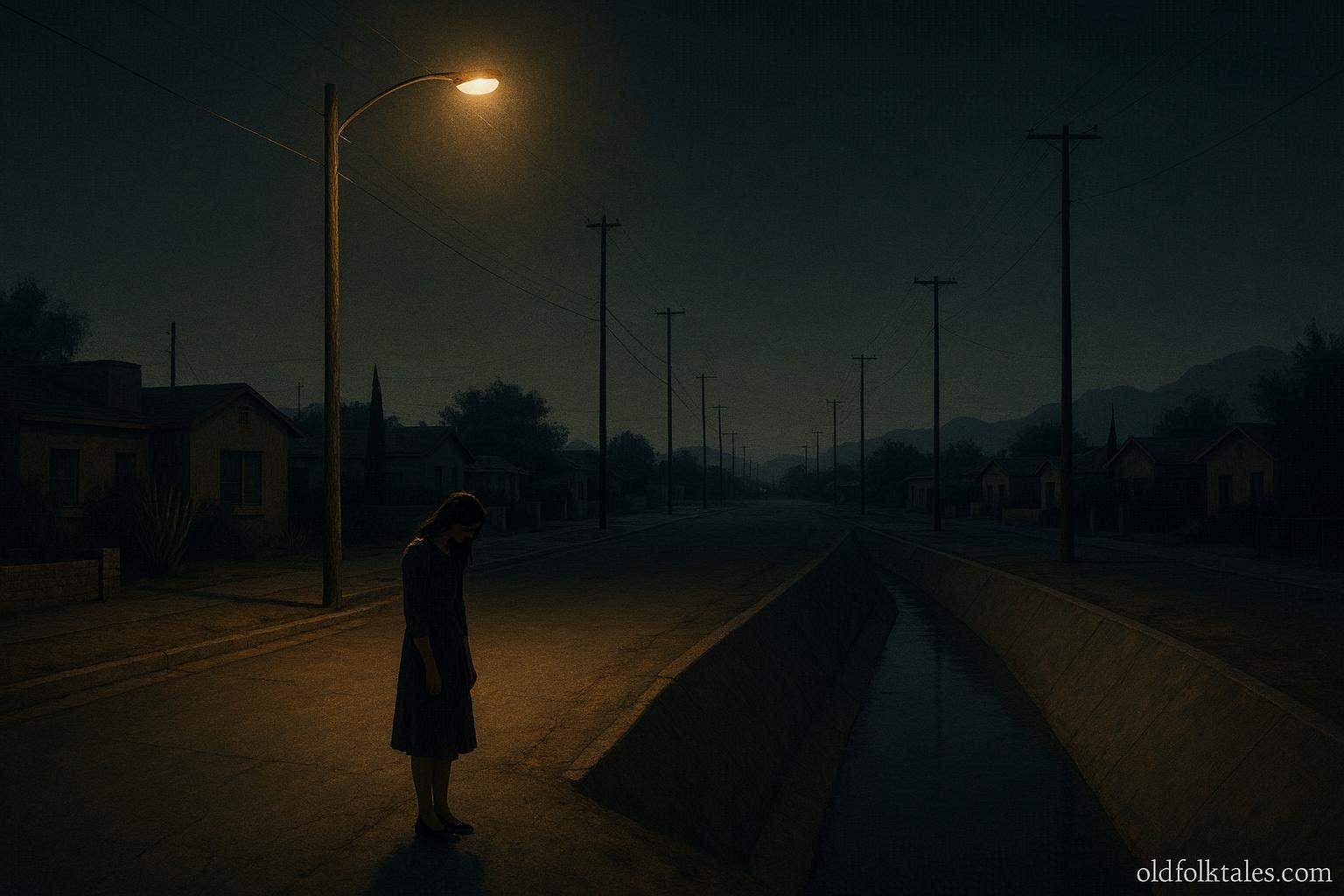
The first reports came from late night drivers returning home from factory shifts or border crossings. They described seeing a lone woman standing beneath a streetlight near canal edges, her head lowered, her shoulders shaking as if overcome by grief. At first glance, she appeared ordinary. She wore simple clothing, her hair hanging loose and dark against her back. Many slowed their cars, believing she needed help.
Those who stopped describe an overwhelming sense of sadness before they even reached her. The air seemed heavier, quieter. When they called out, she did not respond. Some said her crying grew louder, echoing faintly off the concrete canal walls. Others claimed the sound was strangely muted, as if carried from far away rather than coming from her mouth.
Explore the heart of America’s storytelling — from tall tales and tricksters to fireside family legends.
As witnesses stepped closer, the woman would vanish. Not by running or retreating, but by simply no longer being there. The streetlight continued to glow. The canal water flowed as before. No footprints marked the ground. Only the memory of her presence remained, lingering longer than expected.
Over time, the sightings became more specific. The woman appeared near drainage canals built decades earlier to manage seasonal flooding. These channels cut through neighborhoods where old homes sit beside newer developments. The canals themselves occupy land that once served as informal pathways, gathering spaces, and in some cases, burial or memorial sites tied to earlier communities.
Local elders say the woman is not merely a ghost but a warning. They believe she appears near places where danger hides in plain sight. Floodwaters rise quickly in the desert after sudden storms. Children have fallen into canals. Migrants crossing the border have collapsed from exhaustion nearby. Accidents that rarely make headlines leave quiet scars on the land.
Some stories claim the woman was once a mother searching for a child lost during a flash flood. Others say she died waiting for someone who never returned from a journey north. No single origin story dominates, which only deepens the mystery. Her grief feels collective rather than personal, shaped by the border city’s long history of movement, loss, and separation.
Residents living near the canals say dogs sometimes whine or refuse to go outside late at night. Porch lights flicker more often. A sense of being watched settles in when the woman is near, though she never raises her head. She remains fixed beneath the streetlight, as if anchored to its glow.
The weeping woman does not follow people, nor does she speak. Her presence is passive, yet powerful. Those who see her report altered behavior afterward. Drivers slow down near canals. Parents warn children to stay away after dark. Even skeptics admit the stories encourage caution where the city’s infrastructure meets its hidden dangers.
Unlike older rural legends, this tale belongs fully to the modern city. The streetlight replaces the campfire. The canal replaces the riverbank. The woman adapts to urban space, her sorrow woven into concrete and electricity rather than forests or fields. She is shaped by the realities of El Paso itself, a place of crossings and waiting.
Some believe she appears more often during certain times of year, especially after heavy rain or during periods of increased border movement. Her weeping seems to mark moments when loss is close, when the boundary between safety and danger narrows.
Despite repeated sightings, no photograph has captured her clearly. Images show only empty sidewalks and glowing lights. This absence strengthens belief rather than weakening it. People say the woman does not wish to be seen by machines, only by those present and paying attention.
In this way, the Weeping Woman of El Paso Streetlights becomes part of the city’s moral landscape. She stands where help is needed but often absent. She cries where people hurry past. Her silence forces reflection rather than fear, urging awareness in a place where lives often move unseen.
Click to explore all American Ghost Stories — haunting legends of spirits, lost souls, and mysterious places across the U.S.
Moral Lesson
The Weeping Woman reminds us that grief leaves traces in places as much as in people. Paying attention, slowing down, and caring for overlooked spaces can prevent harm and honor those lost to silence.
Knowledge Check
- Where does the Weeping Woman most often appear?
Answer: Beneath streetlights near drainage canals in El Paso. - What sound is associated with her presence?
Answer: Soft, sorrowful crying. - How does she disappear when approached?
Answer: She vanishes suddenly without movement or trace. - What do elders believe her appearance represents?
Answer: A warning connected to danger and past loss. - Why is the legend considered urban rather than rural?
Answer: It is tied to streetlights, canals, and modern city spaces. - How do sightings affect local behavior?
Answer: People become more cautious around canals and at night.
Source
Adapted from University of Texas border folklore collections.
Cultural Origin
El Paso, Texas