In the smoky steel towns of Pennsylvania and the American Midwest, where furnaces roared day and night, stories arose of a worker unlike any other. His name was Joe Magarac, a towering figure said to be stronger than steel itself. Among immigrant communities who labored in mills and foundries, Joe became a symbol of endurance, loyalty, and pride. His legend blended the grit of industrial life with the imaginative spirit of folklore.
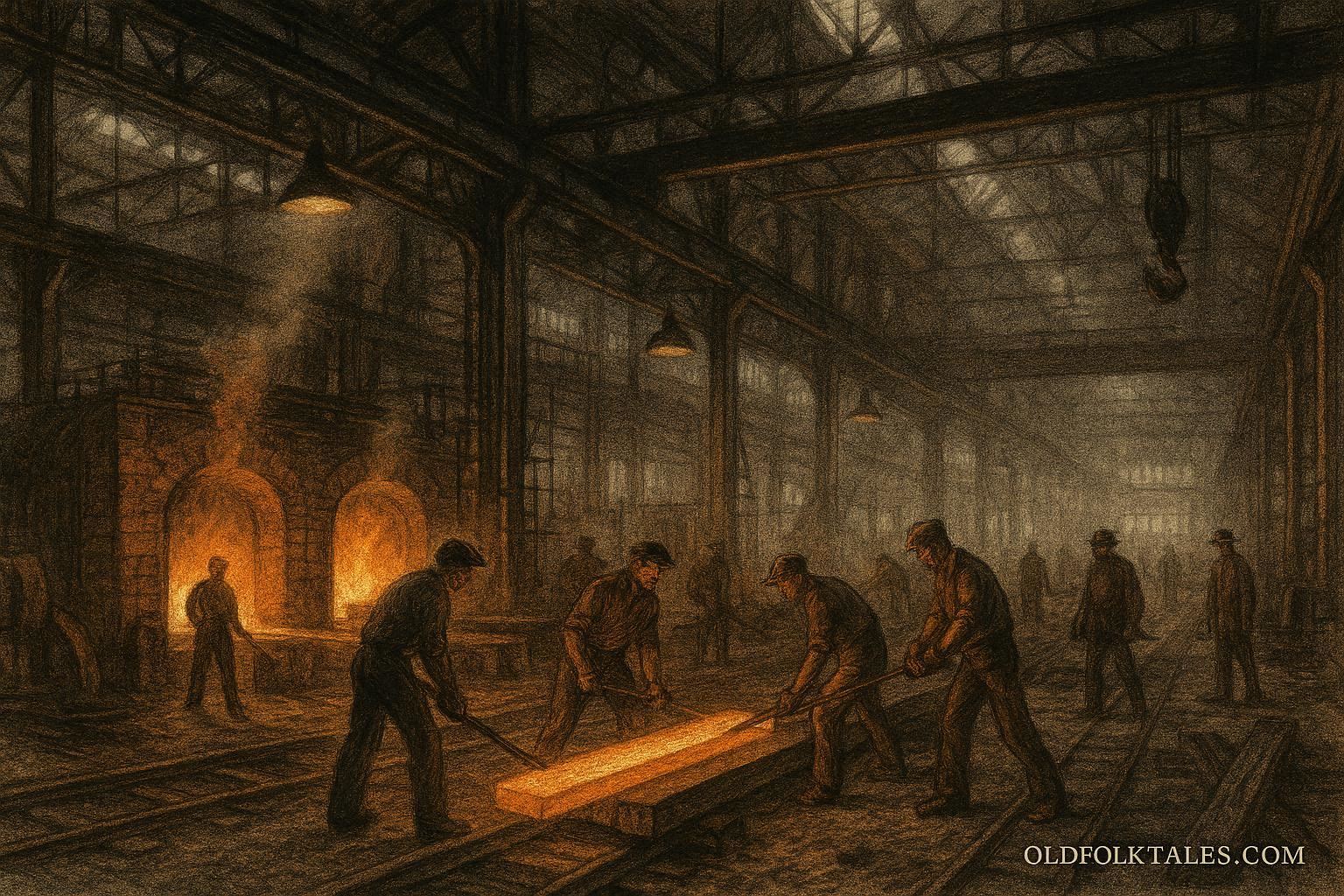
Steel mills in the late nineteenth and early twentieth centuries were places of intense labor. Workers toiled in extreme heat, shaping molten metal into beams and rails that built cities and railroads. The work was dangerous and exhausting, demanding both physical strength and mental focus. In this environment, tales of a superhuman steelworker offered both inspiration and comfort to those facing relentless shifts.
According to legend, Joe Magarac was not born in an ordinary way. Some stories claim he emerged fully grown from a steel furnace, already prepared for labor. Others say he was carved from iron ore by the hands of hardworking immigrants who needed a champion. However told, his origin tied him directly to the mills and to the hopes of those who depended on them.
Encounter the strange and the unseen — from Bigfoot to regional monsters hiding in America’s forests.
Joe’s strength was said to be beyond human limits. He could lift massive steel beams without strain and twist iron bars into knots with his bare hands. When machines broke down, Joe would step in and do their work himself. Workers claimed that he could pour molten steel faster than any mechanical device. These exaggerations reflected admiration for the resilience required in real steel production.
The name “Magarac” is often interpreted as meaning “donkey” in some Slavic languages, symbolizing stubborn strength and tireless labor. Immigrant workers from Eastern Europe brought their languages and traditions with them to Pittsburgh and other steel centers. In their bunkhouses and gathering halls, they shared stories of Joe as a reflection of their own sacrifices and pride.
One popular tale describes a competition between Joe and a powerful steel machine. When a new automated device threatened to replace workers, Joe challenged it to a test of strength and speed. As the furnace roared, Joe worked tirelessly, shaping steel faster than the machine could manage. In some versions, he won decisively. In others, he sacrificed himself to ensure the mill’s success, melting into the steel he forged.
These stories highlight themes of labor heroism and loyalty. Joe Magarac did not seek fame or riches. His purpose was to protect jobs, support fellow workers, and strengthen the mills that sustained entire communities. Through folklore, he embodied the dignity of industrial labor. He stood not as a lone hero, but as a representative of collective effort.
The industrial era brought rapid growth but also harsh conditions. Steel towns were often blanketed in smoke, and workers faced long hours with minimal safety protections. Injuries were common, and economic instability loomed during downturns. Against this backdrop, Joe’s legend served as emotional reinforcement. He symbolized hope that strength and unity could overcome hardship.
Children growing up in steel towns heard stories of Joe Magarac as a local giant. They imagined him striding across bridges built from the steel he shaped. They pictured him laughing in the glow of furnaces, unfazed by heat or exhaustion. Through storytelling, the mills were transformed from sites of danger into arenas of heroic achievement.
Joe’s legend also reflects the broader American tradition of tall tales. Like lumberjacks and railroad builders, industrial workers created a larger-than-life figure to express pride in their contributions. Steel built skyscrapers, ships, and railways. By personifying that power in Joe Magarac, communities gave a human face to industrial might. He became the spirit of steel itself.
In some versions of the tale, Joe ultimately chooses to merge with the steel he loves. Seeing that machines will eventually replace him, he leaps into a furnace and becomes part of a massive beam used to construct a great building. This ending carries deep symbolism. It suggests sacrifice for progress and immortality through creation.
The legend of Joe Magarac persisted long after the peak of the steel industry. Even as mills closed and towns faced economic decline, his story remained a reminder of resilience. Folklore preserved a sense of pride during times of uncertainty. For many families, Joe represented ancestors who labored in firelit mills to build modern America.
Scholars studying Midwestern and Pennsylvania folklore note that Joe Magarac reflects immigrant identity and industrial transformation. His exaggerated feats reveal emotional truths about labor, community, and adaptation. Through myth, workers expressed values of endurance, solidarity, and dedication. Joe’s strength symbolized the collective power of steel-town communities.
Ultimately, Joe Magarac stands as a mythic embodiment of industrial pride. His story celebrates those who shaped raw materials into the framework of cities. Though fictional in scale, his legend honors real sacrifices. In the roar of furnaces and the glow of molten metal, workers found in Joe a hero forged from their own determination.
Explore how American legends shaped the nation — from frontier heroes to Revolutionary War tales.
Moral Lesson
Hard work, unity, and dedication give strength to communities. True heroism lies in perseverance, loyalty, and pride in honest labor.
Knowledge Check
1 Who was Joe Magarac?
A mythical superhuman steelworker
2 Where did his legend originate?
Pennsylvania and Midwestern steel towns
3 What did he symbolize?
Industrial pride, labor strength, and resilience
4 What industry shaped his story?
The American steel industry
5 How did some versions of the legend end?
He sacrificed himself by merging with molten steel
6 Why was his story important to immigrant communities?
It reflected their hard work, unity, and cultural pride
Source
Adapted from steelworker folklore and Midwestern legend studies
Cultural Origin
Pennsylvania and Midwestern industrial folklore