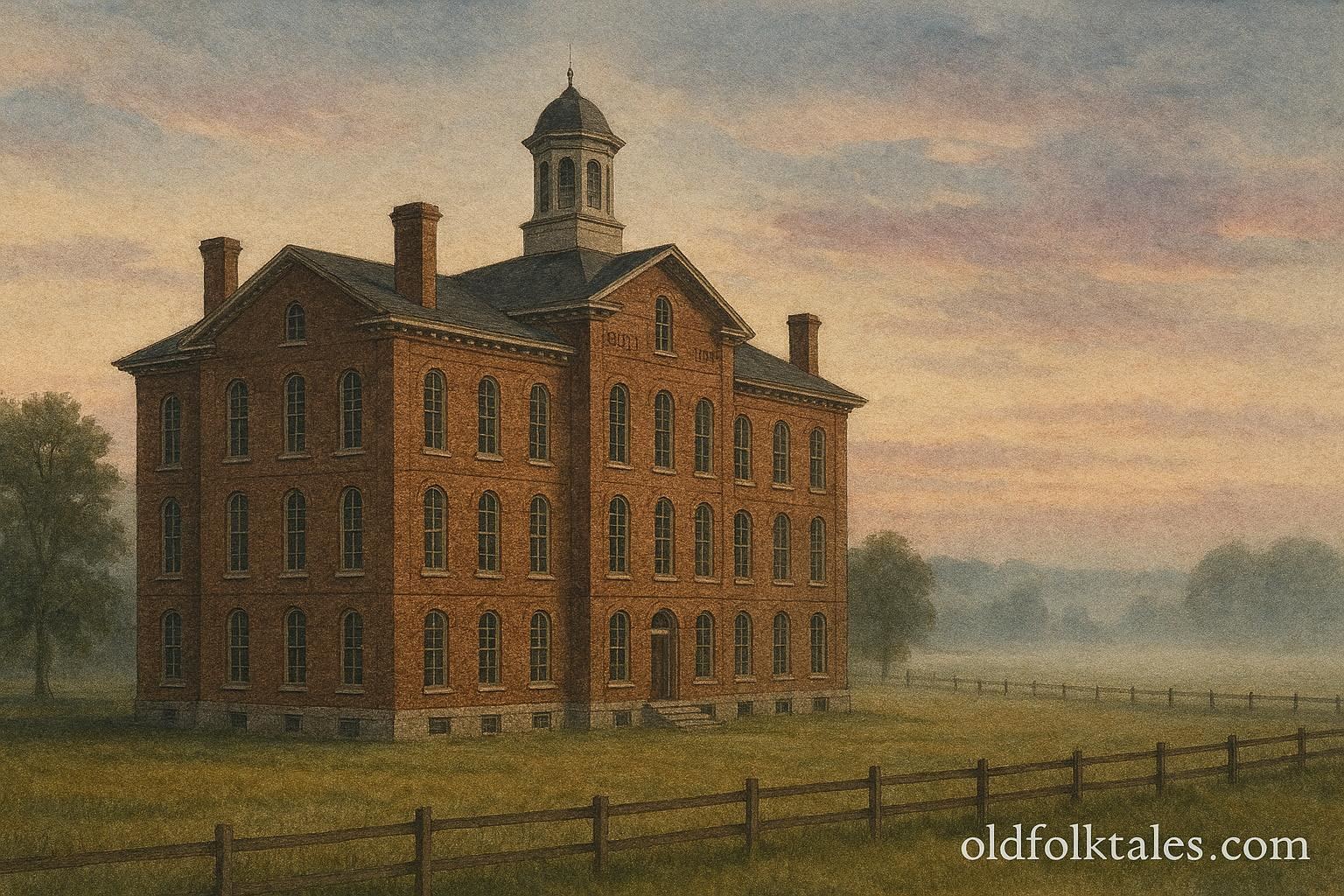
In the rural landscape of western New York, surrounded by open farmland and long quiet roads, stands a large brick building that once served as a county poorhouse. Today it is widely known as Rolling Hills Asylum. Though peaceful fields stretch around it, the structure carries a heavy history shaped by poverty, institutional care, and social reform. Over time, that history transformed into one of the Northeast’s most enduring haunted legends.
The building originally opened in 1827 as the Genesee County Poorhouse. During the nineteenth century, poorhouses were established across New York State to shelter those who could not support themselves. Residents included the elderly, widows, abandoned children, people with disabilities, and individuals struggling with mental illness. These facilities were meant to provide order and structure, but life inside was often strict and emotionally isolating.
Unlike modern social services, poorhouses required residents to work if they were physically able. Men labored in fields and workshops. Women cooked, cleaned, and sewed. Children sometimes assisted with chores instead of receiving formal education. Though the intention was self-sufficiency, the reality could feel more like confinement than charity. Over time, these conditions shaped the building’s atmosphere and its later reputation.
Encounter the strange and the unseen — from Bigfoot to regional monsters hiding in America’s forests.
In the mid-1800s, reforms in mental health care led to the separation of some residents into specialized institutions. Yet many who suffered from mental illness or developmental disabilities remained in poorhouses for decades. Rolling Hills thus became a place where different struggles intersected poverty, aging, illness, and abandonment. The emotional weight of these experiences would later fuel stories of lingering presences.
Architecturally, the building was practical rather than ornate. Long corridors connected dormitory-style rooms. Narrow staircases linked upper floors to basements used for storage and work areas. Windows allowed in light, but winters in upstate New York were harsh. Cold drafts, creaking wood, and echoing footsteps were common features of daily life. These natural sounds would eventually be reinterpreted as supernatural phenomena.
As decades passed, the facility evolved. It served not only as a poorhouse but also as an infirmary and later as a nursing home. Generations of residents lived and died within its walls. County records document ordinary lives marked by hardship rather than dramatic tragedy. Yet in folklore, even ordinary suffering can become magnified through storytelling.
By the mid-twentieth century, changing social policies rendered county poorhouses obsolete. Rolling Hills eventually closed its doors as a medical facility. The building stood largely unused for years, its long hallways silent. Abandoned institutional spaces often invite imagination. Without daily activity to explain sounds and shadows, stories begin to grow.
Local residents began sharing accounts of unexplained experiences. Some described hearing footsteps when no one else was present. Others reported doors closing on their own or faint whispers in empty rooms. Paranormal investigators who later visited the site claimed to capture unexplained audio phenomena. Whether interpreted scientifically or spiritually, such reports strengthened the building’s haunted identity.
One frequently repeated story centers on the children who once lived there. Visitors claim to hear laughter or feel small handprints against theirs in certain hallways. Historically, children were indeed housed at the poorhouse, often because their families could not provide for them. The folklore surrounding them reflects sympathy and sorrow more than fear.
Another legend involves shadowy figures seen at the ends of corridors. In dim lighting, long institutional hallways naturally distort perspective. Light filtering through old windows can create moving shapes. Yet for those aware of the building’s past, these shadows become symbols of former residents still present in memory.
The basement is often described as the most unsettling area. Historically used for storage, food preparation, and mechanical systems, it remains cooler than upper floors. Temperature changes and acoustics can create sensations that feel unusual. Folklore transforms these physical realities into tales of unseen watchers or unexplained movements.
Cultural scholars studying Northeastern institutional folklore note that places like Rolling Hills embody collective memory. Poorhouses were once essential parts of community infrastructure. Yet they also represented society’s struggle to address inequality and mental health. Haunted legends may serve as narrative expressions of unresolved social reflection.
In New York State archives, records show names, ages, and brief descriptions of residents. These documents humanize the building’s history. Rather than focusing solely on fear, many modern tours emphasize historical education. Guides share stories of resilience, reform, and evolving attitudes toward poverty and care. The ghost stories become one layer of a much larger narrative.
The transformation from poorhouse to haunted attraction reflects broader cultural patterns. Americans have long turned historic institutions into sites of storytelling. By blending documented history with legend, communities preserve interest in structures that might otherwise be forgotten. Rolling Hills Asylum stands as both historical landmark and folklore centerpiece.
Importantly, many of the reported experiences can be explained through environmental factors, aging infrastructure, acoustics, temperature shifts, and suggestion. Yet belief itself plays a powerful role. When visitors enter a place expecting mystery, ordinary sensations feel amplified. Storytelling becomes participatory.
Despite its haunted reputation, the building also symbolizes endurance. It witnessed nearly two centuries of social change from early poorhouse systems to modern welfare programs. Within its walls unfolded thousands of ordinary human lives, marked by struggle but also by survival. The legends that surround it reflect not just fear, but remembrance.
Today, Rolling Hills Asylum remains a site of fascination. Some come seeking paranormal thrills. Others come to study local history. Whether one believes in spirits or not, the building undeniably carries emotional resonance. Its long corridors remind visitors that institutions shape lives and that memory can linger long after doors close.
In the end, the haunted legend of Rolling Hills is less about ghosts and more about echoes of humanity. Poverty, institutional life, and reform left deep marks on the community. Through storytelling, those marks are preserved. The asylum’s reputation continues to grow, blending fact and folklore into a narrative that refuses to fade.
Encounter the strange and the unseen — from Bigfoot to regional monsters hiding in America’s forests.
Moral Lesson
Places shaped by hardship deserve understanding and compassion. Remembering history honestly helps communities learn from the past rather than fear it.
Knowledge Check
- What was Rolling Hills originally called?
The Genesee County Poorhouse - Who lived there in the 19th century?
The poor, elderly, orphaned children, and people with disabilities - Why did poorhouses require residents to work?
To promote self-sufficiency and reduce public expense - What themes define its legend?
Poverty, institutional life, memory - Why do haunted stories often form around such buildings?
They reflect collective memory and emotional history - What replaced poorhouses in modern society?
Structured social welfare and healthcare systems
Source
Adapted from New York State Archives; SUNY Geneseo Special Collections
Cultural Origin
Northeastern institutional folklore