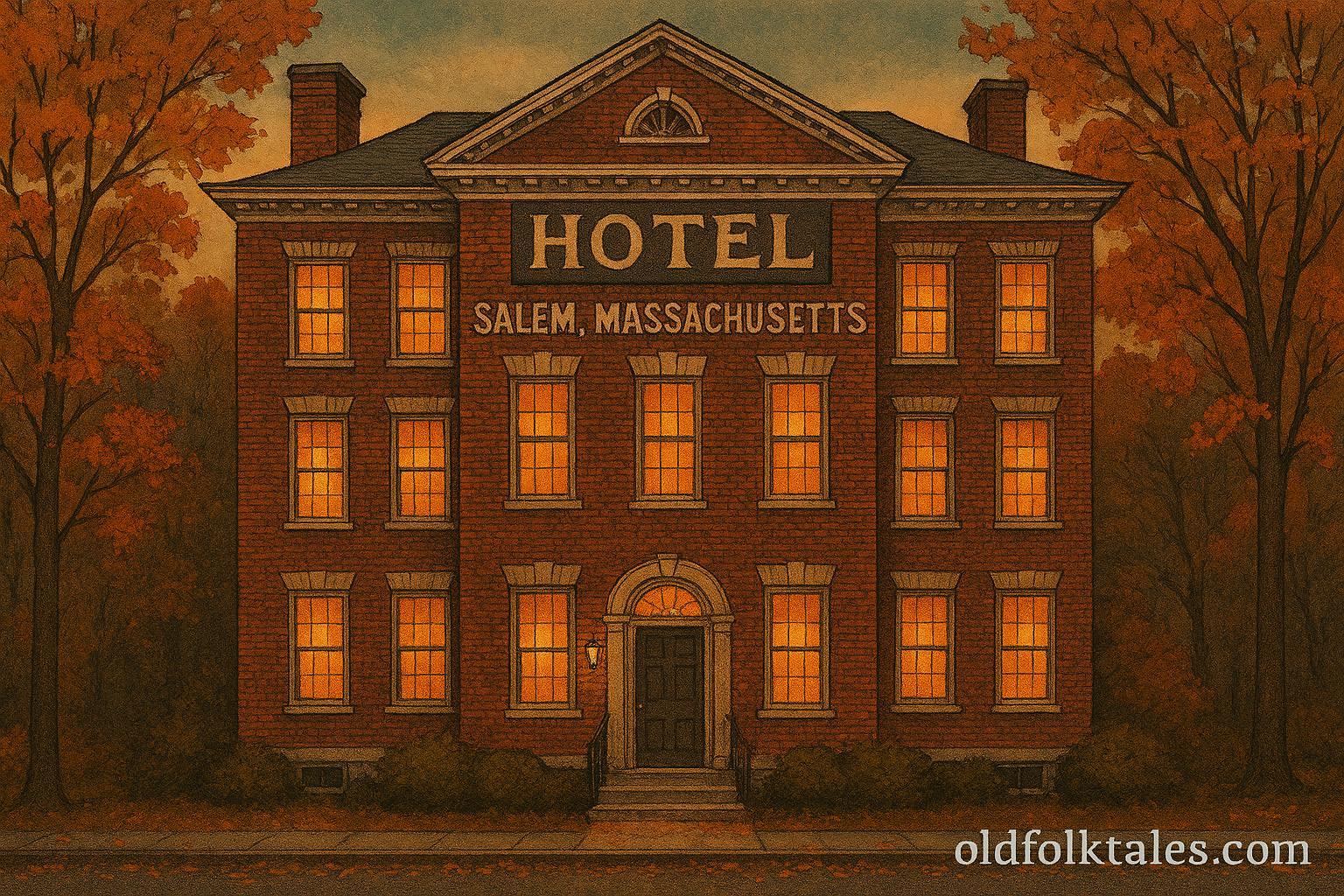
There are places where history feels distant, confined to textbooks and museum displays. Then there are places where the past seems to linger in the air itself. In Salem, Massachusetts, history is never far away. The streets carry centuries of memory, and among the brick buildings that frame the town square stands the Hawthorne Hotel, a place where hospitality and legend quietly coexist.
When the hotel opened in 1925, it was envisioned as a symbol of civic pride. Salem leaders wanted a grand establishment that would reflect the city’s historical importance and attract visitors. Built in Colonial Revival style, the structure deliberately echoed early American architecture. Its red-brick exterior, tall windows, and stately presence were designed to harmonize with Salem’s preserved colonial surroundings.
The hotel’s name pays tribute to Nathaniel Hawthorne, the famed author whose works explored themes of guilt, morality, and Puritan heritage. His ancestral connection to the Salem witch trials gave the hotel an immediate symbolic link to one of America’s most haunting historical episodes. Though the building itself dates to the twentieth century, its cultural foundation reaches back much further.
Encounter the strange and the unseen — from Bigfoot to regional monsters hiding in America’s forests.
Guests arriving at the Hawthorne Hotel often expect charm, comfort, and a touch of historic atmosphere. What some do not expect are the recurring reports of unexplained occurrences. Over the decades, visitors have described hearing soft knocks on doors when no one is there. Others claim to feel sudden cold spots in otherwise warm rooms. These subtle experiences form the backbone of the hotel’s ghostly reputation.
Among the most discussed areas is Room 612. Numerous guests have reported strange plumbing activity, such as faucets turning on by themselves. Some describe seeing fleeting shadows near the bed or sensing an unseen presence standing in the corner. Staff members, while generally offering practical explanations, acknowledge that Room 612 receives more unusual reports than most others.
Unlike crumbling mansions or abandoned hospitals, the Hawthorne Hotel is active and vibrant. Weddings are celebrated in its ballroom. Conferences fill its meeting spaces. Families gather in its dining rooms. This everyday liveliness contrasts sharply with stories of phantom footsteps echoing down quiet corridors after midnight. The coexistence of routine life and mysterious accounts adds depth to the legend.
Salem’s identity plays a crucial role in shaping perception. The city is internationally recognized for the 1692 witch trials, an event that left a profound cultural imprint. Visitors arrive already aware of Salem’s supernatural associations. In such an environment, unexplained sounds may be interpreted through the lens of colonial memory and superstition. Context shapes belief.
Local folklore suggests that the hotel’s energy is tied not to a single spirit, but to the collective memory of Salem itself. Some storytellers speculate that residual emotions from the witch trial era linger in the town, influencing modern spaces. While historians stress that the hotel was built centuries later, the symbolic connection remains powerful in public imagination.
Guests have also reported hearing children’s laughter in empty hallways or seeing figures reflected in mirrors behind them. In most cases, no concrete explanation is found, yet no definitive proof of haunting is established either. These ambiguous experiences sustain curiosity. The absence of certainty keeps the legend alive.
Scholars who study New England folklore note that haunted hotel stories often emerge in towns with deep colonial roots. Such buildings act as stages upon which history and imagination meet. The Hawthorne Hotel, positioned at the center of Salem’s historic district, naturally becomes part of that narrative tradition.
Architectural elements contribute to the atmosphere. Hardwood floors expand and contract with temperature changes. Older plumbing systems produce unexpected sounds. Shadows stretch across long hallways illuminated by antique-style lighting. These environmental factors can easily be interpreted as paranormal, especially by visitors already immersed in Salem’s storytelling culture.
During October, when Salem hosts its annual Haunted Happenings festival, the hotel becomes especially active. Paranormal enthusiasts book rooms hoping for an experience. Stories circulate rapidly, shared in lobbies and online forums. Each new account adds another layer to the legend, reinforcing the building’s reputation.
Yet beyond the ghost stories lies a broader reflection. The Hawthorne Hotel represents how communities preserve and reinterpret history. By embracing both documented facts and folklore, Salem maintains a dynamic relationship with its past. The hotel stands not only as accommodation, but as a cultural symbol.
Whether one attributes the unexplained occurrences to restless spirits, environmental quirks, or the power of suggestion, the experiences feel real to those who report them. The emotional atmosphere of a place especially one steeped in centuries of narrative can be deeply influential. Visitors leave with stories of their own, becoming part of the ongoing tradition.
In the end, the Hawthorne Hotel’s legend is less about fear and more about continuity. It embodies the idea that history is not static. It lives in architecture, storytelling, and collective memory. The whispers in the hallway may be nothing more than shifting air but in Salem, even the air carries echoes of the past.
Discover chilling ghost tales and haunted places that echo through America’s towns and countryside.
Moral Lesson
History shapes perception. Understanding the past with balance and awareness helps us distinguish between fact, folklore, and imagination.
Knowledge Check
- When did the Hawthorne Hotel open?
1925 - What architectural style was it built in?
Colonial Revival - Which famous author inspired the hotel’s name?
Nathaniel Hawthorne - Which room is most frequently mentioned in ghost stories?
Room 612 - What historical event influences Salem’s haunted reputation?
The Salem witch trials of 1692 - Why do scholars say haunted hotel stories persist?
They reflect cultural memory and community storytelling traditions
Source
Adapted from Salem State University archives; Massachusetts Historical Society digital collections
Cultural Origin
New England colonial folklore