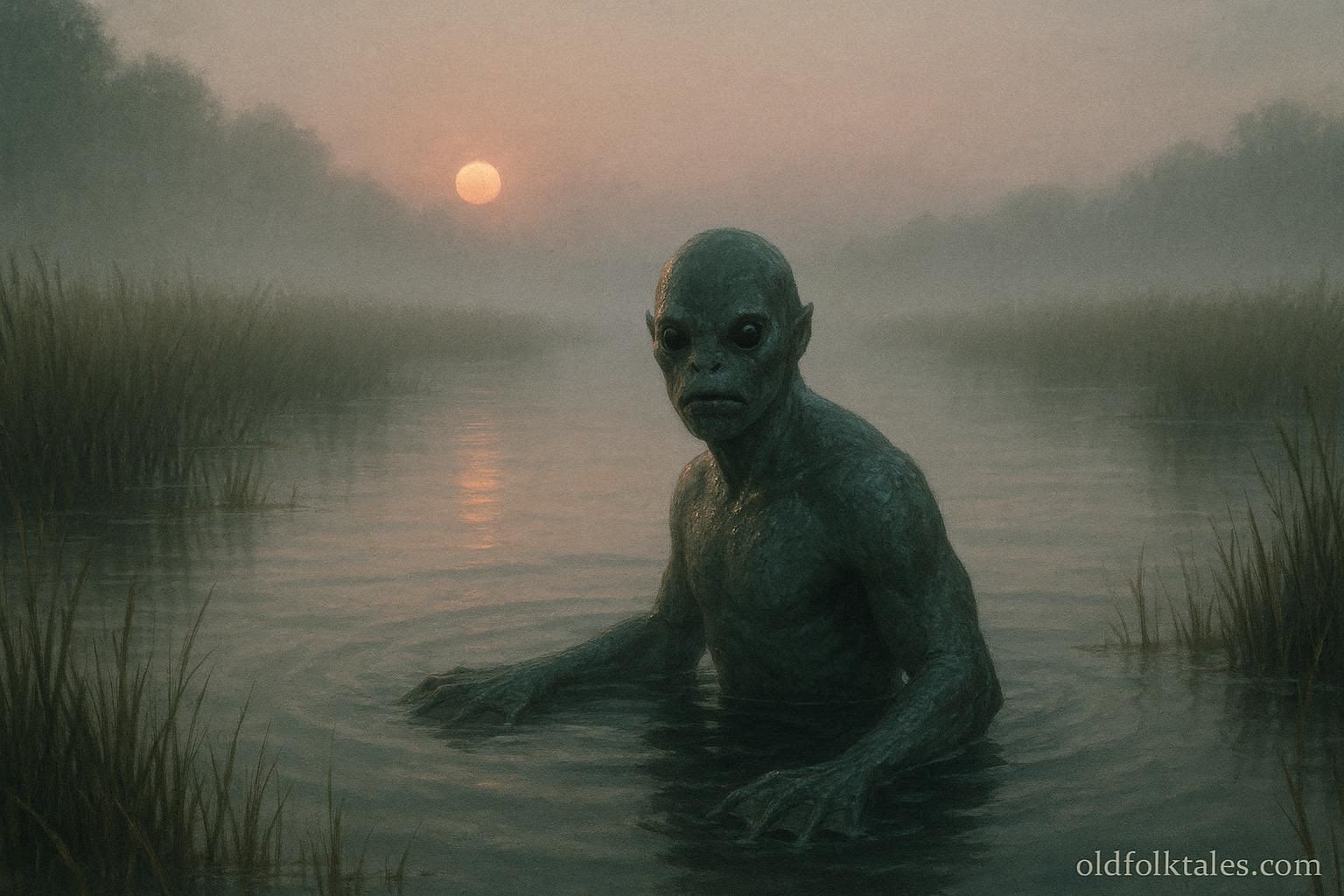
Reports of the Waterman have persisted through the decades, capturing the attention of fishermen, locals, and folklore enthusiasts alike. Many early accounts describe sudden ripples in calm waters, disturbances in nets, or fleeting glimpses of a humanoid form gliding just beneath the surface. Witnesses often recall a sense of intelligence and awareness in the creature, as if it observes human activity and intentionally evades capture or direct interaction.
The creature is said to stand between six and seven feet tall. Its limbs are long and webbed, aiding in its movement through the shallow marshes and inlets. Some descriptions include a torso resembling that of a human, but covered in slick, glistening skin. Observers have noted sunken eyes that reflect the early morning light in an unsettling way. Occasionally, the Waterman is said to rise partially above the water, giving a glimpse of its head or shoulders before disappearing beneath the waves.
Sightings are most common during dawn and dusk, when the mist over the bay is thickest. Fishermen recount sudden splashes or ripples that cannot be attributed to wind, fish, or passing boats. Some claim the creature seems to patrol certain channels, appearing in the same areas repeatedly over years. Its elusive nature has added to the aura of mystery surrounding it and has kept the legend alive.
Step into shadowy legends of restless spirits and ghostly travelers in American Ghost Stories.
In the 20th century, reports of the Waterman increased, particularly along isolated stretches of the Chesapeake Bay. Families, children, and groups of fishermen claimed to see a figure moving swiftly through the water, sometimes appearing near docks or wading in shallow areas. Local newspapers documented these sightings, and sketches were circulated, attempting to capture the creature’s humanoid form and aquatic features. Although photographs were grainy and inconclusive, they fueled public interest and cemented the Waterman as a regional legend.
Local traditions often describe the Waterman as both a warning and a protector. Some fishermen believe that the creature guards the bay, warning against reckless behavior or disrespect toward the water and its resources. Children were taught to exercise caution when navigating marshes or inlets, often using stories of the Waterman to reinforce lessons about safety. The legend has thus served both as a folkloric narrative and as a practical cautionary tool for communities that depend on the bay for their livelihoods.
Historical archives support the continuity of Waterman sightings. Maryland State Archives and the Library of Congress preserve letters, oral histories, and newspaper clippings documenting encounters. Researchers studying Mid-Atlantic folklore note that humanoid aquatic creatures appear in multiple traditions, often emerging in regions with rivers, lakes, and marshes that inspire both fear and fascination. The Waterman fits this pattern, representing the unknown potential lurking beneath familiar waters.
Skeptics have attempted to explain sightings through natural phenomena. Large sturgeon, otters, or even unusual tidal currents may account for some of the observations. Fog, low light, and reflective water surfaces can create optical illusions that make ordinary objects appear extraordinary. Despite these explanations, the consistency of reports across decades and multiple independent observers suggests that the Waterman legend fulfills a larger cultural and psychological role. It reflects the human desire to explain the unknown and to give personality to the mysteries of nature.
The legend continues to influence modern culture. Art, literature, and festivals celebrate the Waterman, with local artists depicting it in paintings, sculptures, and murals. Cryptid enthusiasts and tourists visit the Chesapeake Bay seeking evidence or attempting to witness the creature firsthand. Trail cameras, night watches, and sonar equipment have occasionally captured unusual shapes, though none provide definitive proof. Yet these efforts keep the legend alive, blending folklore, tourism, and local heritage into a dynamic cultural narrative.
The Waterman also demonstrates the connection between environment and imagination. The Chesapeake Bay’s tidal waters, dense marshes, and shifting channels create conditions in which sightings are difficult to verify. The natural environment encourages speculation, fostering stories that blend reality and imagination. The creature’s humanoid yet aquatic features may reflect a psychological need to interpret ambiguous shapes and movements in the water, providing a story that explains the inexplicable while connecting communities to their natural surroundings.
Overall, the Waterman of Chesapeake Bay remains a symbol of the unknown, a mysterious figure that bridges human experience and natural phenomena. Whether an undiscovered species, a misidentified animal, or purely a product of folklore, the legend continues to intrigue and terrify. Its story emphasizes respect for nature, the power of oral tradition, and the enduring fascination humans have with creatures that straddle the line between reality and myth.
Explore Native American beings, swamp creatures, and modern cryptid sightingsacross the country.
Moral Lesson
Respect natural environments, heed local knowledge and traditions, and balance curiosity with caution when exploring unknown or potentially dangerous places.
Knowledge Check
- Where is the Waterman said to inhabit?
Chesapeake Bay marshes and inlets - What does the Waterman reportedly look like?
A humanoid figure with webbed hands and feet, slick skin, and sunken eyes - When is the Waterman most often seen?
During dawn and dusk - What does the creature’s behavior suggest about its intelligence?
It appears aware of observers and deliberately avoids direct confrontation - How is the Waterman used in local folklore?
As a cautionary figure to promote respect for the Bay and safe practices - Which sources preserve Waterman stories?
Maryland State Archives, Library of Congress oral histories, and local newspapers
Source:
Adapted from Maryland State Archives and Library of Congress maritime folklore
Cultural Origin:
Chesapeake Bay folklore