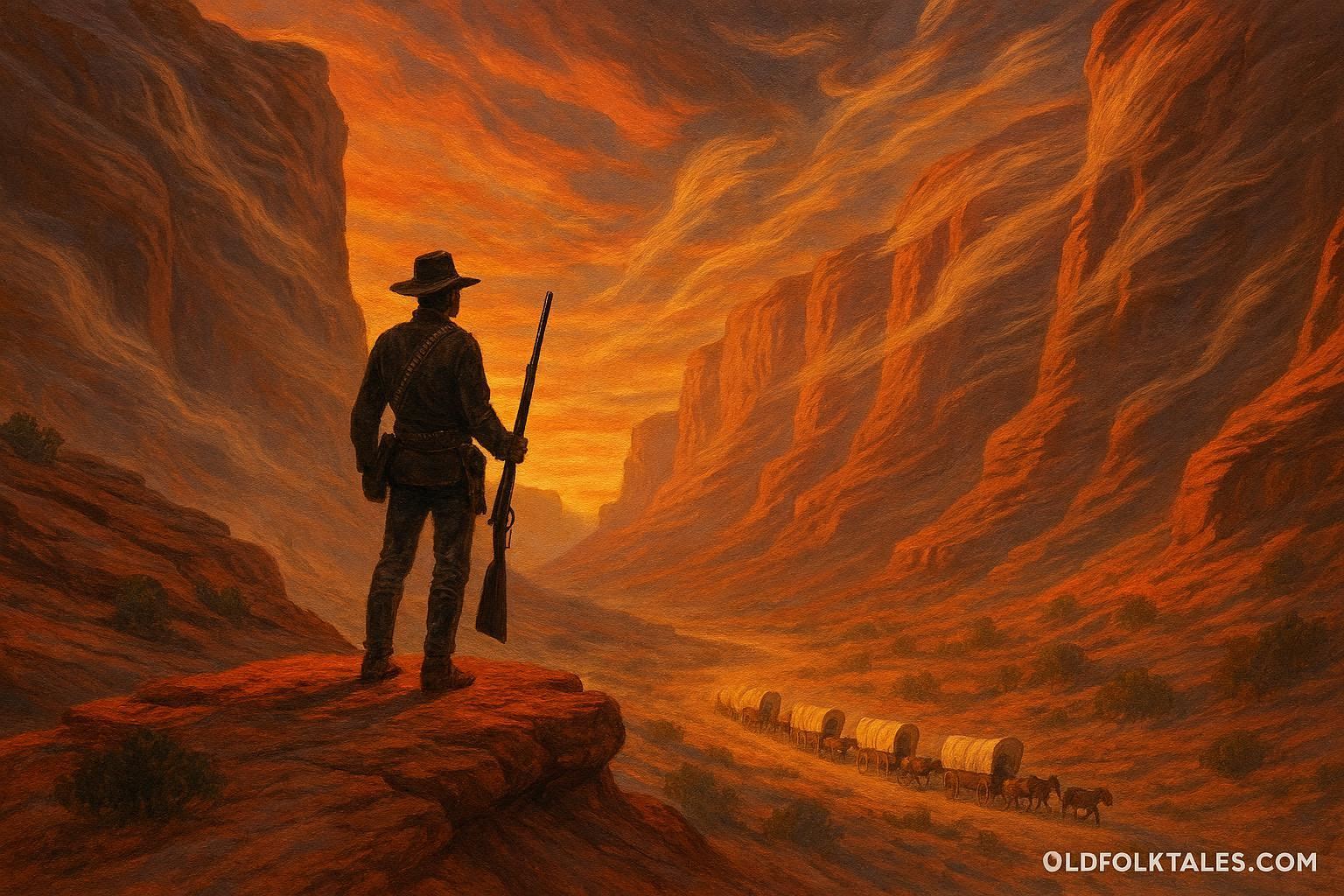
Echo Canyon stretched like a stone corridor through the red heart of the Southwest, its towering sandstone walls rising high above the desert floor. Wind did not merely pass through the canyon; it twisted, circled, and returned upon itself, carrying with it sounds that most travelers ignored. To the untrained ear, the canyon was only an echo chamber of shifting air and distant rockfall. But to one man, it was a living voice. The settlers who crossed those narrow trails spoke in hushed tones of a rifleman who could hear whispers in the wind long before danger revealed itself. They called him the Echo Canyon Marksman.
No one could say exactly where he came from. Some believed he had once been a scout for the army, hardened by desert campaigns and sharpened by years of listening for distant movement. Others claimed he had grown up among the canyon walls, learning their language as a child learns speech. What mattered was not his past but his presence. When wagon trains prepared to cross the most treacherous stretch of Echo Canyon, they felt safer knowing he was somewhere above, watching and listening.
One late summer afternoon, a wagon train heavy with supplies entered the narrowest pass of the canyon. The sun pressed down relentlessly, and the oxen strained against the weight of loaded wagons. Dust clung to every surface, and the only sound was the grinding of wooden wheels against stone. The Marksman rode quietly along the ridge above, his eyes scanning the rock face while his head tilted slightly, as though catching fragments of a distant conversation.
Discover chilling ghost tales and haunted places that echo through America’s towns and countryside.
Suddenly, he raised his hand and called down for the wagons to halt. The wagon master hesitated, glancing at the clear path ahead. There was no visible threat, no riders, no animals, no shifting rock. Yet something in the Marksman’s voice carried an authority that could not be ignored. The train stopped. The canyon grew still.
The Marksman dismounted and pressed his palm lightly against the canyon wall. He listened, not with his ears alone but with his entire posture. Beneath the steady hum of wind, he detected a faint grinding vibration, subtle yet unmistakable. High above, a shelf of shale had begun to loosen. It would not fall immediately, but it would fall soon directly onto the path below. Without hesitation, he lifted his rifle and fired a single precise shot into a weak section of the rock face. The echo cracked sharply through the canyon, and seconds later the shelf gave way, crashing down in a violent cascade of stone. Dust engulfed the trail where the wagons had stood only moments before.
The settlers stared upward in stunned silence. When the air cleared, the danger was undeniable. Had they continued forward, the falling rock would have crushed the lead wagons. The wagon master approached the Marksman and asked how he had known. The rifleman simply replied that the canyon always speaks before it acts. Most men, he explained, are too busy talking or worrying to listen.
From that day forward, stories of his uncanny hearing spread across the Southwest. Travelers claimed he could detect the difference between the wind brushing sagebrush and the wind brushing fabric. He could distinguish between the echo of a wandering coyote and the careful footfall of a hidden rider. Some believed he could even hear a change in echo patterns when strangers moved between canyon walls. Whether exaggerated or not, each tale reinforced the idea that he possessed senses sharpened beyond ordinary limits.
One autumn evening, as a group of traders camped near a bend in the canyon, the Marksman sat apart from the firelight. The traders laughed and shared stories, but he remained attentive to the night air. Gradually, he noticed a small irregularity in the rhythm of the wind, a pause that did not belong. It was followed by the faint crunch of gravel, too deliberate to be natural. Without raising alarm, he stood and quietly instructed the traders to extinguish the fire.
Confusion flickered across their faces, but they obeyed. As darkness settled, the Marksman positioned himself along a low rock ledge overlooking the trail. Minutes later, three shadowed figures emerged, believing the camp asleep and vulnerable. Before they could advance, the Marksman’s steady voice broke the silence, warning them that they had come far enough. The calm certainty in his tone and the unmistakable readiness of his rifle convinced the intruders to retreat without conflict. By dawn, the traders understood that his gift was not magic but mastery unwavering awareness of the environment.
Yet his greatest test came during a winter dust storm that swept through Echo Canyon with ferocious speed. Visibility vanished as sand and wind collided in blinding fury. Wagons veered off course, and shouts were swallowed by the storm. Even the Marksman struggled to separate meaningful sound from chaos. Then, beneath the roar of wind, he detected a hollow tremor, a deep vibration signaling that saturated rock above was about to collapse under pressure.
Knowing that words would not carry through the storm, he fired three controlled shots toward the eastern canyon wall. The echoes returned sharply from that side, creating a directional cue. He shouted for the settlers to move toward the returning sound. Guided by instinct and trust, they followed the echoing rifle reports through the storm. Moments later, a massive section of the western wall collapsed where they had been trapped.
When the storm finally settled, the survivors stood shaken but alive. They looked to the ridge where the Marksman stood silhouetted against clearing skies. To them, he was more than a rifleman; he was a guardian shaped by the land itself. He had not defeated danger with force alone but by listening longer, thinking faster, and acting with calm precision.
As years passed and safer roads replaced hazardous canyon trails, sightings of the Marksman became less frequent. Some believed he had journeyed deeper into the desert. Others whispered that the Echo Canyon Marksman was never one man but a tradition embodiment of heightened awareness passed from guardian to guardian. Yet even today, hikers speak of hearing a distant rifle crack moments before small rockslides occur, or of a warning echo carried strangely clearly through the wind.
Whether man or myth, the Echo Canyon Marksman endures in Southwestern folklore as a symbol of vigilance. In a land where danger often approaches silently, his legend reminds travelers that survival depends not only on strength or speed but on the discipline to listen carefully and respond wisely.
Moral Lesson
Awareness and calm thinking are powerful forms of courage. Those who listen carefully and act wisely can protect entire communities from unseen danger.
Knowledge Check
- What special ability made the Echo Canyon Marksman legendary?
He could hear distant and subtle warnings carried by the canyon wind - How did he prevent the wagon train disaster?
By detecting unstable rock and triggering a safe collapse before the wagons passed - What did he teach travelers about survival?
To observe, listen carefully, and understand their environment - How did he guide settlers during the dust storm?
By firing shots that echoed from the safe canyon wall to give direction - What quality is emphasized most in his legend?
Vigilance and environmental awareness - Why is he considered a Southwestern frontier hero myth?
Because he symbolizes guardianship, heightened senses, and calm leadership in dangerous terrain
Source
Adapted from Western storytelling archives
Cultural Origin
Southwest frontier folklore