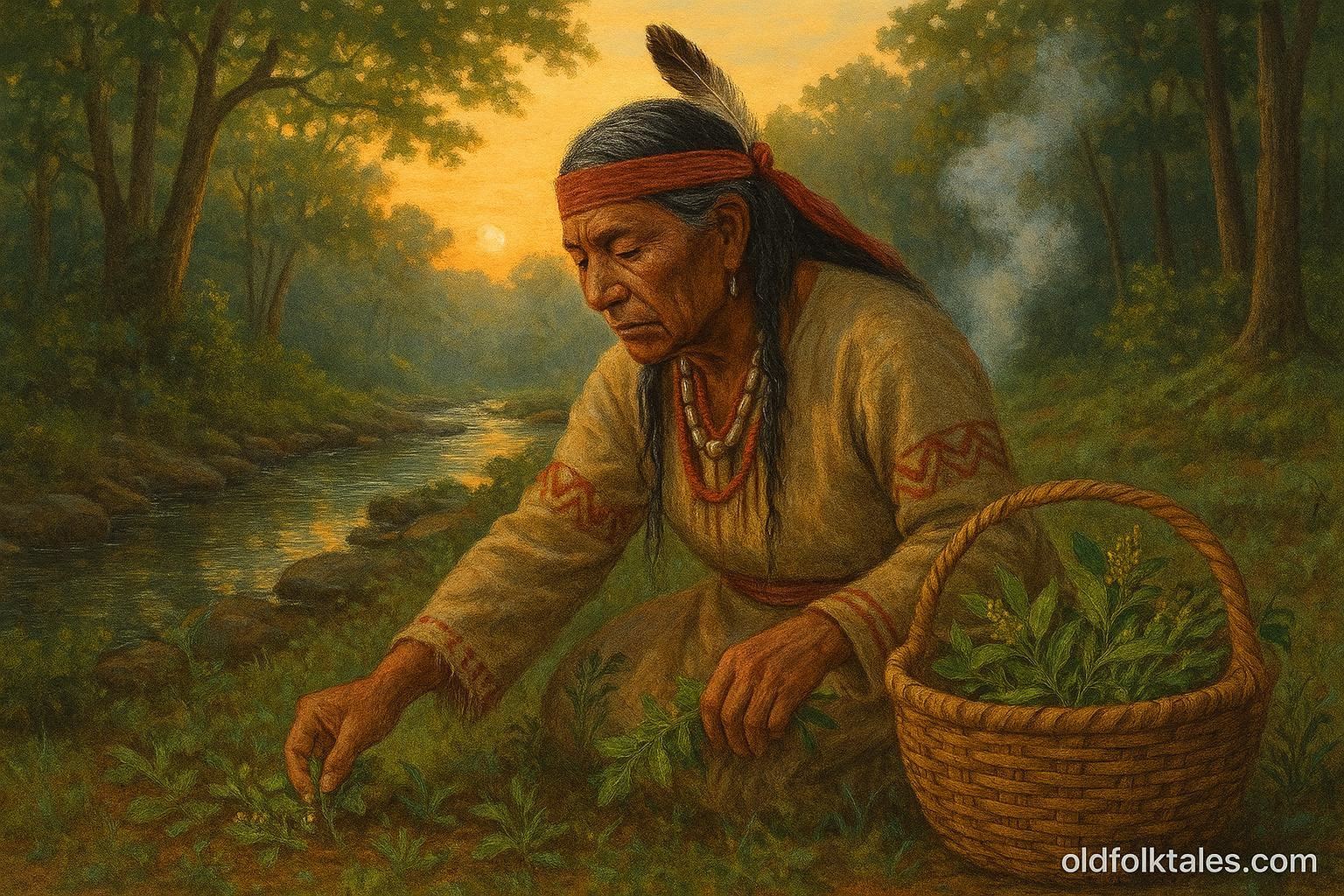
Before the sun touched the ridgelines of the Smoky Mountains, the forest was already awake. Mist drifted like breath between tall hickory and oak trees. Dew clung to fern leaves, and the slow murmur of a nearby stream carried through the valley. In this quiet hour, when night still lingered but morning had begun to stir, a Cherokee medicine person named Galilahi stepped from his home and walked toward the woods.
He carried no metal tools, only a woven river cane basket and a small deerskin pouch. His pace was steady and reverent. Each footstep pressed gently into the earth. For Galilahi, the forest was not wilderness. It was kin. The trees were elders. The plants were teachers. The wind was a messenger.
Among the Cherokee people, sacred plant medicine traditions arise from a worldview rooted in balance. Health is not defined only by the absence of illness. It is the alignment of body, mind, spirit, and community within the natural order. When that balance is disturbed, sickness can appear in many forms, physical weakness, troubled dreams, emotional heaviness, or spiritual disconnection.
Encounter the strange and the unseen — from Bigfoot to regional monsters hiding in America’s forests.
Galilahi paused beside a patch of wild mint growing near the stream’s edge. He knelt and placed his hand gently on the soil. Before harvesting, he offered words of gratitude in the Cherokee language. He explained aloud why he had come. The act of speaking honored the plant’s spirit and acknowledged its sacrifice.
He gathered only a few leaves.
Further uphill, he located yarrow, its delicate white blossoms open to the dawn. He remembered his grandmother guiding him to this same clearing when he was a child. She had taught him how to observe the color of stems, the shape of leaves, the season of growth. She taught him that knowledge without respect becomes misuse.
He added a small piece of black cohosh root to his basket, carefully covering the disturbed soil afterward. Sustainable gathering was not simply practical. It was spiritual responsibility. To take too much would create imbalance.
The medicine he prepared today was for a young man named Atohi.
Atohi had returned from months working far from his community. Since his return, he felt restless and exhausted. His appetite faded. He avoided conversation. His mother worried that something within him had shifted. She believed his spirit was unsettled.
When Atohi arrived at Galilahi’s cabin, he carried himself heavily. His eyes avoided direct contact. The medicine person did not begin immediately. Instead, he invited Atohi to sit near the hearth. Silence filled the space. Healing begins with listening.
Galilahi asked gentle questions. What had he experienced while away? Had he felt fear? Loneliness? Anger? Atohi spoke slowly at first, then more openly. He described long days, isolation, and the feeling of being disconnected from land and family.
The medicine person nodded. He explained that sometimes the spirit becomes misaligned when separated from its roots. The body follows that disturbance.
Galilahi crushed mint leaves and yarrow together using a smooth river stone. The scent rose bright and sharp into the air. He poured warm water over the herbs, allowing them to steep while speaking words of intention. The steam curled upward like a quiet prayer.
Atohi drank slowly. The warmth moved through him. The bitterness of yarrow lingered on his tongue, grounding and real.
As evening approached, Galilahi prepared for purification. Outside, beneath a sky fading into amber and violet, he arranged heated stones in a small circle. Sacred herbs were placed atop them. Smoke rose in soft spirals.
He motioned for Atohi to stand.
Using an eagle feather fan, Galilahi guided the smoke around Atohi’s body. He began with the head, moving downward with deliberate care. He chanted softly, invoking harmony and calling for the restoration of clarity and strength. The Cherokee words flowed rhythmically, ancient and steady.
The smoke carried symbolism beyond its scent. It represented cleansing, renewal, and reconnection to sacred order. As the smoke enveloped him, Atohi closed his eyes. His breathing slowed. The forest around them seemed to hold its breath.
The ritual continued with a prayer to the four directions. Galilahi turned east, south, west, and north, acknowledging the balance of the world. Each direction held meaning, each carried its own medicine.
The following days brought continued treatment. Herbal infusions supported physical strength. Time spent beside running water encouraged reflection and emotional release. Galilahi instructed Atohi to walk barefoot on the earth at sunrise and to greet the day with gratitude.
Healing in Cherokee sacred plant traditions is gradual. It unfolds like a season. No single ritual cures everything. Instead, balance is restored step by step.
As Atohi regained energy, he began assisting Galilahi in gathering herbs. He learned the names of plants and their purposes. He practiced offering gratitude before harvesting. Knowledge was not simply given. It was experienced.
The medicine person explained that every plant holds a story. Bloodroot carries lessons of protection. Elderberry teaches resilience. Each plant once approached the Creator, offering its medicine to humans in exchange for respect. This understanding shapes every act of gathering.
Years later, Atohi would remember this period as a turning point. His illness had not been dramatic, yet its healing transformed him. He understood that separation from land and community had unsettled his spirit. The rituals reconnected him.
Cherokee sacred plant medicine traditions endure because they are rooted in relationship. Despite centuries of displacement and suppression, knowledge survived in families, in whispered instruction, and in continued ceremony. Cultural archives preserve documentation, but the living tradition continues in forests and homes.
On another misted morning, Galilahi returned once more to the stream. He knelt and pressed his palm into the cool earth. The cycle of giving and receiving continued. Plants would grow. People would seek healing. Balance would be disturbed and restored again.
In the hush before sunrise, as birds called across the valley, the medicine person whispered gratitude. Sacred plant medicine is not only about curing illness. It is about remembering one’s place within the living world.
Step into America’s cultural roots — from folk healing and weather lore to seasonal celebrations.
Moral Lesson
True healing begins when we restore harmony with the land, our community, and our own spirit.
Knowledge Check
- Why does the medicine person offer gratitude before harvesting plants?
To honor the plant’s spirit and maintain balance - What caused Atohi’s imbalance?
Disconnection from land, community, and spiritual roots - What does the purification smoke represent?
Cleansing, renewal, and spiritual realignment - Why is sustainable gathering important in Cherokee tradition?
Taking too much disrupts ecological and spiritual harmony - How is plant knowledge passed down?
Through oral teaching, lived experience, and ceremonial practice - Why is healing described as gradual?
Because restoring balance takes time and continuous effort
Source
Adapted from Cherokee Nation cultural archives; Smithsonian National Museum of the American Indian
Cultural Origin
Cherokee Nation (Oklahoma and Southeastern U.S.)