The evening air in rural Mississippi carried the scent of damp soil and magnolia blossoms. Crickets sang from tall grasses while the last glow of sunlight faded behind cypress trees. At the edge of a dirt road stood a modest wooden house with a small front porch. Inside, lantern light flickered against glass jars lined carefully along wooden shelves.
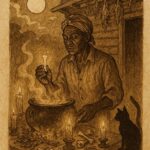
Behind a sturdy pine table sat Miss Liza, a respected root doctor in her community. Before her were bundles of dried herbs, small cloth squares, glass bottles filled with oils, and a worn Bible resting near her elbow. Her hands moved with quiet certainty. Every movement was deliberate.
In the American South, particularly across Louisiana, Mississippi, Georgia, and South Carolina, Hoodoo rootwork developed as a system of African American folk healing and spiritual protection. Its foundations stretch back to West and Central African spiritual traditions, shaped by the brutal realities of enslavement and survival. Over generations, knowledge blended with Indigenous plant wisdom and European influences, forming a uniquely Southern practice.
Discover chilling ghost tales and haunted places that echo through America’s towns and countryside.
For Miss Liza, rootwork was not superstition. It was inheritance.
Her grandmother had been born into bondage and carried plant knowledge passed down in whispers. Certain roots were used to protect against harm. Certain herbs soothed fever or cleansed negative influence. Spiritual strength was often the only defense available in hostile environments.
That evening, a mother named Clara knocked softly on the door. Her young son had been waking in fear each night, crying that shadows watched him. Clara believed something unsettled lingered around her home. She did not speak of curses or spirits directly. In the South, such matters were handled with caution.
Miss Liza listened carefully. She never dismissed fear. Fear itself can weaken a household. She began preparing a protective mojo bag.
She selected a square of red flannel cloth. Red symbolized protection and vitality. Into the center she placed angelica root for spiritual strength, dried basil for purification, and a small piece of High John the Conqueror root, long associated with resilience and overcoming adversity. She added a pinch of salt to absorb negativity and a tiny folded scripture verse for spiritual covering.
As she assembled the bag, she whispered a prayer. Her voice was low but steady. Hoodoo rootwork often blends Christian faith with African diasporic spirituality. The Bible rests beside the roots not as contradiction, but as complement.
She tied the bag tightly with red thread, knotting it three times. Each knot sealed intention.
Clara was instructed to place the mojo bag beneath her son’s pillow and to sprinkle a light herbal wash near doorways and windows. The wash, made from steeped rosemary and bay leaf, would symbolically cleanse the home’s entrances.
Before Clara left, Miss Liza reminded her of something important. “Protection works strongest when the house holds peace,” she said gently. Harmony within the family strengthens any charm.
Hoodoo rootwork served many purposes across Southern communities. Some root doctors focused on healing fevers, stomach ailments, and minor wounds using herbal poultices and teas. Others specialized in spiritual protection or breaking harmful influences. In eras when medical care was scarce and legal protection was limited, rootwork provided both practical remedies and psychological empowerment.
The practice was also quiet resistance.
During times when African American communities faced violence and oppression, protective charms offered a sense of agency. Carrying a mojo bag or wearing a root around the neck symbolized more than superstition. It symbolized survival.
Days later, Clara returned with relief in her eyes. Her son had slept peacefully. The fearful dreams had stopped. Whether through faith, suggestion, or spiritual intervention, the home felt lighter.
Miss Liza nodded but did not boast. Root doctors understood that pride disrupts balance. The work was sacred and required humility.
Another visitor arrived that week, an elderly man with persistent joint pain. Miss Liza prepared an herbal oil infused with camphor and warming roots. She instructed him to massage the oil into his knees while reciting a prayer for strength. Healing in Hoodoo is rarely separated from intention. The act of applying medicine becomes ritual.
On quiet afternoons, Miss Liza gathered fresh herbs from wooded edges and fields. She spoke softly as she harvested, thanking the plants. Sustainability mattered. Taking more than necessary weakened both land and spirit.
As decades passed, modernization altered Southern life. Hospitals became more accessible. Electricity replaced lanterns. Yet Hoodoo rootwork endured. It moved from rural cabins to city apartments. Mojo bags rested in pockets beside bus tickets. Protection oils were carried discreetly in purses.
Scholars later documented these practices in folklore archives and museum collections. They noted the blending of African cosmology, Christian scripture, and Southern botanical knowledge. Yet for communities who lived it, rootwork was not academic study. It was lived tradition.
One humid summer night, as thunder rolled across the horizon, Miss Liza prepared another charm by lantern light. Outside, rain struck the tin roof in steady rhythm. She paused to listen. Storms, like life, bring turbulence. Protection, she believed, strengthens endurance rather than eliminating hardship.
When she finally extinguished the lantern, the shelves of roots and jars stood quietly in the dark. Each held memory. Each carried story.
Hoodoo rootwork in the American South remains a testament to African diasporic spirituality shaped by survival, faith, and resilience. It reminds communities that even in oppression, cultural knowledge can endure. In small cloth bags and whispered prayers lives a tradition of strength passed from generation to generation.
Step into America’s cultural roots — from folk healing and weather lore to seasonal celebrations.
Moral Lesson
Cultural knowledge, faith, and resilience can provide protection and strength even in difficult times.
Knowledge Check
- What is a mojo bag used for?
It is used for protection, healing, or attracting positive energy - Why is red cloth often used in protection charms?
It symbolizes vitality and spiritual protection - How does Hoodoo blend spiritual traditions?
It combines African diasporic spirituality with Christian faith and local plant knowledge - Why was rootwork important during times of oppression?
It provided empowerment and a sense of agency - What must accompany any charm for it to work effectively?
Peace and harmony within the home - Why is humility important for a root doctor?
Pride can disrupt spiritual balance
Source
Adapted from African American folklore archives; Smithsonian National Museum of African American History resources
Cultural Origin
Southern United States (Louisiana, Mississippi, Georgia, South Carolina)