In the rolling hills of Tennessee, where red clay dust clings to boots and cicadas sing louder than church choirs in July, there once lived a gardener named Miss Clementine Harper.
She was not tall, nor particularly loud, nor famous beyond her county line.
But she could grow things.
Tomatoes blushed brighter in her garden. Corn stalks stood straighter. Beans climbed higher. Folks said she spoke to seedlings the way others spoke to babies. And the seedlings listened.
Yet nothing prepared the county for the year Miss Clementine decided to grow a pumpkin.
Now pumpkins were common enough in Tennessee. They fattened up in late summer and decorated porches come autumn. But Miss Clementine was not interested in common.
“I don’t grow vegetables,” she once declared at the feed store. “I grow possibilities.”
Encounter the strange and the unseen — from Bigfoot to regional monsters hiding in America’s forests.
That spring, she planted a seed larger than a silver dollar in a patch of soil she had turned with her own hands. She mixed river silt with composted leaves, sang hymns while watering, and refused to let anyone step within ten feet of the sprout once it emerged.
By June, the vine had stretched across half her field.
By July, it had crossed into her neighbor’s pasture.
By August, folks were gathering at her fence every evening just to measure it.
The pumpkin itself began as a modest green bulb no bigger than a kettle. But it swelled with unnatural determination. Chickens mistook it for a new coop. A dog tried to nap against it and rolled downhill when it shifted.
“Reckon she’s feeding it molasses,” someone whispered.
“Reckon she’s feeding it thunder,” another replied.
Miss Clementine only smiled and kept tending her vine.
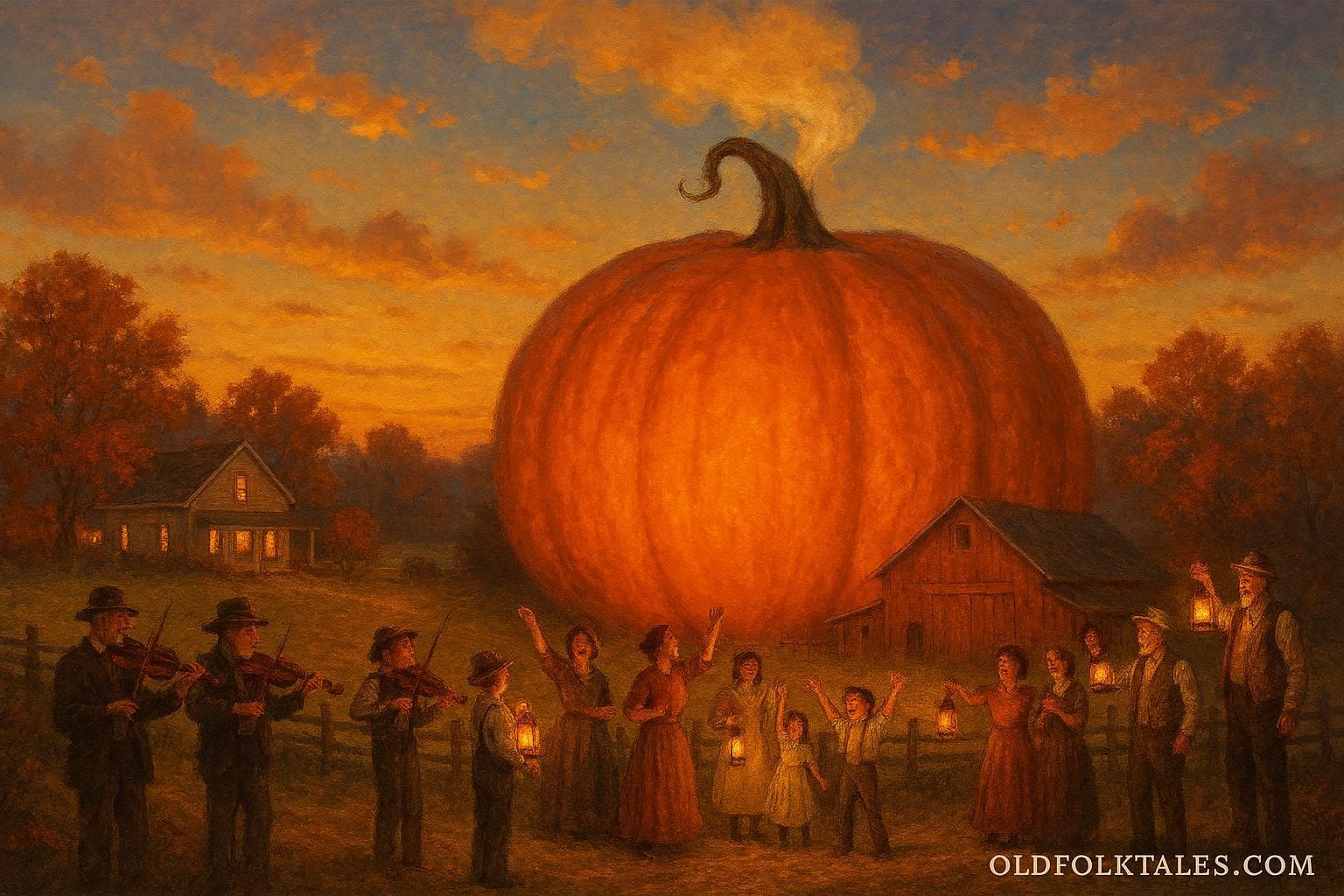
By early September, the pumpkin stood taller than a mule and wider than a wagon wheel. Its skin gleamed a deep orange that caught sunset light like polished copper. When tapped, it gave off a hollow echo.
Then came the steam.
One crisp morning, as dew clung to the grass, a faint hiss drifted across the field. A small puff of vapor rose from the pumpkin’s stem.
Neighbors ran.
They feared explosion. They feared collapse. They feared witchcraft.
Miss Clementine walked calmly toward the vine and pressed her ear against the pumpkin’s side.
“She’s breathing,” she announced.
Word spread faster than wildfire.
The Big Steam Pumpkin.
By harvest time, it had grown so large that four men holding hands could not encircle it. Children played hide-and-seek in the vine leaves. A traveling preacher declared it a “blessing of abundance.” The town blacksmith swore he heard faint rumbling from inside, like distant thunder.
Then came the first test of its size.
After heavy rains flooded the creek, two boys were stranded on the opposite bank. Bridges had washed out. Wagons could not cross.
Miss Clementine studied her pumpkin thoughtfully.
“Roll her down,” she instructed.
It took a dozen townsfolk and three mules to nudge the massive fruit toward the swollen creek. With one final push, it plopped into the water.
It floated.
Children cheered. The pumpkin bobbed like a bright orange boat. Two men paddled it across with fence boards and retrieved the stranded boys safely.
From that day forward, the Big Steam Pumpkin became more than a vegetable.
It became transportation.
When harvest wagons broke an axle, they hitched ropes around the pumpkin and used it to haul corn sacks. When shade was scarce at field picnics, families leaned against its cool side for relief from the sun.
And every now and then, a gentle puff of steam would rise from the stem, as though the pumpkin approved of its usefulness.
The annual county fair approached, and debate raged over whether the pumpkin could be moved.
“She’s part of the land now,” some argued.
“She belongs on display,” others insisted.
Miss Clementine resolved the matter herself.
“If she wants to move,” she said, patting the vine, “she’ll let us know.”
That night, a soft rolling sound echoed across the pasture.
By morning, the pumpkin had shifted three feet closer to the road.
The fair committee took that as permission.
Transporting the pumpkin required ingenuity. Wooden beams were placed beneath it. Barrels acted as rollers. The entire town participated. As it reached Main Street, church bells rang and children tossed flower petals before it.
At the fairgrounds, it dwarfed every exhibit. Prize-winning hogs looked miniature beside it. Quilts hung in its shadow.
And just as the mayor prepared to award Miss Clementine the blue ribbon for Largest Produce Ever Witnessed, the pumpkin let out a mighty whistle of steam.
Not a hiss.
Not a puff.
A full-bodied whistle, like a riverboat announcing departure.
The crowd gasped.
From somewhere inside, a hollow thrum vibrated. The pumpkin quivered slightly, as if remembering it had once been a seed.
Miss Clementine stepped forward calmly.
“She ain’t done growing,” she said.
Over the next year, the Big Steam Pumpkin became the heart of an annual festival. Musicians played fiddle tunes beside it. Bakers experimented with recipes carved from its outer layers, though somehow it never shrank. Painters captured its likeness. Storytellers embellished its origin.
Some claimed it was heated by underground springs.
Others insisted lightning had struck the seed.
Still others swore Miss Clementine whispered secrets into the soil at midnight.
Yet the gardener herself always credited patience.
“Everything grows bigger when you give it time,” she would say.
Eventually, as tall tales demand, the pumpkin reached such grand size that it could no longer be measured in feet or hands. It became legend rather than produce. In later retellings, families spent whole summers camping beside it. Fiddlers held concerts atop it. Children slid down its curved sides like playground hills.
Whether it eventually returned to seed or rolled gently back into the earth remains uncertain.
But each autumn in that Tennessee town, pumpkins still swell proudly in gardens. And when steam rises from cool morning soil, elders smile knowingly.
“Miss Clementine’s watching her crop,” they say.
Click to read all American Folktales — timeless oral stories passed through generations across the United States.
Moral Lesson
Growth does not always come from force or speed. Sometimes it comes from patience, care, and belief in possibility. Miss Clementine’s pumpkin reminds us that when communities nurture something together whether a garden, a dream, or a tradition. it can grow beyond expectations. Her story teaches that abundance is not only measured in size but in how generously we share what we cultivate. True harvest is found in unity, creativity, and the joy of celebrating what we build together.
Knowledge Check
- What made Miss Clementine’s pumpkin unusual?
It grew to enormous size and released steam - How did the pumpkin help during the flood?
It was used as a floating boat to rescue boys - What sound did it make at the fair?
A loud whistle of steam - What did townspeople believe caused its growth?
Lightning, underground springs, or secret gardening methods - What annual event developed because of the pumpkin?
A pumpkin festival - What is the main lesson of the story?
Patience and shared care can produce extraordinary results
Source
Adapted from Southern Folklife Program; state agricultural archives
Cultural Origin
Southern United States (Tennessee and neighboring states)