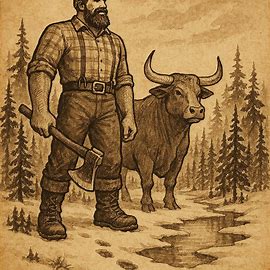
Deep in the dense, misted forests of Maine, where pines stretch like cathedral spires and rivers run cold and swift, there was a man known far and wide as Jigger Johnson. He was a lumberjack, a woodsman, and a legend before most men had fully grown a beard.
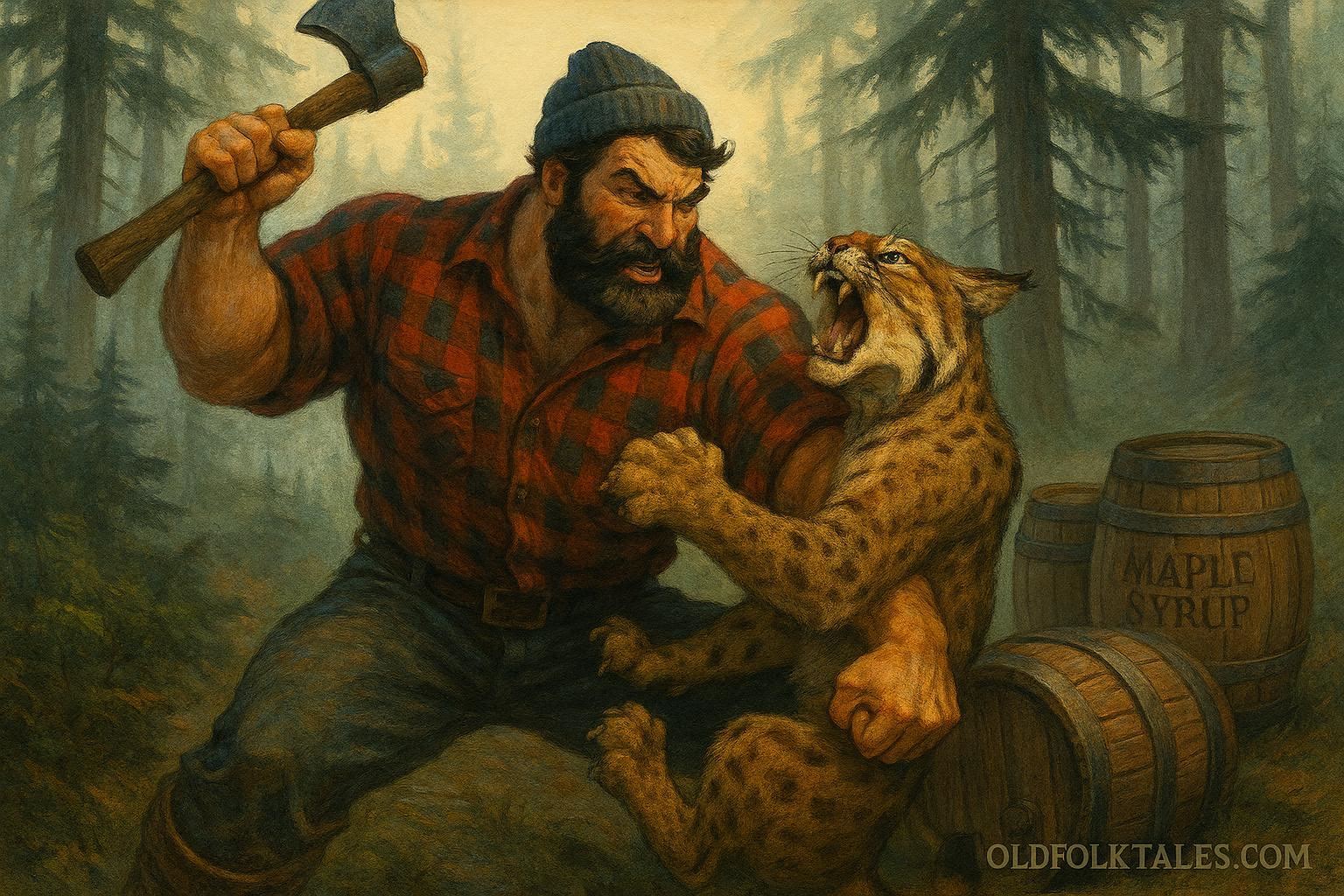
Jigger Johnson was not an ordinary man. Tales tell of him catching bobcats with his bare hands, wrestling them to the forest floor, and then releasing them unharmed back into the woods, as if they had agreed to a pact of respect. Neighbors said he could fell the tallest pine with a single swing of his axe, then balance on its trunk as it fell, landing perfectly on the soft moss below.
But it was not only feats of strength that earned Jigger his reputation. He was known for his humor, as loud and infectious as a winter wind through the treetops. In the lumber camps, he would challenge men to races up steep hills, to drinking contests of pure maple syrup, and to outrageous dares that no ordinary man would attempt. And somehow, Jigger always emerged victorious, smiling and untarnished, a streak of daring energy in the misty forests.
Discover chilling ghost tales and haunted places that echo through America’s towns and countryside.
The first stories told of him catching a bobcat that had terrorized a nearby village. The cat had stolen chickens and scared children, leaving the settlers at wit’s end. Jigger, hearing the commotion, walked silently through the snow-laden forest. He spotted the bobcat crouched behind a boulder, eyes glinting. Without hesitation, he grabbed it bare-handed, wrestling it into submission. When he released the animal, it bolted back into the wild, leaving behind an air of awe and fear among the witnesses.
He was equally famous for his maple syrup feats. During spring sugaring season, barrels of syrup would arrive at the camp, and Jigger would drink from them as if quenching the thirst of an entire village. Stories claim he once drank a full barrel in a single afternoon, all while laughing and chopping wood, leaving his companions both astounded and worried for his well-being.
Despite his rowdy antics, Jigger Johnson had a deep respect for the forest and its creatures. Hunters and settlers often sought his guidance in tracking elusive game or navigating harsh winter storms. He taught young lumberjacks how to read the signs of the woods: how the wind shifted in the trees, where wolves would travel, and how to find shelter before blizzards arrived. His lessons were as much practical wisdom as they were tales of courage and survival.
Jigger’s humor often mixed with his bravery. Once, a pack of wolves threatened a logging camp during a harsh winter night. While others cowered, Jigger leapt onto a stump and mimicked their howls, sending the wolves into confusion and retreat. Lumberjacks would recount the event for years, embellishing each telling, but all agreed that his courage and quick thinking saved the camp.
He was also a man of legend for his endurance. Stories say he could work from sunrise to sunset, survive on minimal food, and continue through storms that would halt ordinary men. His feats became taller with each telling: dragging logs that weighed as much as houses, surviving nights in snowbanks, or wrestling river otters to keep them from stealing his camp’s fish supply.
Yet beneath the exaggeration, Jigger Johnson’s tale conveys a moral: skill, bravery, and respect for nature’s creatures, when combined with humor and confidence, allow individuals to navigate even the harshest environments. He was never cruel. He never used his strength to harm unnecessarily. Every bobcat caught, every barrel drunk, every daring act was rooted in a balance between daring adventure and woodland respect.
Over time, his legend spread beyond Maine. Traveling storytellers carried the tales to northern towns, and journals recorded his exploits in folklore collections. Lumber camps named him as a benchmark of courage and skill, and even modern descendants of the forests still whisper his name when retelling tall tales of the woods.
Even today, in misty Maine mornings when fog curls between pine trunks, some swear they can hear the echo of Jigger’s axe swing or the laughter of a man who could wrestle bobcats and drink barrels of syrup, reminding all that bravery and humor can exist side by side, and that the woods hold stories as wild as the men who walk them.
Explore the heart of America’s storytelling — from tall tales and tricksters to fireside family legends.
Moral Lesson
Courage and skill are best tempered with humor and respect. Jigger Johnson’s story teaches that true heroism is not only about strength, but also about understanding the natural world, protecting the community, and finding joy in life’s challenges. Adventure, when balanced with wisdom, creates enduring legends that inspire generations.
Knowledge Check
- Who was Jigger Johnson?
A legendary Maine lumberjack known for daring feats and humor - What unusual acts made him famous?
Catching bobcats with his bare hands and drinking barrels of maple syrup - How did he help lumber camps during harsh winters?
By guiding men through storms and scaring away wolves with clever tactics - What skills did he teach young lumberjacks?
Reading the forest, tracking game, and finding shelter in storms - How did Jigger balance his daring with respect for nature?
He never harmed animals unnecessarily and understood the forest’s rhythms - What is the main lesson of Jigger Johnson’s story?
Bravery combined with humor, skill, and respect creates lasting legend
Source
Adapted from Maine historical society archives; Northeastern folklore collections
Cultural Origin
Maine and New England forest culture