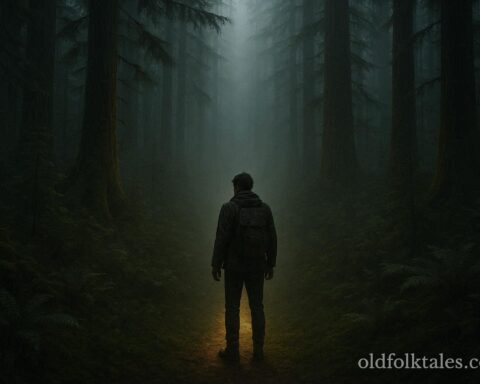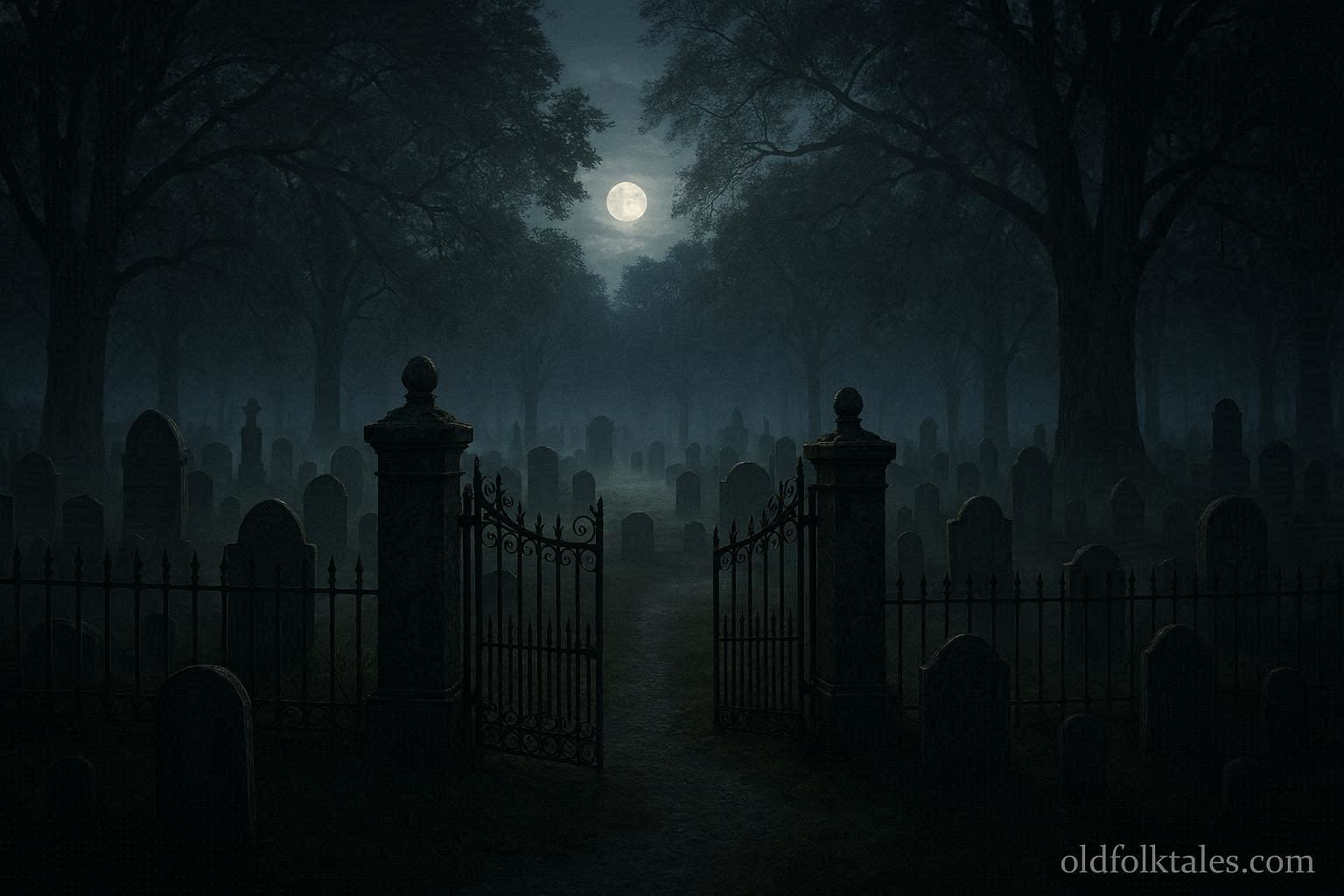
On certain mist-covered nights in Easton, Connecticut, drivers along Sport Hill Road tell of a pale figure standing silently near the iron gates of Union Cemetery. The road curves gently past old stone walls and leaning gravestones that date back to the eighteenth century. Trees arch overhead, their branches weaving shadows across the pavement. In daylight, the cemetery appears peaceful, a quiet resting place marked by weathered names and fading inscriptions. But after midnight, when fog gathers low against the ground and headlights cut narrow tunnels through the darkness, the atmosphere feels different. It feels expectant.
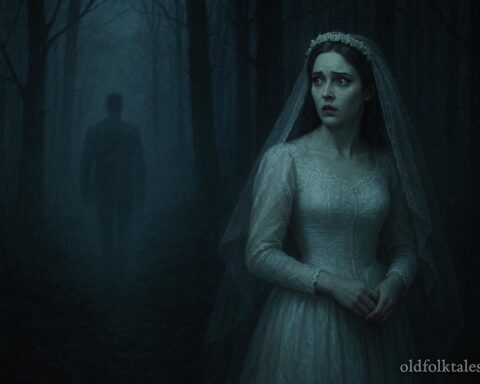
For decades, stories have circulated about a woman dressed in white who appears near the cemetery entrance. Witnesses describe her as pale and solemn, sometimes standing motionless, sometimes drifting slowly across the road. Some claim she raises her hand as though asking for a ride. Others say she simply watches passing cars without expression. Those who stop or attempt to approach her often report that she vanishes without sound.
The earliest whispers of the White Lady trace back to the nineteenth century, though written documentation appears more clearly in the twentieth. Local folklore suggests she may be tied to tragedy. One version claims she was a young woman who died in a carriage accident on a stormy evening, thrown from her seat near the cemetery gates. Another story suggests heartbreak, that she lost the love of her life and wandered in grief until death claimed her. In each telling, sorrow lingers at the center.
Explore the heart of America’s storytelling — from tall tales and tricksters to fireside family legends.
Union Cemetery itself deepens the mystery. Established in the 1700s, it holds generations of families whose lives shaped the region. Time has softened many of the carvings, leaving only faint dates and symbols. The presence of centuries-old graves creates a natural bridge between memory and imagination. In places like this, where history feels close enough to touch, legends take root easily.
In the mid-twentieth century, accounts of the White Lady grew more widely known. Drivers reported sudden drops in temperature when passing the cemetery at night. Some described their headlights flickering as the figure appeared. A few claimed that she materialized directly in front of their vehicles, forcing them to brake suddenly, only to disappear before impact. None reported physical harm, yet the encounters left lasting impressions.
Unlike many ghost stories filled with violence or menace, the White Lady’s presence is often described as calm and mournful. She does not chase or threaten. She appears, lingers, and fades. This quietness has made her legend enduring rather than terrifying. She feels less like a warning and more like a memory that refuses to rest.
Folklorists studying New England ghost traditions note that the “White Lady” archetype appears in many regions. Often, she represents unresolved grief, unfinished love, or sudden death. In Connecticut, however, the Union Cemetery apparition gained particular attention because of repeated sightings across generations. Stories passed from grandparents to grandchildren, from neighbors to newcomers. Each retelling preserved the core image: a woman in white on a misty road.
In the 1990s, regional investigators and paranormal enthusiasts visited Union Cemetery hoping to witness the legend firsthand. Some claimed to capture unexplained photographs. Others reported strange sensations or fleeting shapes at the edge of vision. Skeptics pointed to fog, reflected headlights, and the power of suggestion. Yet even skepticism has not silenced the story.
What makes the White Lady endure is not proof but atmosphere. Union Cemetery sits at the intersection of history and imagination. The iron gates creak softly in the wind. Fallen leaves gather against gravestones. Night settles heavily among the trees. In such a setting, the mind becomes sensitive to movement and shadow.
But the legend is more than a trick of light. It speaks to something deeply human. Love interrupted. Life cut short. The longing to be remembered. Whether the White Lady is a spirit bound to the road or a symbol carried by community memory, she represents loss that echoes across time.
Residents of Easton sometimes speak of her with a mixture of respect and familiarity. She is not treated as a horror but as part of local heritage. Teenagers dare one another to drive past the cemetery at midnight. Couples pause near the gates, half hoping to glimpse the pale figure. Tourists arrive with cameras, curious but cautious. Through all of it, the legend continues quietly.
The road remains. The cemetery remains. And on certain nights, when fog lowers itself like a veil over the stones, drivers still report a figure standing near the entrance, luminous against the dark.
Perhaps she is the echo of countless stories layered upon one another. Perhaps she is grief given form. Or perhaps she is simply a reminder that places remember more than we realize.
The White Lady of Union Cemetery does not demand belief. She asks only to be noticed. And in being noticed, her story lives on.
Click now to read all American Legends — heroic tales where truth and imagination meet, defining the American spirit.
Moral Lesson
Legends like the White Lady remind us that memory and loss shape communities. Even when facts fade, the emotions behind stories endure. Respect for history and empathy for the past keep these tales alive without fear.
Knowledge Check
- Where is Union Cemetery located?
Easton, Connecticut. - How is the White Lady commonly described?
As a pale woman in white who appears near the cemetery gates on misty nights. - What themes are connected to her legend?
Love, loss, grief, and haunted memory. - When did sightings become widely reported?
During the twentieth century, especially mid-century onward. - Does the legend portray her as violent?
No, she is usually described as calm and mournful rather than threatening. - Why has the legend endured for generations?
Because it blends local history, emotional storytelling, and repeated community sightings.
Source
Adapted from Connecticut folklore archives and regional historical society records
Cultural Origin
Connecticut folklore, New England ghost tradition