Before there were forests whispering along the shores of the Great Lakes, before canoes cut across shining waters, before villages sent smoke curling into the sky, the world was covered entirely by water. There was no solid earth where feet could stand. No hills rose against the horizon. No trees rooted themselves in soil. Only vast waters stretched in every direction, reflecting the endless sky above.
Upon this wide expanse moved Wenabozho, the cultural hero and teacher of the Ojibwe, also known as the Anishinaabe. He was both spirit and teacher, a being of wisdom and curiosity. He looked across the rolling waters and understood that something was missing. The world needed land. It needed a place where life could grow strong and steady.
Wenabozho knew that beneath the waters lay the remnants of an earlier world. Deep below, hidden in darkness and silence, rested soil that once held forests and rivers. If even a small portion of that earth could be brought to the surface, it might grow again. From something small, something vast could emerge.
Step into shadowy legends of restless spirits and ghostly travelers in American Ghost Stories.
He was not alone upon the waters. Around him floated many animals who had survived the great flood. There was Beaver with his broad tail and powerful limbs. There was Otter, quick and playful yet brave. Loon drifted nearby, watchful and calm. Duck and other water birds rested upon the gentle swells. A great turtle swam steadily beneath them all, strong and patient.
Wenabozho gathered the animals together and spoke with seriousness. He explained that the world needed land. Without land, there could be no forests, no berries, no medicine plants, no place for future generations to build their homes. Someone would have to dive into the deep waters and retrieve a handful of earth from the bottom.
The animals listened. They understood the importance of the task, but they also knew the waters were cold and immeasurably deep. No one could see the bottom. The darkness below seemed endless.
Beaver stepped forward first. He was known for his strength and determination. With confidence in his powerful body, he took a deep breath and plunged beneath the surface. The waters swallowed him, and ripples spread outward in widening circles.
The animals waited in silence. Time seemed to stretch. At last Beaver rose again, exhausted and breathing heavily. His paws were empty. The depth had defeated him. He shook the water from his fur and lowered his head, disappointed but alive.
Next Otter volunteered. He was swift and agile, able to twist and turn through water with ease. He dove smoothly, vanishing into the dark blue below. Longer he stayed beneath the surface than Beaver had managed. The animals began to hope.
But eventually Otter too returned, gasping for air, his body trembling from the strain. He had nearly reached the bottom, but not quite. His paws held nothing.
One by one, other strong swimmers attempted the dive. Each showed courage. Each pushed beyond comfort. Yet none could reach the hidden earth.
As the attempts failed, discouragement spread among the animals. Perhaps the waters were too deep. Perhaps land would never rise again.
Then a small voice spoke.
Muskrat, modest in size and often overlooked, stepped forward. He was not as strong as Beaver nor as swift as Otter. His body was small, his legs short. Yet his eyes held quiet determination.
He asked Wenabozho for permission to try.
Some of the larger animals doubted him. If the strongest had failed, what chance did the smallest have? But Wenabozho did not measure worth by size. He looked into Muskrat’s steady gaze and saw courage there.
He nodded.
Muskrat inhaled deeply and slipped into the water. Unlike the others, he did not dive with great splashes. He disappeared quietly, swallowed by the vastness.
The surface grew still. Only the sound of wind over water could be heard. Moments passed. Then more moments. The waiting felt heavy. Even Wenabozho’s heart grew anxious.
Muskrat stayed below longer than any before him. The silence became almost unbearable.
Finally, a small shape floated upward.
Muskrat’s body rose to the surface, limp and unmoving. Wenabozho quickly lifted him from the water. The little diver had given every bit of his strength. He had reached the bottom, but the journey had cost him dearly.
In Muskrat’s tiny paw was a small clump of dark earth.
Wenabozho felt both sorrow and gratitude. The smallest among them had accomplished what none other could. He honored Muskrat’s sacrifice and gently held the precious soil.
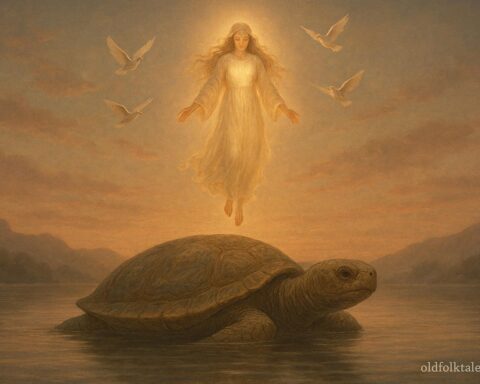
At that moment, the great turtle surfaced fully, offering his broad back as a resting place. Wenabozho carefully placed the clump of earth upon the turtle’s shell. He knelt beside it and began to breathe upon the soil. He sang sacred songs and spoke words of creation.
The small clump began to grow.
It spread slowly at first, no larger than a mound. Then it widened. It thickened. It pushed outward in every direction. Hills rose. Valleys formed. Rivers carved winding paths. Grasses sprouted, followed by trees reaching upward toward the sky.
The turtle carried the growing land steadily upon his back. As the earth expanded, it became vast and strong. This new land came to be known as Turtle Island.
Forests filled with birdsong. Animals found places to roam. Lakes shimmered beneath the sun. The world that had once been only water now held solid ground rich with life.
Wenabozho walked across the fresh earth, shaping mountains and teaching balance. He showed the first people how to live respectfully upon the land. He reminded them that the world rested upon cooperation and sacrifice.
He never forgot Muskrat. The small diver was honored as a hero. His bravery proved that greatness is not measured by strength alone. Courage, humility, and willingness to serve can shape the entire world.
The Ojibwe tell this story to remind each generation that creation itself is rooted in relationship. Beaver tried. Otter tried. Turtle offered support. Muskrat gave everything. Wenabozho guided and breathed life into what was given.
The earth beneath our feet, according to this teaching, began with a small handful of mud carried upward through darkness by a determined heart.
Whenever waves move gently across the Great Lakes and forests stand tall along their shores, the memory of that first dive remains alive. The land is not taken for granted. It is respected as a gift born of sacrifice.
And so the people remember that even the smallest among us may carry the seed of a new world.
Discover celestial myths of the sun, moon, and stars — and the heroes who bridged earth and sky.
Moral Lesson
True strength is found in courage and selflessness. Even the smallest helper can change the course of creation.
Knowledge Check
- What covered the world at the beginning of the story?
The world was entirely covered with water. - Why did Wenabozho ask the animals to dive?
He needed earth from the bottom of the waters to create land. - Which animals attempted the dive before Muskrat?
Beaver and Otter tried but could not reach the bottom. - What did Muskrat bring back from the depths?
He brought a small clump of earth in his paw. - What is Turtle Island?
It is the land formed on the back of the great turtle. - What important theme does this story teach?
It teaches creation through sacrifice and cooperation.
Source
Adapted from Great Lakes tribal archives and Anishinaabe oral tradition collections
Cultural Origin
Ojibwe also known as Anishinaabe, Great Lakes region North America