Long before the night sky was filled with stars, the world of the Lakota people existed in a quiet balance. The land was rich with rolling plains, rivers, and forests, but darkness reigned once the sun set. People walked carefully by the light of campfires, relying on memory and intuition to navigate the vast plains. The spirits observed the human need for guidance, and among them was a woman of great courage and curiosity, known for her wisdom and connection to both earth and sky.
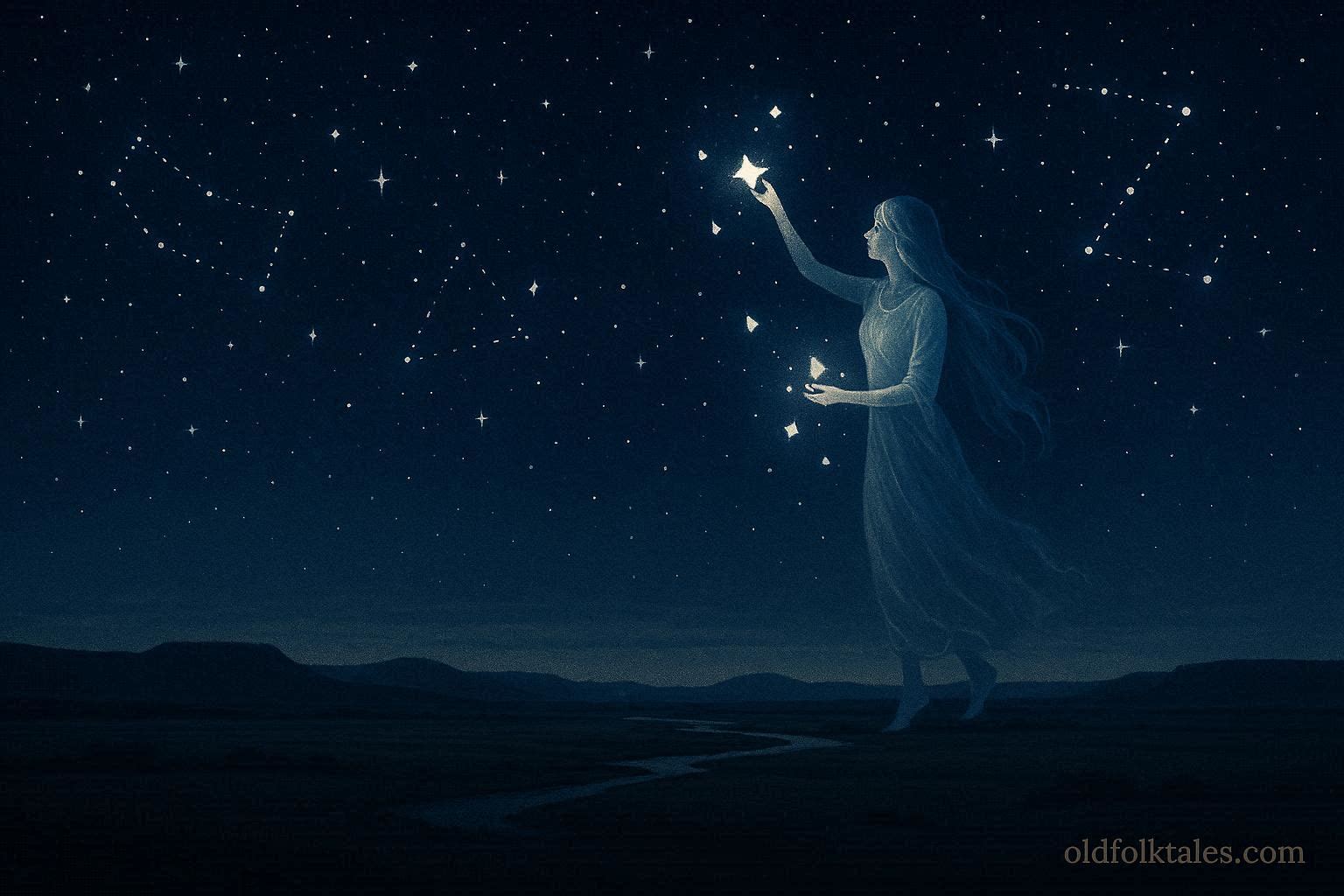
This woman felt a calling to journey beyond the world she knew. Legends tell that she was lifted by the spirits into the sky realm, a luminous place of clouds, wind, and radiant beings. There, she discovered light in its purest form, scattered fragments of brilliance that had not yet found a home in the world below. These fragments were eager to shine, but without guidance, they would drift aimlessly. The woman recognized the opportunity to help both the lights and her people.
Returning to earth, the woman carried these fragments carefully, understanding their potential. She traveled across plains and rivers, high hills, and deep valleys, finding places where the lights could rest and illuminate the world. Wherever she placed a fragment, it hung in the sky as a star, shining steadily to guide travelers, hunters, and families after dark. Each star was positioned with intention, reflecting lessons about direction, balance, and connection. The constellation patterns that emerged were meant to tell stories, mark the seasons, and provide a cosmic map for those who looked up in wonder.
Discover chilling ghost tales and haunted places that echo through America’s towns and countryside.
The act of bringing light to the sky was not easy. The fragments resisted control at times, flickering or moving unpredictably. The woman’s patience, skill, and understanding of balance were essential in guiding them to their proper places. Through her efforts, humans were given a gift that combined beauty with utility: stars to navigate, to tell stories, and to inspire awe. Night became a time not of fear but of observation, reflection, and learning.
As the stars settled into the sky, the woman taught the people about their purpose. Some stars were meant to guide travelers, ensuring they could follow rivers and trails safely. Others marked the times for planting, harvesting, and seasonal ceremonies. Many formed patterns that told the histories and lessons of the Lakota people, connecting human experiences with cosmic events. Through her guidance, the stars became both functional and spiritual, linking the earthly and celestial worlds.
The legend emphasizes the importance of courage, foresight, and understanding. By venturing into the unknown, the woman not only transformed the night sky but also created a bridge between humans and the cosmos. The stars became symbols of hope and stability, reminding people that guidance can come from observation, respect for the world, and acts of service. The story shows that even in darkness, careful attention and dedication can bring illumination to the world.
Over generations, Lakota storytellers passed this tale to children and community members, emphasizing lessons about patience, courage, and responsibility. The narrative also reinforced the sacred relationship between humans, the earth, and the sky. Observing the stars was not merely a practical activity but a spiritual practice, connecting individuals with the cosmic order and the wisdom of the woman who placed them.
The story of the star creation also teaches that the natural world and the sky are gifts that require respect. Just as the woman carefully handled the fragments of light, humans are expected to treat the land, water, animals, and celestial bodies with care. By maintaining this harmony, life on earth remains balanced and enriched by the beauty and guidance of the cosmos.
Even today, when Lakota people gaze at the night sky, the stars are seen as reminders of courage, patience, and guidance. The constellation patterns continue to serve as educational and ceremonial markers, linking generations of observers to both earthly and spiritual knowledge. The woman’s journey and her careful placement of the stars remind everyone that even small actions can have profound and lasting impacts on the world.
Explore ancient Native American creation myths and the symbolic tales that shaped America’s belief systems.
Moral Lesson
The legend of the stars teaches that courage, wisdom, and careful attention can transform darkness into guidance. Patience and respect for natural forces create order, understanding, and beauty in both the human and spiritual realms.
Knowledge Check
- Who brought light fragments to the earth in the legend?
A woman from the sky realm carried the fragments and placed them as stars. - What was the purpose of the stars for humans?
They provided guidance, marked seasons, and conveyed stories and lessons. - How did the woman manage the fragments of light?
She guided them patiently and intentionally, placing each in its proper position. - What spiritual significance did the stars hold?
They connected humans to the cosmos and reflected moral and practical teachings. - How does the story emphasize human behavior?
It teaches patience, courage, respect, and careful attention to the world. - Why is the night sky important according to this legend?
It provides guidance, education, and a symbolic connection between earth and sky.
Source
Adapted from Lakota Sioux tribal archives and Plains Star Lore collections
Cultural Origin
Lakota (Sioux) Nations, Northern Plains