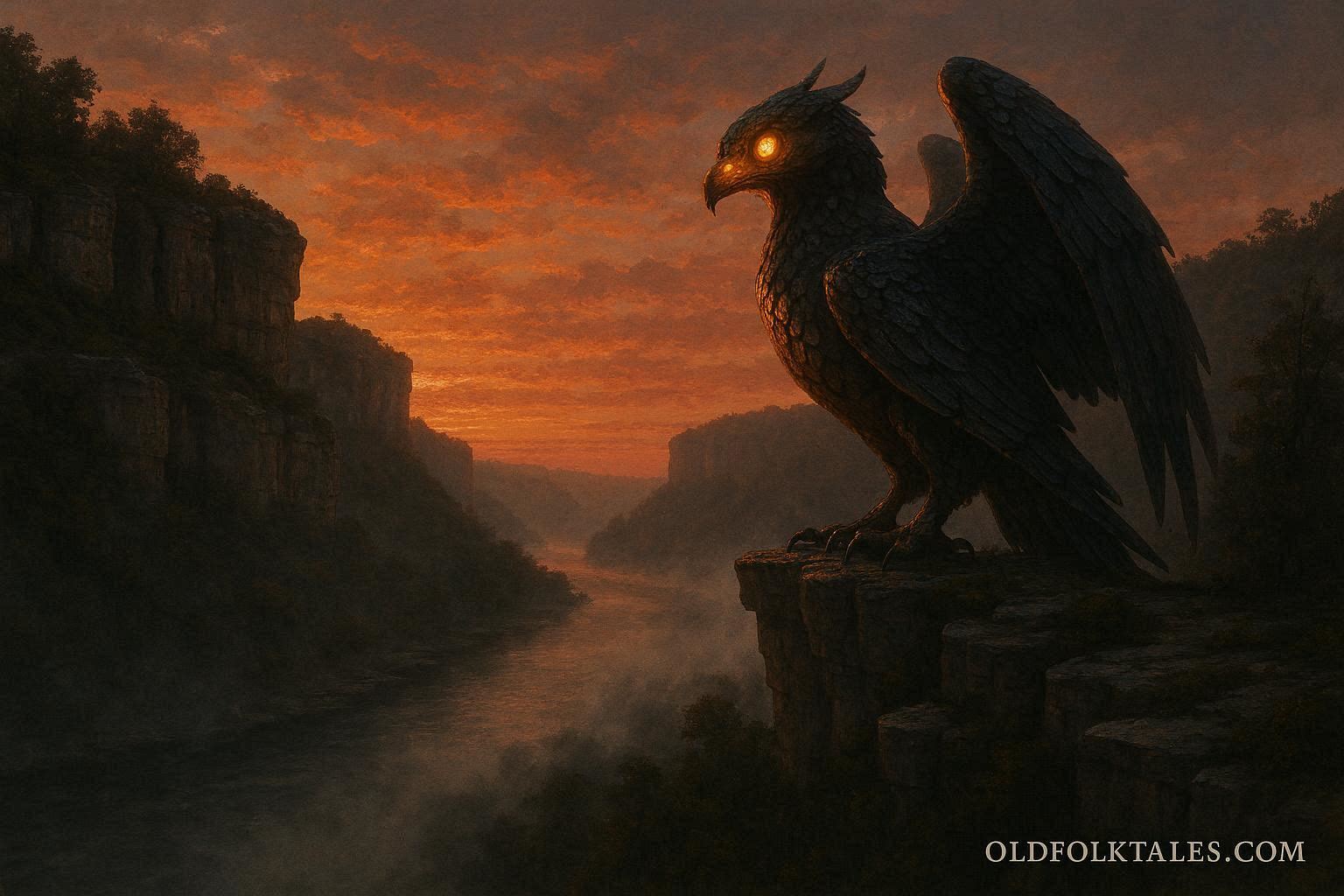
Long ago, when the Mississippi River carved its winding path through dense forests and towering limestone bluffs, the villages of the Illiniwek people thrived along its banks. One summer, a young hunter named Waya set out at dawn to track deer in the forest near the cliffs. As he moved quietly among the trees, he noticed the birds suddenly fall silent and the wind grow still. Waya’s heart quickened as he caught a glimpse of something massive perched on the highest bluff above the river. Its wings spread wide, shadowing the land below. Waya knew immediately he was looking at the Piasa Bird, a creature his elders had warned him about.
The Piasa Bird was larger than any animal Waya had ever seen. Its body was covered in green and bronze scales that shimmered in the morning light. Its eyes glowed with an intensity that seemed to pierce the forest, and its long, serpentine tail coiled around the cliff rocks. Waya remembered the stories told by the village elders. They said that the Piasa Bird protected the river and the forest, punishing those who took more than they needed from nature and rewarding those who lived in balance.
For days, the villagers had noticed that their fish traps along the river had been emptied too quickly, and Waya feared that hunters had ignored the elders’ warnings. He watched as the bird leapt from the bluff and glided silently above the river, wings folding with impossible precision. The air vibrated with its wings, and the river below seemed to respond, ripples forming in strange patterns that reflected the morning sun. Waya’s heart pounded as he realized the bird was observing not just him, but the whole village.
Step into shadowy legends of restless spirits and ghostly travelers in American Ghost Stories.
Determined to honor the creature, Waya returned to the village to speak to the elders. They reminded him that the Piasa Bird was both guardian and teacher. It did not harm recklessly, but it demanded respect. The elders told Waya that to protect the balance, humans had to remember the river, the cliffs, and the creatures that lived among them were sacred. Waya listened carefully, understanding that the Piasa Bird was not merely a beast of terror, but a living reminder of the fragile harmony between humans and nature.
The following evening, a group of villagers ventured to the river to check their traps. As they approached the bluff, they saw the Piasa Bird swoop down gracefully, gliding just above the water before disappearing into the forest. Its shadow stretched across the river, and the villagers fell silent, struck by awe. One child asked if the bird was angry, and the elders explained that the Piasa Bird would only act to restore balance, not out of malice. Its presence was a test of wisdom and respect.
As weeks passed, the villagers noticed that the river’s fish returned in abundance, the forests seemed healthier, and the balance of life felt restored. Waya remembered the bird each day, telling stories to his younger siblings about the lessons he had learned. He described the Piasa Bird as a guardian who watched over not only the river but the hearts and actions of those living nearby. His stories emphasized patience, humility, and the need to live in harmony with the land.
One night, during a storm, the river rose and battered the cliffs with waves and wind. The villagers huddled in their homes, fearing damage and loss. Through the howling wind, a shadow passed overhead. It was the Piasa Bird, wings extended against the storm, guiding the river’s flow and keeping the bluffs from collapsing. By morning, the floodwaters had receded, leaving the village untouched. The elders nodded knowingly, saying the Piasa Bird had ensured balance once more. The story spread through the village, reminding everyone that the forces of nature were alive, powerful, and deeply connected to their lives.
Over time, explorers and travelers passing along the Mississippi recorded the images of the Piasa Bird painted on the cliffs. They described a creature with scales, wings, horns, and sharp teeth, perched above the river as if watching every movement below. While some dismissed it as legend, the villagers knew the bird was real in spirit and in purpose. Parents taught their children to respect the river, to take only what was needed, and to honor the guardian that watched from the cliffs above.
The Piasa Bird legend became more than a tale of fear. It was a story of guidance, a living lesson of balance and responsibility. Hunters, fishermen, and villagers all learned to observe carefully, move with respect, and honor the natural world. Through Waya’s stories and the teachings of the elders, the Piasa Bird reminded generations that every action has a consequence, and that the river, the cliffs, and all creatures within them were sacred.
Even today, when travelers look up at the Mississippi limestone bluffs, they are reminded of the Piasa Bird. Its legend continues to inspire awe, teaching that respect for nature, attentiveness, and wisdom are essential. The creature is a guardian of the past, present, and future, linking the human world to the spiritual and natural realms. The story endures as a testament to the power of storytelling and the lessons that nature can teach when observed with humility and care.
Click to read all American Folktales — timeless oral stories passed through generations across the United States.
Moral Lesson
The Piasa Bird teaches that humans must act responsibly and respectfully toward the natural world. Observing balance, exercising restraint, and honoring the sacredness of the land and river ensures harmony between humans, nature, and spiritual forces.
Knowledge Check
- Where did the Piasa Bird live?
On limestone bluffs along the Mississippi River? - How did villagers describe the Piasa Bird?
As a giant bird-like creature with wings, scales, glowing eyes, and a serpent-like tail? - What role did the Piasa Bird play in the stories?
It acted as a guardian, teacher, and enforcer of balance in nature? - How did the villagers respond to the Piasa Bird?
By respecting nature, taking only what was needed, and listening to elders’ teachings? - What natural events were associated with the Piasa Bird?
Storms, river flow, and the protection of fish and forests? - What lesson does the legend convey?
That respect, wisdom, and harmony with nature are essential for survival and moral living?
Source
Adapted from Illinois State Museum archives
Cultural Origin
Illiniwek Native communities, Mississippi River region