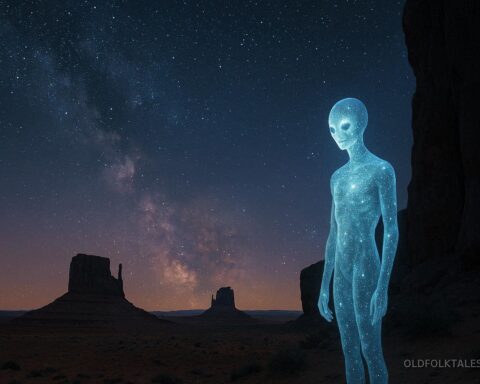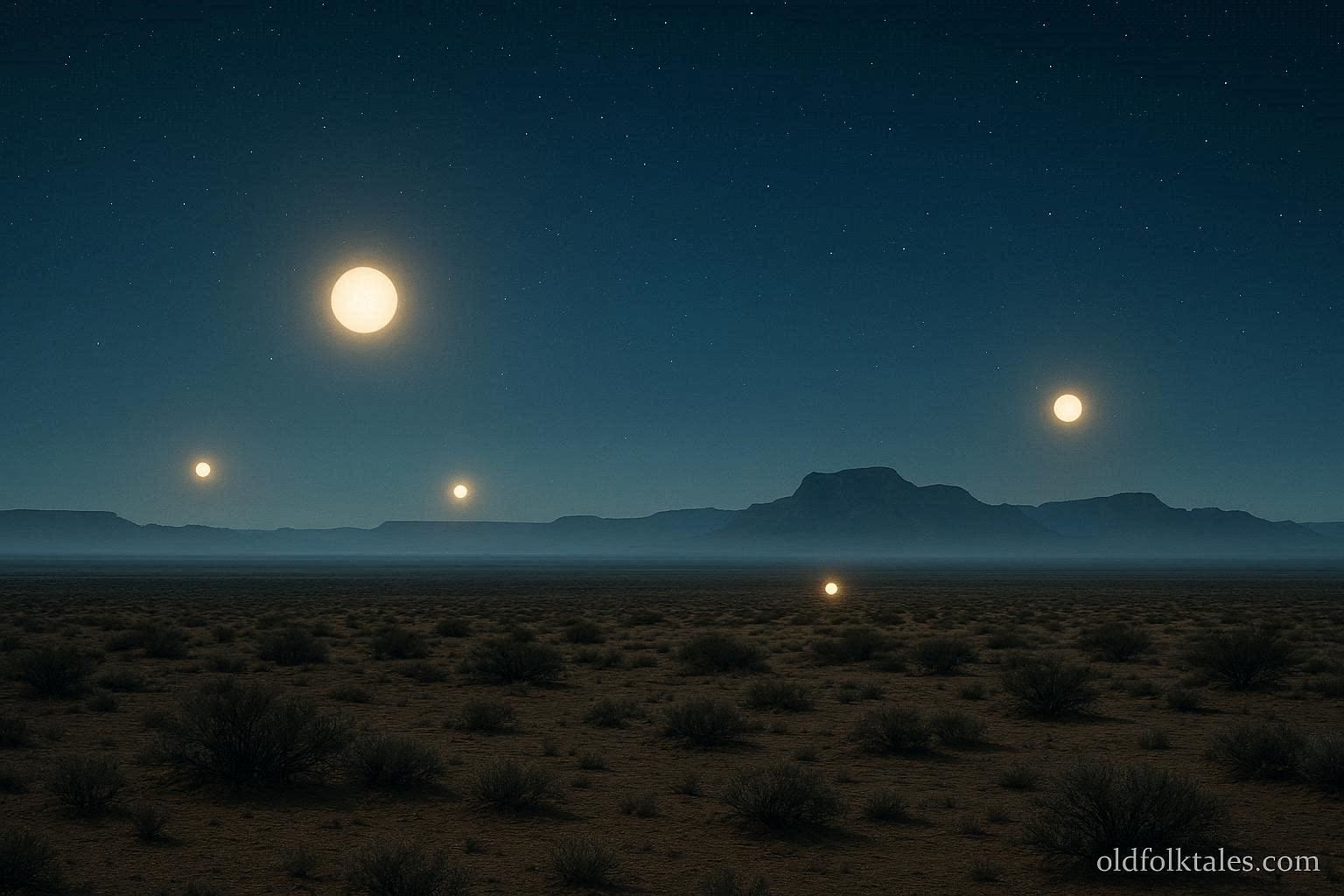
Long before highways cut through the arid expanse of West Texas, the wide desert plains surrounding Marfa were a place of stillness and wonder. Ranchers moving cattle across the dry brushlands and travelers navigating the narrow trails often spoke in hushed tones of glowing lights that appeared in the distance. They called them the Marfa Lights, mysterious orbs of green, red, or orange that hovered, danced, and sometimes darted across the desert horizon at night.
The earliest stories came from local Native communities, who told of spiritual beings and ancestors watching over the land. They believed these lights were not merely natural phenomena but signs of protection, guidance, or warnings for those who traveled carelessly across the desert. The lights often appeared near the Chinati Mountains, casting reflections on mesas and seemingly interacting with the terrain in ways that defied explanation.
One evening, a ranching family was returning from their cattle pens when the first light appeared. A bright green orb hovered above the flat plains, pulsating gently as if breathing. The father, a seasoned cowboy, dismounted from his horse and stared, uncertain whether the glow came from some natural source or something supernatural. His children whispered nervously, pointing toward smaller lights flickering along the horizon. The family spent hours observing the orbs, watching them split into two, drift apart, and then vanish without a trace. Their experience was shared at the local town gathering the next day, adding to the growing legend of the Marfa Lights.
Explore how American superstitions and rituals still influence modern life and local traditions.
Observers describe the lights in a variety of ways. Some appear stationary, floating in midair with a gentle radiance, while others move in erratic patterns that suggest intelligence or playful energy. Witnesses sometimes report hearing faint hums or feeling a sudden drop in temperature when the lights are near. These experiences, while fleeting, often leave a lasting impression. Travelers who initially approached the lights with skepticism find themselves awed by the unexplainable, retreating from the desert with stories of their encounter.
Scientific curiosity about the Marfa Lights began in the early twentieth century, when geologists, astronomers, and physicists visited the area to document them. Some proposed that the lights were the result of atmospheric reflections, distant vehicle headlights distorted by air layers, or natural gases igniting above the ground. Others suggested that the desert’s unique topography and temperature gradients caused mirages, bending light in unusual ways. Despite these theories, no explanation fully accounts for the consistency and unpredictability reported by observers over decades.
Local folklore provides an imaginative framework to understand the lights. One story tells of a rancher lost in a storm who saw a pair of lights guiding him to safety. Another recounts a traveling trader who followed the orbs, only to find himself at a hidden spring where he could water his animals. For some, the lights symbolize ancestors keeping watch over the land, ensuring balance and protection for those who respect the desert. For others, they are tricksters or spirits teasing travelers, appearing suddenly and vanishing just as quickly.
Tourists and paranormal enthusiasts began visiting Marfa in the mid-twentieth century, hoping to witness the lights firsthand. Local businesses recognized the legend’s draw, and observation platforms were built on the outskirts of town. On quiet nights, visitors gather with binoculars, cameras, and notebooks, patiently scanning the horizon for the telltale glow. Accounts of experiences are shared widely, creating a community of enthusiasts who treat the phenomenon with reverence and curiosity.
The Marfa Lights are most frequently seen during the fall and winter months, when the air is cool and clear. The surrounding desert, open and unobstructed, enhances visibility and adds to the eerie beauty of the orbs. Witnesses describe the lights as both beautiful and unsettling, evoking feelings of wonder, respect, and sometimes fear. Their unpredictability strengthens the sense that the desert is alive with unseen forces.
Over time, the legend of the Marfa Lights has become inseparable from the identity of the town itself. Stories are passed down through families and shared in regional newspapers and folklore collections. The lights are celebrated not only as unexplained phenomena but also as part of the cultural heritage of West Texas. Local festivals honor the lights, incorporating art, music, and storytelling to preserve the legend for future generations.
Despite modern scientific attempts to explain the phenomenon, the Marfa Lights retain their mystery. Visitors report that the lights seem to respond to attention, appearing or disappearing as if aware of human observation. Some speculate that the lights are the spirits of those who traveled the desert long ago, while others simply marvel at a natural phenomenon still beyond understanding. Whatever their origin, the lights inspire respect for the vast and unforgiving desert landscape and for the mysteries that lie hidden within it.
The Marfa Lights remind observers that the world holds wonders that cannot always be explained. They encourage curiosity, careful observation, and humility in the face of nature’s enigmas. Each sighting is a story, a connection between the human mind and the vast, ancient desert, and a reminder that some mysteries endure because they are meant to be experienced, not fully understood.
Click to read all American Folktales — timeless oral stories passed through generations across the United States.
Moral Lesson
The legend of the Marfa Lights teaches us to respect the natural world and to remain humble before phenomena that exceed our understanding. Curiosity and wonder should be guided by caution and reverence for the land.
Knowledge Check
- Where do the Marfa Lights appear?
In the desert surrounding Marfa, Texas? - How are the lights often described?
As glowing orbs that hover, move unpredictably, and vary in color? - What natural explanations have scientists proposed?
Atmospheric reflections, distant vehicle lights, mirages, and natural gas ignitions? - What role do the lights play in local folklore?
They are seen as guides, spirits, or tricksters influencing human activity? - During which seasons are sightings most frequent?
Fall and winter? - What lesson does the legend convey?
That humans should approach the unknown with respect, curiosity, and humility?
Source
Adapted from University of Texas archival collections
Cultural Origin
West Texas desert communities