In the quiet town of Cassadaga, Florida, where moss hangs heavily from ancient oak trees and narrow roads wind through old spiritualist neighborhoods, there stands a cemetery that many locals approach with caution after sunset. Cassadaga is known for its spiritualist history, mediums, and belief in communication with the spirit world. Yet among all its ghost stories and psychic traditions, one legend continues to fascinate teenagers, travelers, and believers alike. It is the legend of the Devil’s Chair.
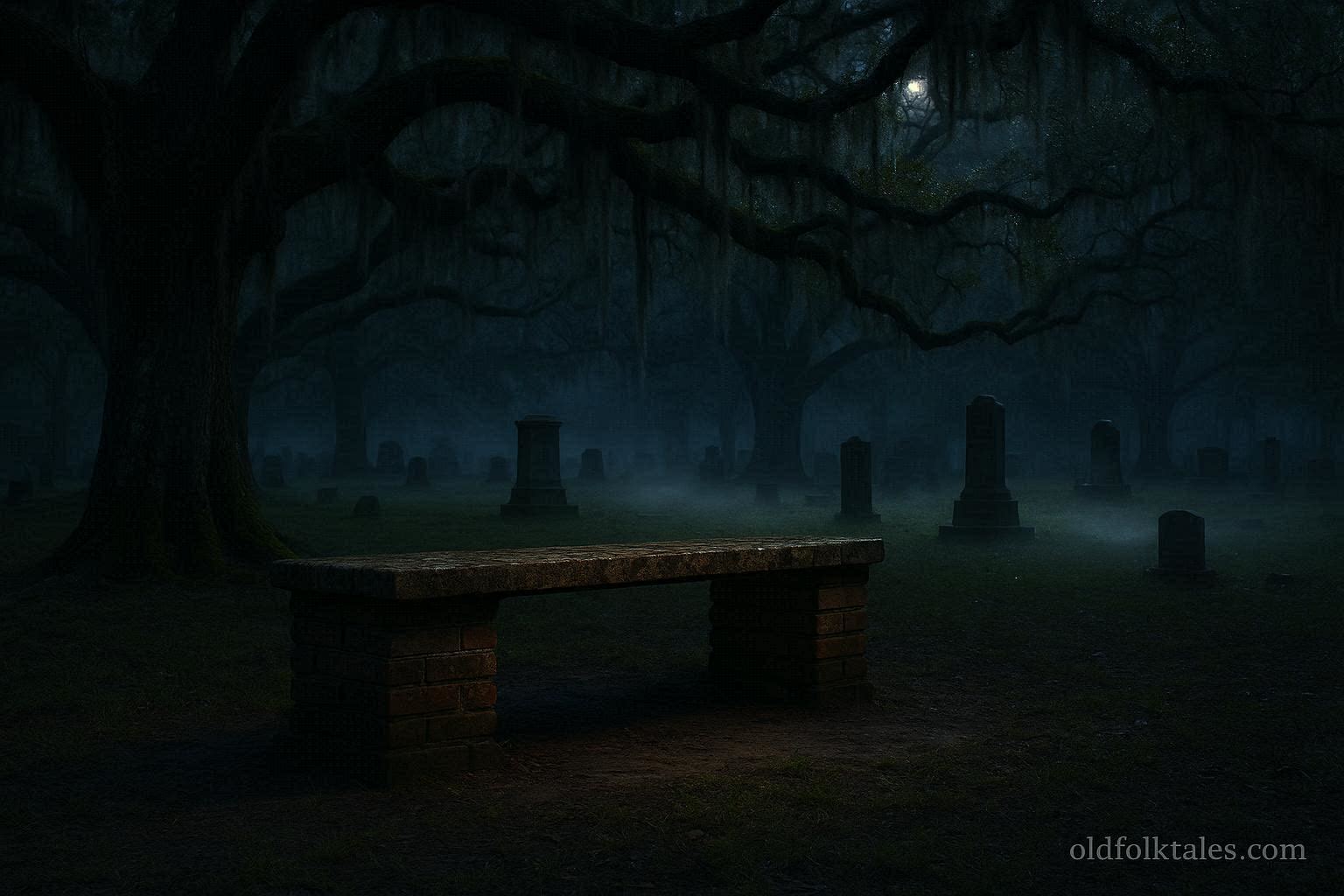
Deep inside the Lake Helen Cemetery rests a simple brick bench. It does not look extraordinary at first glance. It is weathered by years of Florida rain and sun. Fallen leaves gather around its base, and the air near it feels strangely still. During the day, visitors may sit on it without a second thought. But once night falls, the story changes.
The legend says that if a person sits alone on the chair exactly at midnight, they may summon a spirit or even the Devil himself. Some say the chair grants wishes. Others claim it allows the dead to whisper secrets into the ears of the living. The rules vary depending on who tells the story. Some insist you must bring a can of soda, open it, and place it on the ground beside the chair. When you return at dawn, the can will be empty, as though something unseen has taken a drink. Others say you must sit silently without speaking, waiting for a presence to make itself known.
Encounter the strange and the unseen — from Bigfoot to regional monsters hiding in America’s forests.
One autumn evening, four college students from Orlando decided to test the legend for themselves. They had heard the story passed around campus, mixed with laughter and nervous excitement. None of them truly believed it, but curiosity pulled them toward Cassadaga. The town already carried an atmosphere that felt different from anywhere else. Psychic reading signs lined the streets, and old wooden houses creaked softly in the night breeze.
As midnight approached, they parked outside the cemetery gates. The moon was thin and pale, casting faint light across rows of gravestones. Crickets chirped loudly, but beyond that, silence seemed to swallow every sound. They walked slowly toward the brick bench, their flashlights cutting narrow beams through the darkness.
The chair looked ordinary. It sat between two large oak trees, roots twisting around old headstones. One of the students, Daniel, volunteered to sit first. He laughed nervously as he lowered himself onto the brick surface. His friends stood a few feet away, watching.
For several minutes, nothing happened. The air felt thick and humid, as Florida nights often do. Daniel tapped his foot impatiently. Then, without warning, the wind shifted. The trees began to rustle violently even though moments before there had been no breeze at all. The temperature seemed to drop.
Daniel froze.
He later described the sensation as pressure on his shoulders, as though invisible hands had rested upon him. He claimed he heard faint whispering near his ear. The words were not clear, but the tone felt urgent. He leaped from the chair, pale and shaken.
His friends insisted it was only imagination. They laughed again, trying to dismiss the tension. But none of them volunteered to sit next.
The legend of the Devil’s Chair has existed in Cassadaga for decades, passed from one generation to the next. Some believe the chair is connected to the town’s spiritualist roots. Cassadaga was founded in the late nineteenth century as a spiritualist camp meeting community. Residents believed in communicating with spirits and holding séances. In such a place, it is easy to see how a simple bench could become the center of supernatural speculation.
Others argue that the legend serves as a warning. Cemeteries are sacred places, and stories like the Devil’s Chair discourage reckless behavior. Teenagers seeking thrills may think twice before trespassing at midnight if they fear encountering something beyond explanation.
There are countless versions of what happens to those who sit on the chair. One story tells of a man who mocked the legend and demanded proof of any spirit’s existence. He sat confidently at midnight and felt nothing. But in the weeks that followed, he reportedly experienced strange dreams and unexplained noises in his home. Another tale describes a young woman who asked the chair for guidance about her future. She claimed to receive clarity in her thoughts afterward, as though an unseen force had answered her question.
Skeptics suggest that the eerie atmosphere of cemeteries combined with expectation creates powerful psychological effects. When people anticipate something supernatural, their senses heighten. Every rustling leaf becomes a whisper. Every breeze feels like a touch.
Yet believers insist there is more.
They say the Devil’s Chair is not about evil but about boundaries. It represents the thin line between the living and the dead. Sitting upon it at midnight is symbolic. Midnight is traditionally considered a liminal hour, a moment between one day and the next. Cemeteries are places between memory and presence. In such spaces, imagination and belief become strong forces.
Over time, local authorities have discouraged nighttime visits to the cemetery. Not because of confirmed supernatural activity, but because crowds sometimes gather hoping to witness something extraordinary. Despite warnings, the legend persists. Social media posts and whispered conversations keep it alive.
Today, visitors who come to Cassadaga during daylight hours often seek spiritual readings or historical tours. The Devil’s Chair remains in the cemetery, unchanged and silent. It does not move. It does not glow. It waits.
Whether it truly grants wishes or summons spirits is impossible to prove. What is certain is that the story continues to draw people into reflection about belief, fear, and the power of folklore. A simple brick bench became legendary because people chose to tell its story again and again.
The Devil’s Chair teaches that stories themselves hold power. When communities repeat a legend, it becomes woven into the identity of a place. Cassadaga is known for spirituality and mystery, and the chair reflects that cultural heritage.
Long after Daniel and his friends returned home, they still spoke of that night. They could not agree on what happened. Some insisted it was wind and nerves. Daniel remained quiet whenever the subject arose. He never sat on the chair again.
The brick bench still stands beneath the oak trees. By day, it is simply a seat among gravestones. By night, it becomes something more in the minds of those who dare approach it.
And at midnight, when the air grows still and shadows stretch long across the cemetery paths, some say the chair is never truly empty.
Click now to read all American Legends — heroic tales where truth and imagination meet, defining the American spirit.
Moral Lesson
Legends remind us to respect sacred places and understand the power of belief. Curiosity should be balanced with caution, especially in places tied to history and memory.
Knowledge Check
- Where is the Devil’s Chair located?
In Lake Helen Cemetery in Cassadaga, Florida - What time must someone sit on the chair according to legend?
Midnight - What is Cassadaga historically known for?
Spiritualism and communication with spirits - What are people said to experience on the chair?
Whispers, pressure, or granted wishes. - What does the legend symbolize?
The boundary between the living and the dead - Why do some believe the story continues?
Because folklore strengthens community identity
Source
Adapted From University of Central Florida Special Collections
Cultural Origin
Cassadaga, Florida spiritualist community