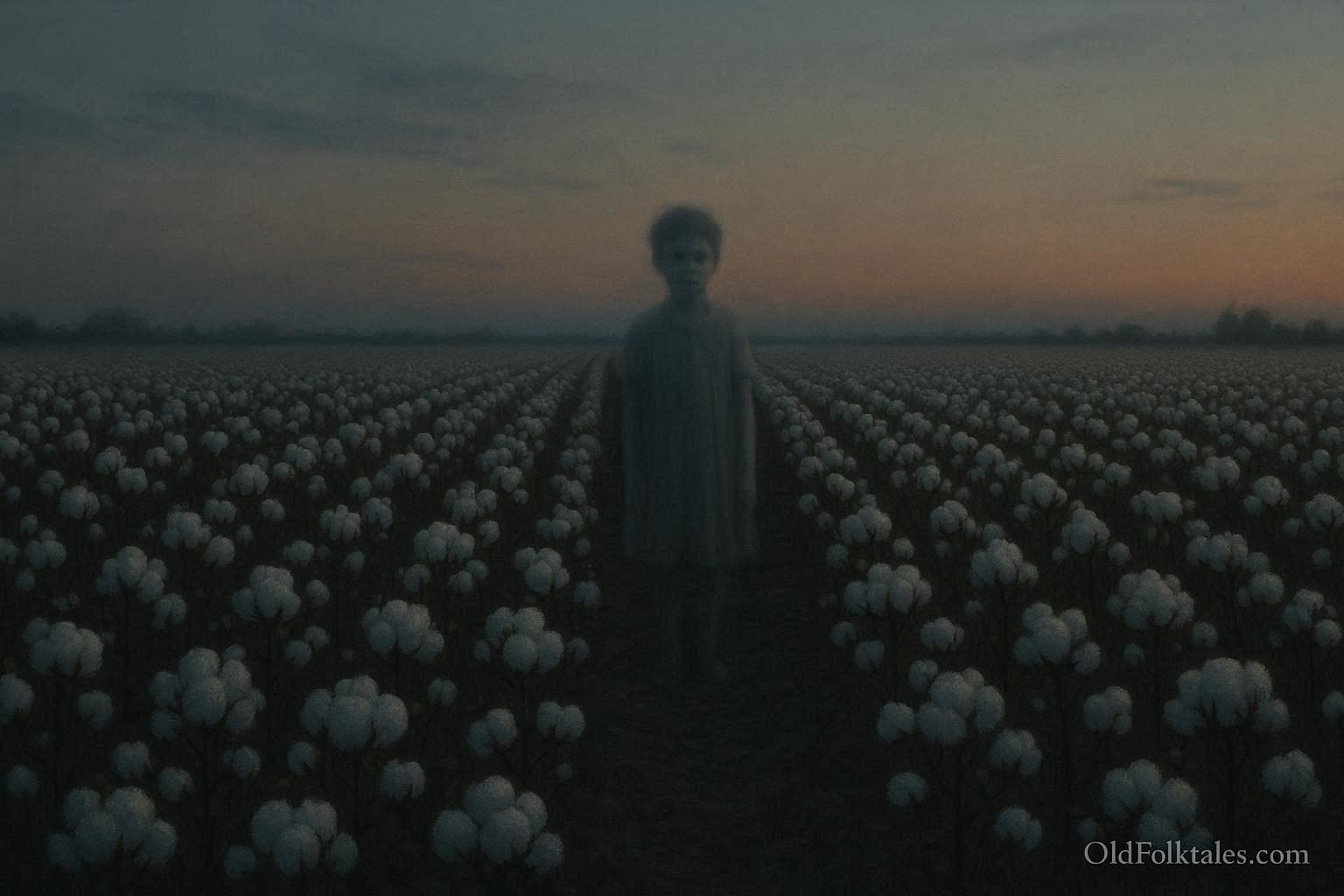
The fields stretched far beyond what the eye could see, filled with rows of cotton that moved gently whenever the wind passed through. During the day, the land was alive with activity, voices, and the constant rhythm of work. But as evening approached, everything began to slow, and a quiet stillness settled over the fields.
It was in this stillness that the first sightings began.
At first, the workers thought it was nothing more than imagination. Long hours under the sun could make the eyes play tricks, and the fading light of dusk often made shapes seem different than they truly were. Yet the stories continued, and they all described the same thing. A small figure, standing alone between the rows of cotton.
The figure looked like a child.
No one ever saw the child clearly. Its form appeared faint, almost blending into the pale cotton around it. It never spoke or made sudden movements. Instead, it stood quietly, as if waiting or searching for something that could not be seen.
Discover chilling ghost tales and haunted places that echo through America’s towns and countryside.
One evening, a young worker named Samuel remained in the field longer than the others. The sun had already begun to disappear, and shadows stretched across the land. As he worked, he felt an unusual stillness, as though the air itself had become heavier.
He paused and looked up.
There, several rows ahead of him, stood the child.
It was small and motionless, facing in his direction. Samuel felt a chill despite the warmth of the evening. He called out softly, thinking perhaps it was a lost child from nearby homes. But there was no response.
He took a step forward, then another. The cotton brushed against his legs as he moved, but the child did not react. It simply remained there, silent and still.
Then, without warning, the wind moved through the field.
The cotton plants swayed, creating a soft whispering sound. Samuel blinked, and in that brief moment, the figure was gone. There were no footsteps, no movement away, no sign that anyone had been there at all.
Only emptiness remained.
When Samuel returned and shared what he had seen, the reaction was not one of surprise. Instead, others began to speak, revealing that they too had seen the same figure. Some had noticed it from a distance, while others had felt its presence without fully seeing it.
An older woman among them finally explained what many had been afraid to say aloud.
She spoke of a spirit child.
According to her, the fields held more than just crops. They held memories. Stories of people who had lived, worked, and suffered there long before. Some believed that not all spirits had found peace, especially those whose lives had ended too soon or without comfort.
The child, she said, was one of them.
It was not seen during the day, when the world was loud and full of movement. It appeared only at dusk, when the boundary between the physical and the spiritual felt thinner. In that quiet moment between light and darkness, the child wandered.
More encounters were shared over time.
Some workers reported hearing soft footsteps behind them, only to turn and find nothing. Others claimed they heard faint humming, like a lullaby carried gently by the wind. A few said they saw the child walking slowly between the rows, disappearing whenever they tried to get closer.
Despite the fear, there was something else that many felt.
A deep sadness.
The spirit never caused harm. It did not chase or threaten anyone. Instead, it seemed lost, moving through the same paths again and again. It was as though it was searching for something it had lost, or perhaps trying to find a way to rest.
Over time, some workers began to leave small items at the edge of the fields. Pieces of cloth, bits of food, or simple objects. These were not acts of fear, but of respect. A quiet acknowledgment that the spirit existed and was not to be ignored.
The offerings were never disturbed in any obvious way, yet people believed they served a purpose. They believed it helped bring some form of comfort to the wandering presence.
As the years passed, the land changed. New people came, and many of the old stories faded. The fields were no longer worked in the same way, and the voices that once filled them grew fewer.
But the story did not disappear completely.
Even in later years, there were occasional reports. A figure seen at dusk. A feeling of being watched while walking through old fields. A faint sound carried by the wind when no one else was around.
Those who knew the story understood what it meant.
They believed the land still remembered.
The legend of the spirit child became more than just a ghost story. It became a reminder that places hold history, and that not all stories end when life does. Some continue quietly, unseen but still present, waiting to be acknowledged.
And in the brief moments when day turns to night, when the world grows still and silent, some say the child can still be seen.
Standing among the cotton.
Watching.
Waiting.
Click to read all American Folktales — timeless oral stories passed through generations across the United States.
Moral Lesson
Places carry memories, and we should respect the past because some stories continue even when they are no longer seen.
Knowledge Check
- What did workers report seeing in the cotton fields?
A child spirit standing or wandering between the rows. - When did the spirit usually appear?
At dusk. - Did the spirit harm anyone?
No, it did not harm anyone. - What feeling did people associate with the spirit?
Sadness and longing. - What did some workers do in response to the sightings?
They left small offerings as a sign of respect. - What does the story suggest about certain places?
They can hold memories and stories from the past.
Source
Adapted from materials preserved in the Smithsonian Institution
Cultural Origin
Southern plantation-era African American folklore