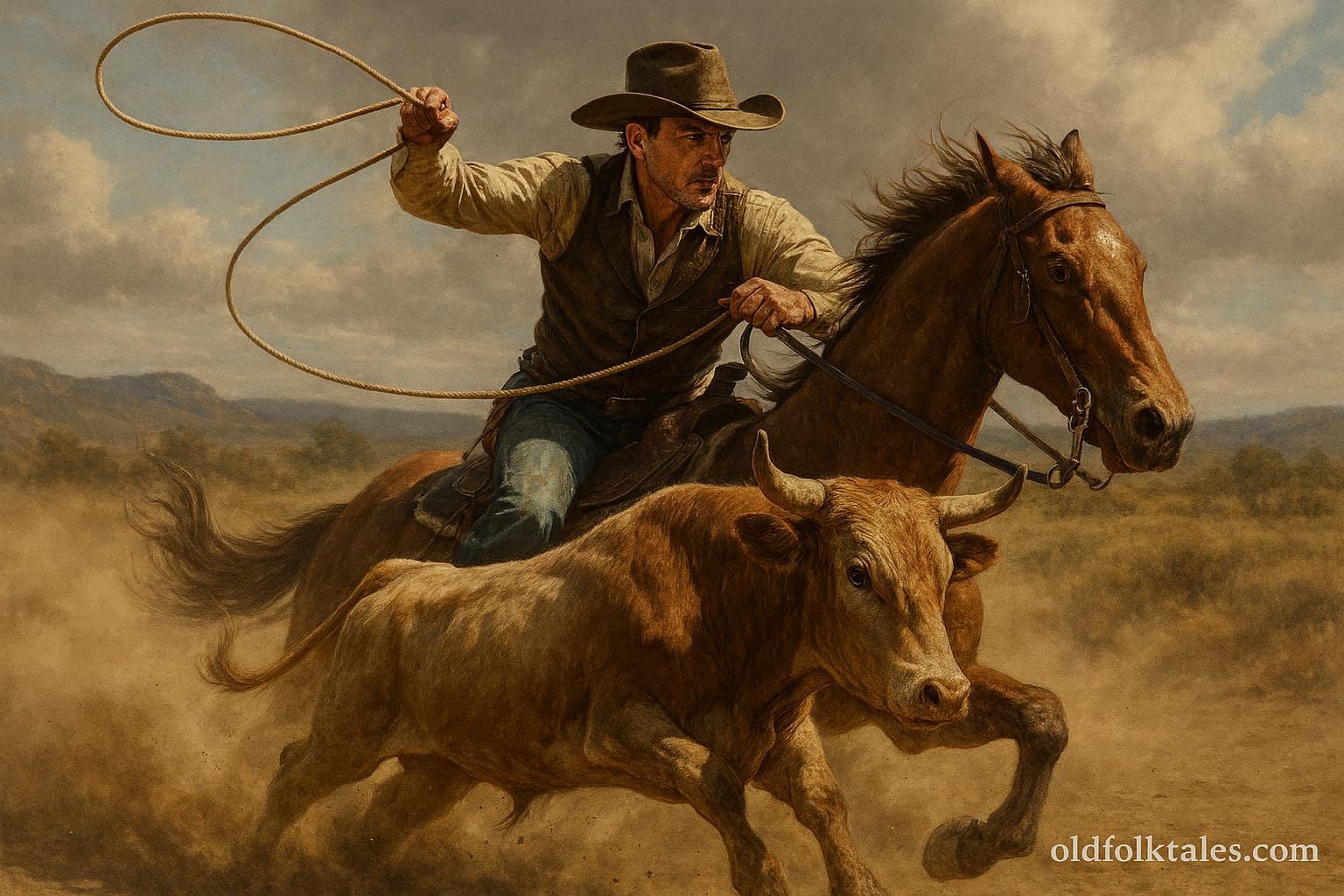
Across the wide open plains of the American West, cattle work was more than a job. It was a way of life shaped by long days, physical strength, and deep understanding of animals and land. Cowboys moved with the rhythm of the herds, guiding them across distances that seemed endless under the open sky.
Among these cowboys was a man whose skill would one day set him apart from all others.
His name was Bill Pickett.
From a young age, Bill showed a natural ability to work with animals. He watched closely, learning not only the movements of cattle but also their behavior. He understood when they were calm, when they were restless, and how they reacted under pressure. This awareness became the foundation of his skill.
But what made Bill different was not just what he learned.
It was what he imagined.
During his early years, Bill observed how certain animals controlled others. He noticed how dogs would guide livestock, sometimes using surprising methods to gain control. These observations stayed with him, shaping an idea that would later change everything.
Explore the heart of America’s storytelling — from tall tales and tricksters to fireside family legends.
As he grew older and gained more experience, Bill began to test new ways of handling cattle.
Most cowboys relied on ropes and physical force to control animals. It was effective, but often difficult and unpredictable. Bill believed there could be another way, something faster and more precise.
One day, while working with a particularly stubborn steer, he put his idea into action.
Instead of relying solely on his rope, he approached the animal directly, moving with speed and confidence. At the right moment, he leaped toward it, using a technique that surprised everyone who saw it. His movements were controlled, calculated, and unlike anything others had attempted before.
The steer was brought under control.
Those who witnessed it were amazed.
At first, many saw it as unusual, even risky. It was not the traditional way of doing things, and change was not always easily accepted. But Bill continued to refine his method, improving it with each attempt.
Over time, his skill became undeniable.
He was faster, more precise, and more effective than many who relied on older techniques. Word of his ability spread quickly, and people began to take notice. What once seemed strange now appeared innovative.
As his reputation grew, Bill was invited to demonstrate his skills in public settings.
These events brought together crowds eager to see displays of strength and ability. Cowboys from different regions gathered to compete and show what they could do. It was here that Bill’s technique truly began to shine.
He performed with confidence, moving with a level of control that seemed almost effortless. Each action was deliberate, each movement carefully timed. The audience watched in amazement as he handled cattle in ways they had never seen before.
His technique became known as something new.
Something important.
It was more than just a skill. It was an innovation that changed how people thought about cattle handling. What had once been done in one way could now be done in another, opening the door to new possibilities.
Despite his growing fame, Bill remained focused on his work.
He understood that his ability came from practice, observation, and respect for the animals he worked with. He did not treat his skill as something to boast about, but as something to continue improving.
There were challenges along the way.
Not everyone accepted his methods immediately. Some questioned whether his approach should be considered part of traditional cowboy work. Others doubted whether it could be safely repeated by others.
But Bill did not allow doubt to stop him.
He continued to demonstrate, to teach, and to prove that his technique had value. Over time, acceptance grew. What was once questioned became recognized.
His influence spread beyond his own work.
Other cowboys began to learn from him, adapting his methods and incorporating them into their own practices. The technique became part of a larger tradition, shaping the future of rodeo performance and cattle handling.
Years passed, but his legacy remained.
The innovation he introduced did not disappear. Instead, it became a lasting part of cowboy culture, remembered and practiced by those who followed in his path.
People came to understand that true skill is not only about strength, but about creativity.
It is about seeing what others do not see.
About taking what is known and finding a better way.
Bill Pickett’s story became more than just a tale of talent.
It became a reminder.
That progress often begins with a single idea.
An idea that challenges tradition, proves itself through action, and leaves a mark that cannot be erased.
Even today, when people watch skilled performances in rodeo arenas, they are witnessing the result of that innovation.
A technique born from observation.
Refined through practice.
And carried forward by those who recognize its importance.
Click now to read all American Legends — heroic tales where truth and imagination meet, defining the American spirit.
Moral Lesson
Innovation and skill can transform tradition when guided by observation, courage, and persistence.
Knowledge Check
- What made Bill Pickett different from other cowboys?
He developed a new technique for handling cattle. - What inspired his innovation?
His observation of animal behavior. - How did people first react to his method?
They found it unusual and questioned it. - Where did he demonstrate his skills publicly?
At events where cowboys gathered to perform and compete. - What happened to his technique over time?
It became widely accepted and influenced others. - What does the story teach about innovation?
New ideas can change traditions when they are proven effective.
Source
Adapted from materials preserved in the National Cowboy and Western Heritage Museum
Cultural Origin
African American cowboy folklore