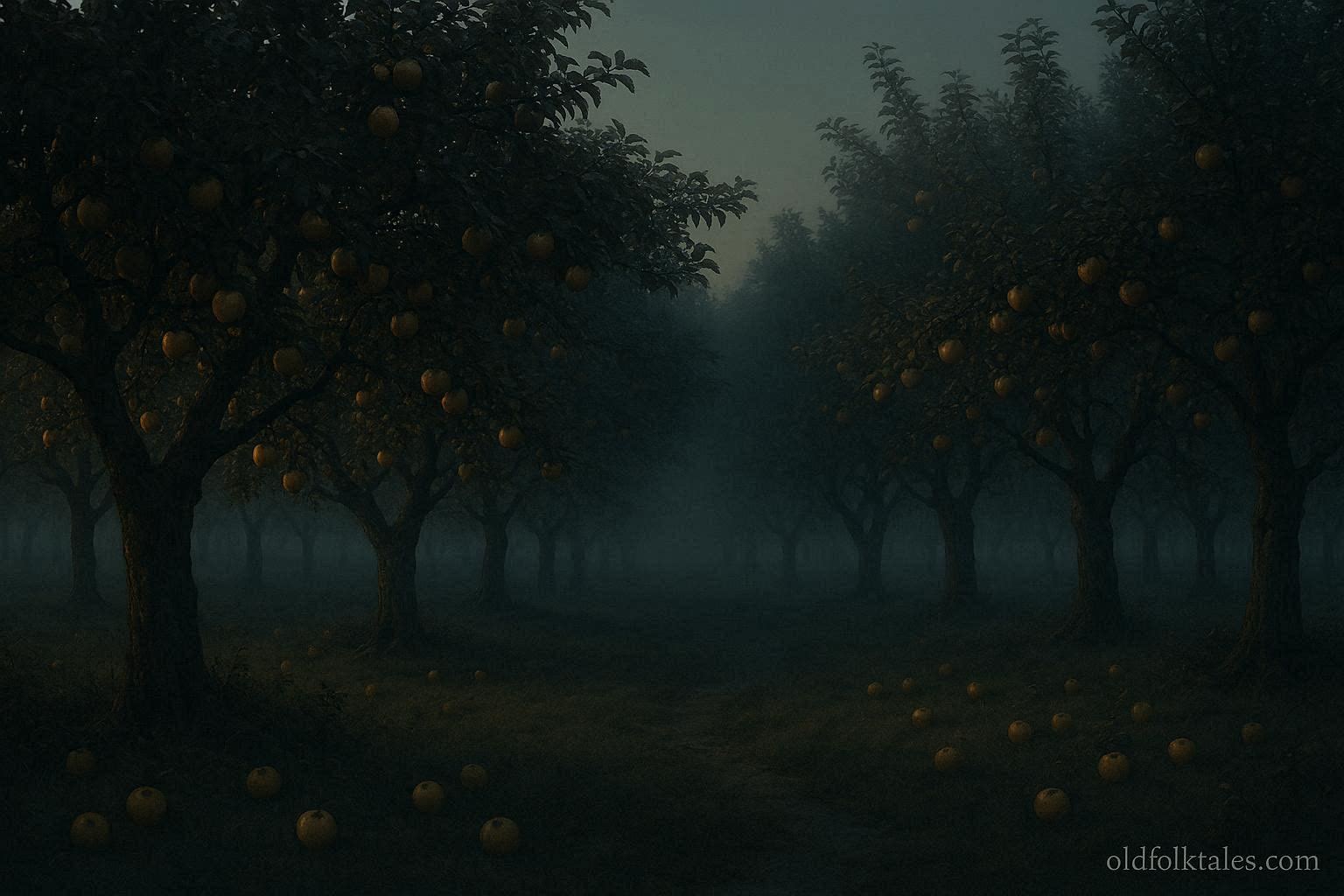
At the edge of a quiet farming community, where fields stretched wide and seasons shaped the rhythm of daily life, there stood an orchard unlike any other. It had been there for many years, planted long ago by hands that were no longer present, yet its trees remained strong and full.
During the growing season, the orchard appeared ordinary.
Branches filled with leaves, blossoms turning slowly into fruit, and the steady progress of nature unfolding as expected. Farmers who passed by would glance at it without much thought, seeing only another part of the land.
But as time went on, something unusual became clear.
The fruit did not fall.
In every orchard, there comes a time when ripened fruit drops to the ground. It is a natural part of the cycle, a sign that the season is reaching its peak. But in this place, that moment never came.
The fruit would grow.
It would ripen.
It would reach the point where it should fall.
Yet it remained.
Hanging in perfect stillness, as though held in place by something unseen.
At first, people thought little of it.
Perhaps the timing was different. Perhaps the conditions of the soil or the air had delayed the process. But as days turned into weeks, and weeks into the passing of the season, the pattern remained unchanged.
The fruit stayed on the branches.
Even when the wind moved through the area, bending grass and shifting leaves, the orchard remained calm. Its trees did not sway in the same way. The fruit did not loosen or drop.
Encounter the strange and the unseen — from Bigfoot to regional monsters hiding in America’s forests.
It held its place.
As though time itself had slowed within the boundaries of that land.
Farmers began to speak of it.
Some approached the orchard to take a closer look. They reached for the fruit, expecting it to behave as it always had elsewhere. But when they touched it, they felt something unusual.
It was firm.
Still fresh.
Not overripe, not spoiled.
As though it existed outside the natural passage of time.
Those who tried to remove it found that it did not come away easily. It resisted in a way that could not be explained by the strength of the stem alone. It was as if the branch and the fruit were bound together by more than physical connection.
Word spread through the community.
The orchard was no longer seen as ordinary.
It became a place of quiet curiosity and growing caution. People visited it less often, choosing instead to observe it from a distance. The stillness within it created a feeling that was difficult to describe.
Not fear exactly.
But awareness.
The elders of the community began to speak of what it might mean.
They reminded others that land carries memory. That places shaped by long years of care, effort, and presence do not simply forget what has happened within them. They spoke of balance, and of how certain actions could leave lasting impressions.
According to their understanding, the orchard had once been tended with great care.
It had been more than a source of food. It had been a place of patience, respect, and steady work. Every tree had been planted with intention, every harvest taken with awareness of what the land provided.
But something had changed.
No one could say exactly when, but the balance had shifted. Whether through neglect, misuse, or the passing of time without proper care, the connection between the land and those who worked it had weakened.
The orchard responded.
Not with destruction, but with stillness.
The fruit no longer followed the natural cycle. It remained where it was, as though waiting. Not falling, not decaying, not moving forward.
Waiting.
One story told of a young farmer who decided to understand the orchard for himself. He had heard the stories but believed that there must be a simple explanation.
He entered the orchard one evening as the light began to fade.
The air inside felt different.
Not colder, not warmer, but quieter. The usual sounds of insects and distant movement seemed to fade, leaving only a deep stillness that settled over the space.
He walked among the trees, observing the fruit.
Each piece hung perfectly in place, unmoving, untouched by the breeze that could be seen beyond the orchard’s edge. He reached out and placed his hand on one.
It did not move.
He pulled gently.
It remained.
He pulled again, with more effort this time, but the result was the same. The fruit resisted, as though it belonged exactly where it was and nowhere else.
For a moment, he paused.
He looked around, noticing how unchanged everything appeared. No fallen fruit, no signs of decay, no evidence of the cycle that should have taken place.
It was as if the orchard had chosen to stop.
The realization settled in slowly.
This was not a place meant to be taken from without understanding. It was a place that required respect, not force.
He stepped back, releasing the fruit.
As he left the orchard, the stillness remained behind him. The air outside felt different again, filled with the ordinary sounds of the land.
When he shared his experience, his words were careful.
He did not speak of fear.
He spoke of balance.
Over time, the orchard became a quiet reminder within the community. It was not avoided completely, but it was approached with awareness. People no longer attempted to take from it without thought. Instead, they observed it, respecting what it had become.
The fruit continued to grow.
To ripen.
And to remain.
Season after season, the pattern did not change.
And so the orchard stood, unchanged yet deeply meaningful, holding within it a lesson that could not be ignored.
That not all things are meant to follow the same path forever.
And that when balance is disturbed, the land itself may respond in ways that call for reflection, patience, and respect.
Discover chilling ghost tales and haunted places that echo through America’s towns and countryside.
Moral Lesson
When balance with nature is lost, the world may respond in ways that remind us to act with respect and understanding.
Knowledge Check
- What was unusual about the orchard?
The fruit never fell from the trees. - How did the fruit appear over time?
It remained fresh and unchanged. - What happened when people tried to pick the fruit?
It resisted and would not come off easily. - What did the elders believe about the orchard?
It had lost its natural balance and was responding to it. - What did the young farmer realize?
The orchard required respect, not force. - What lesson does the story teach?
Nature should be treated with care and balance.
Source
Adapted from materials preserved by Cornell University
Cultural Origin
Northeastern agricultural folklore