In the rural stretches of South Carolina, where open land meets quiet roads and scattered homes, the town of Bishopville became known for something that could not be easily explained. It was not a loud or dramatic event that drew attention, but something far more subtle.
It began with footprints.
They appeared without warning.
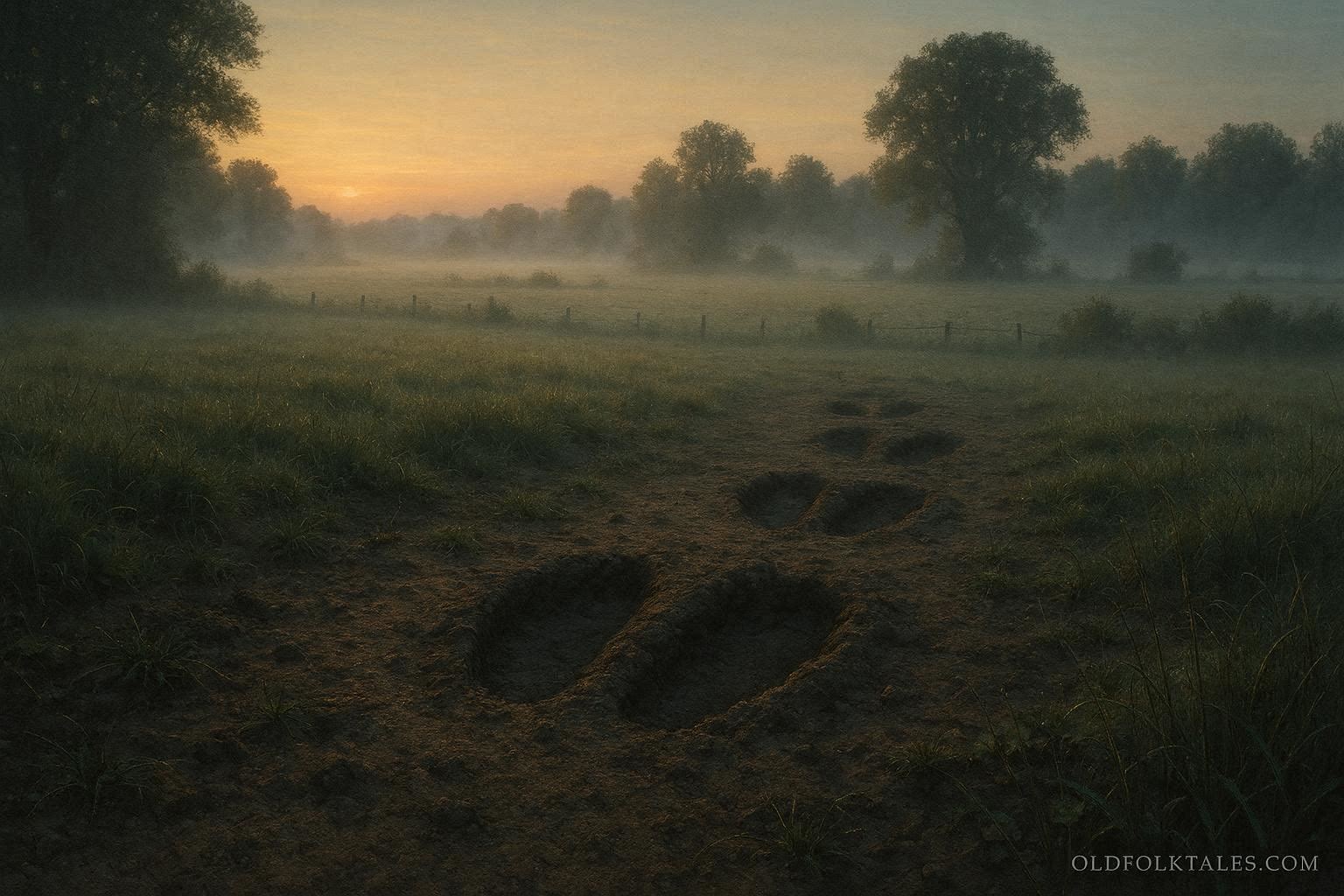
Early one morning, a farmer walking across his land noticed unusual marks pressed into the soil. At first, he assumed they were from an animal. But as he moved closer, he realized something was not right.
The prints were large.
Each one showed three distinct toes.
And they were spaced in a way that suggested something walking upright.
He followed the tracks as far as he could. They moved steadily across the field, passing over ground that had been undisturbed the night before. There were no signs of struggle, no broken plants, no indication of what had made them.
Only the prints remained.
By the next day, more people began to notice similar markings.
In different areas of the town, the same pattern appeared. Three-toed prints, pressed deep into the ground, forming trails that seemed to begin and end without explanation. Some led across roads. Others passed through fields and near homes.
Step into shadowy legends of restless spirits and ghostly travelers in American Ghost Stories.
None revealed their origin.
The community began to take notice.
At first, many believed it must be an unknown animal. Something moving through the area at night, leaving behind evidence of its presence. But as more tracks were found, that explanation became harder to accept.
The prints did not follow typical patterns.
They did not circle back.
They did not lead to a den or resting place.
They simply appeared, crossed the land, and disappeared.
Curiosity grew.
People began to examine the tracks more closely. Some measured them, noting their size and depth. Others tried to follow them for longer distances, hoping to discover where they led.
But every attempt ended the same way.
The tracks stopped.
Abruptly.
As though whatever made them had vanished.
Elders in the area began to share their thoughts.
They spoke of signs that were not meant to be understood through ordinary reasoning. In their teachings, marks left on the land could carry meaning beyond what was visible. They could be messages, reminders, or indications of something moving between worlds.
The footprints, they said, should not be dismissed.
They should be observed.
Respected.
Understood in a deeper way.
One account tells of a young man who decided to stay awake through the night, hoping to witness whatever was leaving the tracks. He chose a field where prints had appeared the previous evening and positioned himself at a distance where he could watch without disturbing the area.
The night was quiet.
There was no wind.
No movement.
Time passed slowly as he remained still, listening to the silence around him. Hours went by, and nothing changed. He began to wonder if the tracks only appeared when no one was watching.
Then, just before dawn, something shifted.
Not a sound.
Not a clear movement.
But a feeling.
The air seemed to grow heavier, as though something had entered the space without making its presence known. He focused his attention on the ground in front of him.
And then he saw it.
A mark forming in the soil.
There was no visible foot.
No shape.
Yet the ground pressed downward, creating the outline of a three-toed print. Another appeared a short distance away, then another, each one forming as though something invisible was walking across the field.
He remained completely still.
Watching.
The prints continued, moving steadily across the land, following a path that seemed deliberate. There was no sound of footsteps, no disturbance beyond the marks themselves.
Then, as suddenly as it had begun, it stopped.
The air felt lighter again.
The space returned to stillness.
The young man waited until the sun began to rise before approaching the area. The prints were there, clear and fresh, just as he had seen them form. He followed them for a short distance until, as others had described, they ended without explanation.
When he shared what he had witnessed, people listened carefully.
Some believed him.
Others remained uncertain.
But no one could deny the evidence left behind.
The tracks continued to appear over time, though never in a predictable pattern. Some nights passed without incident, while others brought new trails across different parts of the land.
The town gradually accepted the mystery as part of its identity.
It was not something that caused panic.
Nor was it something that could be solved.
It simply existed.
A quiet reminder that not everything could be explained.
Even now, stories of the Bishopville tracks continue to be shared. Visitors come to see the places where they once appeared, walking the same ground and imagining what might have passed through.
And though the prints are not always there, the possibility remains.
That somewhere, in the stillness of night, something moves across the land.
Leaving behind only a sign.
Three marks in the earth.
Clear.
Deliberate.
And impossible to ignore.
Click to read all American Cryptids & Monsters — creatures of mystery and fear said to inhabit America’s wild landscapes.
Moral Lesson
Not all mysteries are meant to be solved, and some signs exist simply to remind us that the world holds more than what we can see.
Knowledge Check
- Where did the unusual footprints appear?
In fields around Bishopville, South Carolina. - What made the footprints different?
They had three toes and appeared unusually large. - When were the tracks usually found?
In the morning after appearing overnight. - What did the young man witness?
He saw the footprints form without a visible source. - Why couldn’t the tracks be explained easily?
They appeared and disappeared without any clear origin. - What lesson does the story teach?
Some mysteries exist beyond human understanding.
Source
Adapted from materials preserved by University of South Carolina
Cultural Origin
South Carolina folklore