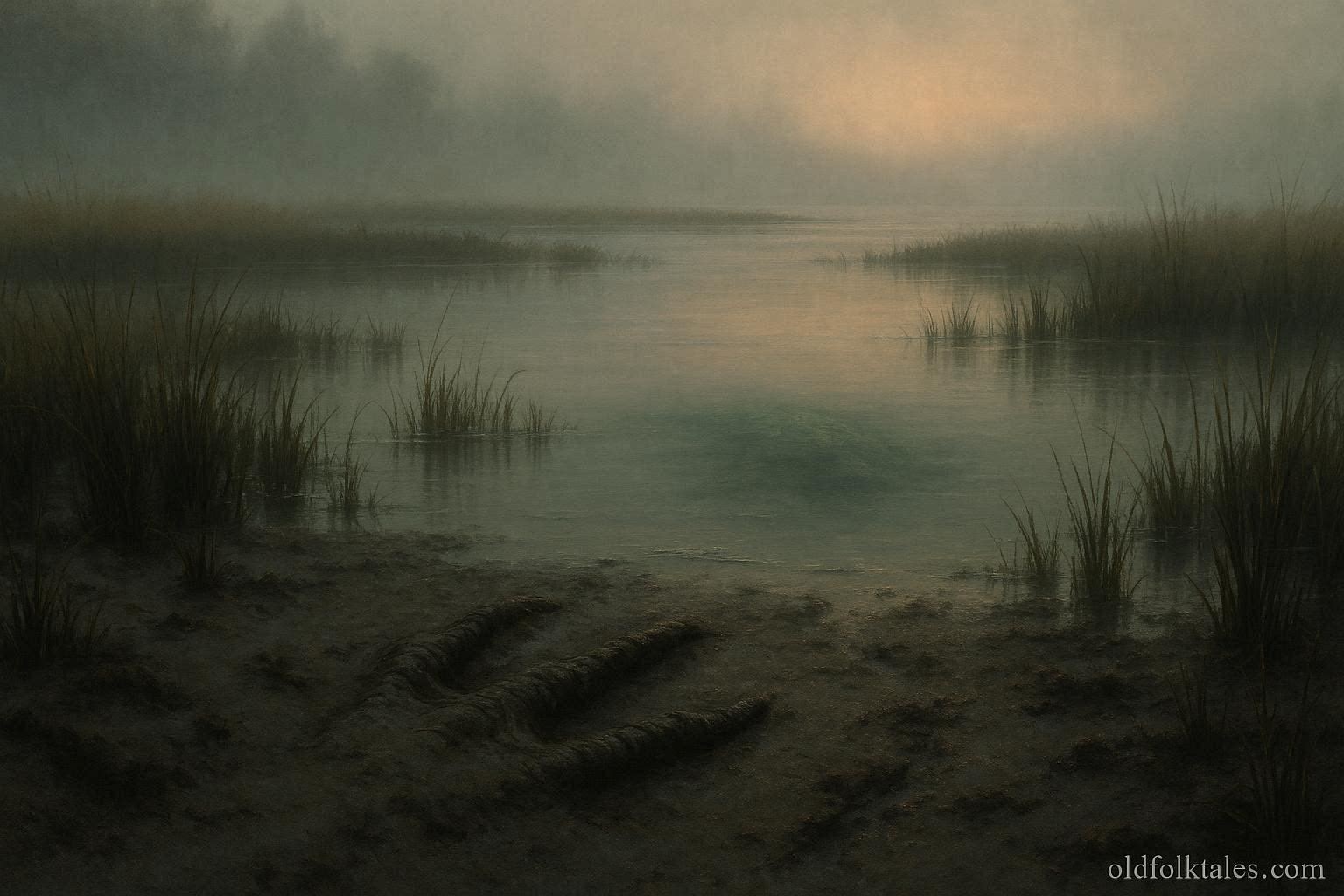
Along the quiet wetlands of Virginia Coastal Marshes, where land and water meet in a shifting boundary of reeds and shallow pools, life moves in slow and careful patterns. The air carries the scent of salt and earth, and the ground beneath one’s feet often feels soft, marked by the natural impressions of birds and small animals.
But among these familiar signs, something unfamiliar has been found.
It begins with tracks.
Not the light imprints of birds.
Not the scattered marks of small creatures.
But deep, deliberate impressions pressed into the wet soil along the edges of the marsh.
They appear overnight.
Without sound.
Without witness.
Each mark shows a distinct shape.
Curved.
Sharp.
Like the imprint of a claw.
And always in patterns that suggest movement.
The first discovery was made by a local fisherman walking the marsh at dawn. He had come to check his nets, expecting nothing more than the usual quiet routine. But as he moved along the water’s edge, something caught his attention.
The ground had been disturbed.
He stepped closer.
What he saw made him pause.
The prints were larger than anything he recognized. Each one curved inward, leaving behind a shape that did not match any known animal in the area. They formed a path, leading from the water, across a stretch of marsh, and then back again.
Explore how American legends shaped the nation — from frontier heroes to Revolutionary War tales.
As though something had emerged.
Moved across the land.
And returned to the water.
He followed the trail as far as he could, but like many before him, he found no clear beginning or end. The tracks seemed to appear suddenly, then vanish just as quickly.
By the next few days, others began to report similar findings.
In different parts of the marsh, the same claw-like impressions appeared. Some were fresh, still holding water within their depth. Others were fading, slowly being erased by the shifting ground.
The pattern remained consistent.
Always near the water.
Always leading in and out.
Curiosity spread through the community.
Some believed it to be an unknown animal, something that had adapted to the marsh and remained hidden from view. Others felt the marks carried a different meaning, one that could not be explained by ordinary understanding.
Elders spoke of the marsh as a place of transition.
A space where boundaries are not fixed.
Where land becomes water, and water returns to land.
In such places, they said, it is not uncommon for things to exist that do not fully belong to one world or the other.
The tracks, they explained, should be treated with caution.
Not fear.
But awareness.
One account tells of a woman who lived near the marsh and had grown used to its rhythms. She often walked along its edges at dusk, observing the movement of the water and the quiet life it held.
One evening, she noticed something unusual.
Fresh tracks.
Deeper than the ones she had seen before.
They were still forming.
As though whatever made them had passed only moments earlier.
She followed them carefully, keeping her distance from the water’s edge. The marks led in a slow curve, moving toward a narrow inlet where the water darkened.
She stopped.
Watching.
Waiting.
For a moment, nothing happened.
Then the surface of the water shifted.
Not with the wind.
Not with the movement of fish.
But with something beneath it.
A shape began to rise.
Slowly.
Quietly.
The water parted just enough to reveal a form.
Not fully.
Only a part.
What she saw was green.
Dark and muted, blending with the color of the marsh.
And from that form, something extended outward.
A claw.
Curved.
Sharp.
Matching the marks she had followed.
It rested briefly at the surface, as though testing the air, before withdrawing again. The water closed over it, returning to its calm state.
She remained still, her attention fixed on the place where it had appeared.
But nothing else emerged.
The moment passed.
And the marsh returned to silence.
When she shared what she had seen, her account added to the growing number of stories. Each one carried a similar sense of quiet encounter, of something present but not fully revealed.
Over time, the legend of the Green Claw became part of the coastal folklore.
It was not spoken of loudly.
Not exaggerated.
But shared carefully, as something to be respected.
Those who walk the marsh now often look more closely at the ground.
They notice the patterns left behind.
They follow the edges of the water with a sense of awareness.
Most will see only the ordinary signs of life.
But some.
On certain mornings.
Or in the fading light of evening.
Will find the marks.
Curved.
Deep.
Leading from the water.
And back again.
And if they wait.
If they remain still.
They may witness something more.
A brief movement beneath the surface.
A shape rising just enough to be seen.
A claw.
Green and silent.
Before disappearing once more into the depths of the marsh.
Leaving behind only its tracks.
And the quiet reminder.
That some things exist where boundaries meet.
Seen only for a moment.
And understood only in part.
Click to read all American Cryptids & Monsters — creatures of mystery and fear said to inhabit America’s wild landscapes.
Moral Lesson
Some mysteries exist in the spaces between worlds, reminding us to respect what we do not fully understand.
Knowledge Check
- Where were the claw-like tracks found?
Along the coastal marshes of Virginia. - What made the tracks unusual?
They were large, curved, and shaped like claws. - When did the tracks usually appear?
Overnight. - What did the woman witness near the water?
A green claw rising briefly from the marsh. - Why is the marsh considered a special place?
It is a boundary between land and water. - What lesson does the story teach?
Some mysteries exist beyond full human understanding.
Source
Adapted from materials preserved by College of William & Mary
Cultural Origin
Virginia coastal folklore