Across wide stretches of farmland, where the sun rose early and rested late, work began each day with quiet determination. The fields extended far beyond the eye could easily follow, rows upon rows shaped by effort and time. The air carried the weight of labor, and each movement required strength that was not always easy to find.
The work was demanding.
It required patience.
It required endurance.
And most of all, it required the ability to continue even when the body felt tired and the mind felt heavy.
At first, the fields were filled only with the natural sounds of labor. The rhythm of tools moving through soil, the soft shifting of feet, the distant calls of birds. Each person worked in silence, focused on the task ahead.
But silence, over time, can become heavy.
It can make the work feel longer.
Harder.
Endless.
It was during such a time that something began to change.
Not suddenly.
Not all at once.
But with a single voice.
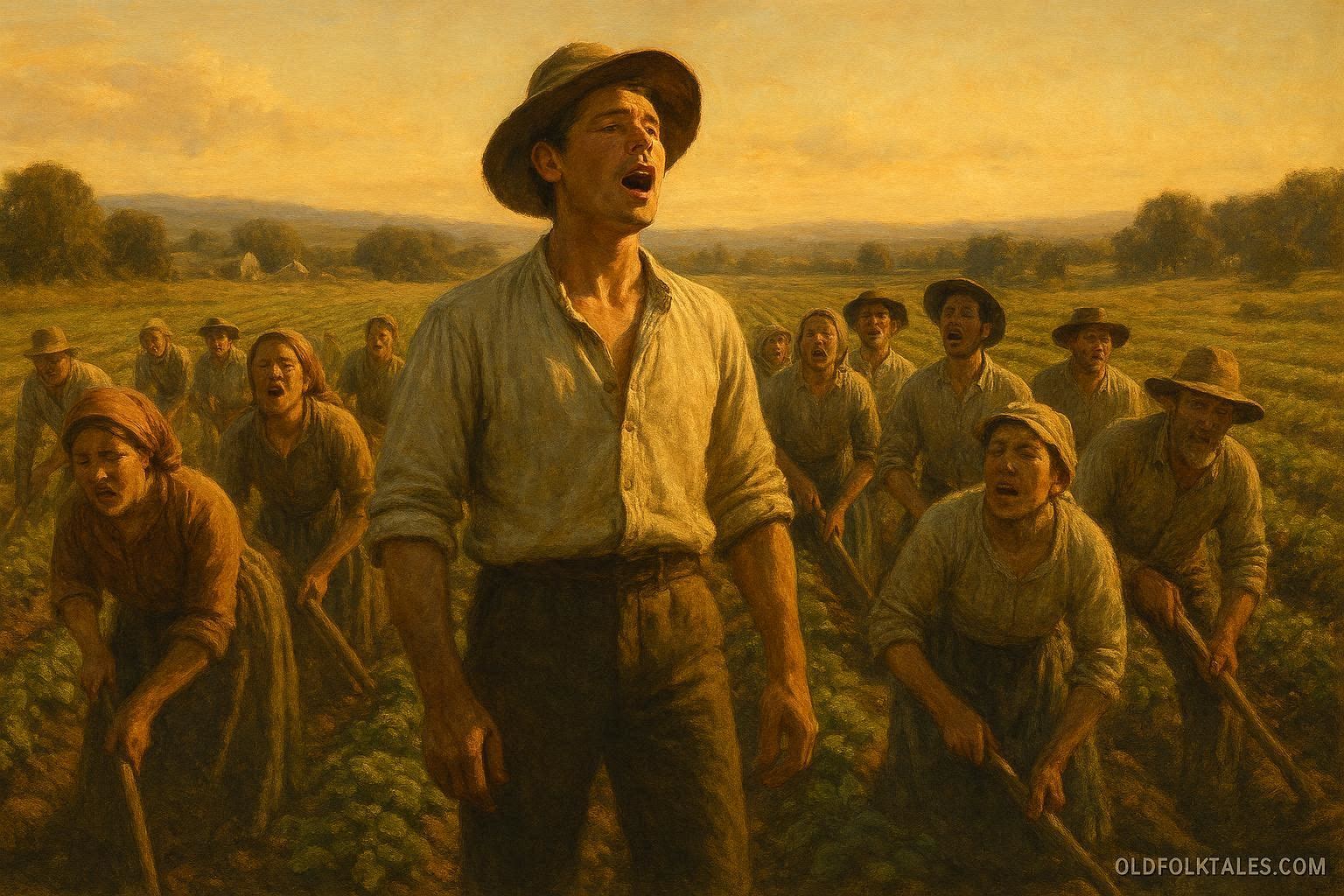
The first note rose quietly, almost blending into the air itself. It was not loud, not meant to draw attention, but it carried a clarity that made it impossible to ignore. The sound moved gently across the field, reaching those nearby before traveling farther outward.
People paused.
Only for a moment.
Just long enough to notice.
Then the voice continued.
Stronger now.
More certain.
It carried a rhythm that matched the movement of the work. Each note rose and fell in a steady pattern, creating something that felt both familiar and new at the same time.
Explore the heart of America’s storytelling — from tall tales and tricksters to fireside family legends.
The workers listened.
Some continued their tasks without looking up, but their movements began to change. The rhythm of the song guided their pace, making each motion feel more connected, more purposeful.
Others lifted their heads, turning toward the source of the voice.
The singer stood among them.
Not apart.
Not above.
But within the same line of work.
The voice did not demand attention.
It invited it.
And slowly, the field responded.
Another voice joined.
Then another.
Not in perfect harmony, but in shared effort.
The song grew.
It moved across the field, weaving through the rows, connecting one person to another. What had once been separate individuals working alone became something different.
A group.
A shared rhythm.
A collective strength.
The work did not become easier.
But it felt lighter.
Time, which had once stretched endlessly, began to move with the rhythm of the song. Each verse marked progress, each chorus carried them forward. The weight of silence was replaced with sound that gave shape to the day.
The singer did not lead in the way a leader is usually understood. There were no commands, no instructions.
Only voice.
And presence.
Over time, the singer became known, not by name alone, but by what they brought to the field. When the day felt longest, when the heat pressed down and energy began to fade, people would listen for that first note.
And when it came, it carried more than sound.
It carried strength.
One day, the work grew especially difficult. The conditions were harsh, and the hours felt heavier than usual. The field seemed larger, the distance between rows longer, the effort greater.
Silence returned.
Not because the voice was gone.
But because even the strongest needed rest.
The workers moved slowly, each step requiring more effort than the last. The usual rhythm was missing, and without it, the work felt uneven and uncertain.
Then, from across the field, the voice rose again.
Softer than before.
But steady.
It did not rush.
It did not strain.
It moved carefully, as though understanding exactly what was needed in that moment.
The song was different this time.
Slower.
Deeper.
Each note carried a sense of calm rather than urgency. It did not push the workers forward. Instead, it met them where they were, guiding them gently back into rhythm.
One by one, others joined.
Not loudly.
But with intention.
The field, once weighed down by silence, began to shift again. The song moved through the rows, reaching those who had felt too tired to continue. It reminded them that they were not alone.
That the work, though difficult, was shared.
That strength could be found not only within, but among them.
As the day continued, the rhythm returned.
Not as it had been before.
But stronger.
More connected.
The work was completed.
Not quickly.
Not easily.
But together.
In the days that followed, the story of the field singer spread beyond the rows of that land. It was not told as a story of performance or skill alone, but as a story of impact.
Of how a single voice could change the way people experienced hardship.
Of how sound could carry strength.
Elders spoke of the importance of such songs. They explained that music, especially in times of labor, was more than expression. It was a tool.
A way to endure.
A way to communicate.
A way to transform difficulty into something that could be faced together.
The singer continued their work as always.
They did not seek recognition.
They did not stand apart.
They remained within the field, among the others, their voice rising when needed, their presence steady and reliable.
The songs changed with time.
Some were fast.
Some were slow.
Some carried joy.
Others carried reflection.
But all carried purpose.
Even now, the memory of that voice remains. It lives in the rhythm of work, in the understanding that strength is not always found in silence.
That sometimes, it rises through sound.
Through connection.
Through the simple act of lifting one voice so that others may follow.
The fields may change.
The work may differ.
But the lesson remains.
That in moments of hardship, unity can be created.
Not through force.
But through shared rhythm.
And that a single voice, when raised with purpose, can carry enough strength to lift many.
Moral Lesson
Unity and shared expression can turn hardship into strength and make difficult tasks easier to endure.
Knowledge Check
- What made the singer important in the story?
Their voice lifted the spirits of the workers. - How did the song affect the workers?
It helped them find rhythm and work together. - What happened when others joined the song?
It created unity and made the work feel lighter. - How did the singer lead?
Through voice and example, not commands. - What changed during the hardest day?
The song returned and restored strength and rhythm. - What lesson does the story teach?
Working together and sharing strength makes hardship easier.
Source
Adapted from materials preserved by Smithsonian Institution
Cultural Origin
African American work song folklore