Long before modern ideas of medicine and sanitation were fully understood, many Indigenous communities across North America developed ways of maintaining balance within both the body and the environment. Among these practices was the use of sacred smoke, rising gently from carefully prepared fires, believed to cleanse what could not be seen.
This practice was not treated as something casual.
It was approached with intention.
With respect.
And with a clear understanding that the act itself carried meaning beyond what the eye could observe.
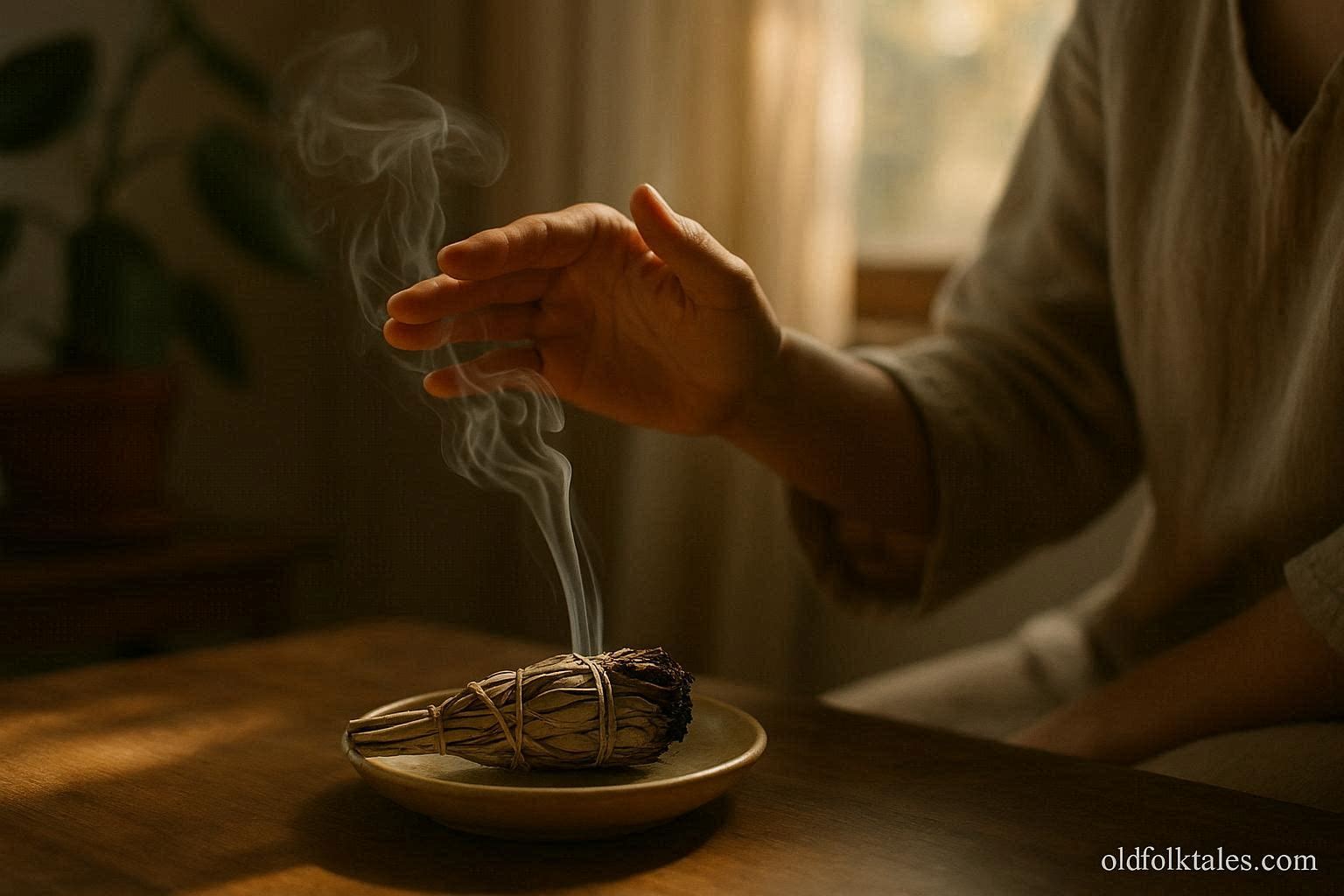
In quiet moments, often at the beginning or end of the day, a small bundle of dried plants would be prepared. Sage was among the most commonly used, valued not only for its natural properties but for the role it held in spiritual and cultural life. When lit, it did not burn with large flames but smoldered slowly, releasing a steady stream of smoke that curled into the air.
The smoke moved gently, filling the space without force.
It drifted through doorways.
Across corners.
Around those present.
People believed that as the smoke spread, it carried away what did not belong. Unwanted energy, lingering tension, and unseen disturbances were thought to be lifted and removed, leaving the space calmer and more balanced.
Explore the heart of America’s storytelling — from tall tales and tricksters to fireside family legends.
The act of cleansing was often done with care and focus. A person might move through a home slowly, guiding the smoke with their hands or a feather, ensuring that it reached every part of the space. There was no rush. Each movement was deliberate, allowing the smoke to settle and rise again, completing its work.
It was not only spaces that were cleansed.
People, too, took part in the ritual.
An individual might stand or sit as the smoke passed around them, moving from head to foot. They would close their eyes, breathe deeply, and allow the moment to center them. The smoke was believed to clear not only physical surroundings but also the mind and spirit, bringing a sense of calm and clarity.
In times of illness or distress, the practice took on even greater importance. Families would gather, and the smoke would be used as part of a larger effort to restore balance. It was understood that healing was not only about the body, but about the connection between all parts of a person’s life.
The environment mattered.
The thoughts mattered.
The unseen aspects of existence mattered.
The smoke became a bridge between these elements.
Stories were told of how the practice helped in moments of unease. A home that felt heavy or unsettled could be transformed through the simple act of cleansing. The air would feel lighter, the space more open, as though something invisible had been lifted away.
There were also teachings about when and how the practice should be done. It was not meant to be used carelessly or without understanding. The plants themselves were respected, gathered thoughtfully, and prepared with care. The act of lighting the sage was accompanied by quiet intention, a recognition that the process was both physical and spiritual.
Elders often guided the younger generations, showing them not just how to perform the ritual, but how to approach it with the right mindset. They explained that the power of the practice came not only from the smoke, but from the purpose behind it.
Without intention, the act lost its meaning.
With intention, it became something more.
Over time, the use of sage smoke spread beyond its original communities, becoming known in different places and contexts. Yet within Indigenous traditions, it remained rooted in its cultural significance, tied to identity, respect, and continuity.
Even as the world changed, the practice endured.
In homes, in gatherings, and in moments of reflection, the smoke continued to rise, carrying with it the same purpose it had always held. It was a reminder that not all forms of care are visible, and that balance requires attention to both what can be seen and what cannot.
There were times when people questioned the practice, seeking explanations that fit within modern frameworks. Some spoke of the natural properties of sage, its ability to influence the air or environment. Others focused on the calming effect of ritual itself, the way repeated actions could bring peace to the mind.
But for those who continued the tradition, the meaning was not limited to one explanation.
It was something experienced.
Something understood through practice.
When the smoke rose, it created a moment of pause. A space where attention shifted, where the outside world seemed to fade, and where focus returned to the present. In that moment, there was clarity.
There was stillness.
There was balance.
The Healing Smoke of Sage Fires remained more than a ritual. It was a way of connecting with the environment, with oneself, and with a long line of tradition that stretched back through generations.
Even now, when the smoke curls upward and disappears into the air, it carries with it a sense of continuity. A reminder that healing is not always immediate or visible, but often found in small, intentional acts repeated over time.
The fire burns quietly.
The smoke rises.
And with it, the belief that what is carried away makes room for what is needed to remain.
Click to read all American Traditions & Beliefs — the living folklore of daily life, customs, and superstitions.
Moral Lesson
True healing involves both the seen and unseen, and intentional actions can restore balance in our lives and surroundings.
Knowledge Check
- What is the purpose of the sage smoke in the story?
To cleanse spaces and people of unwanted or harmful energy. - How is the smoke used during the ritual?
It is guided through spaces and around individuals with care and intention. - Why is intention important in the practice?
It gives meaning and effectiveness to the ritual. - Who teaches the proper way to perform the ritual?
Elders pass down the knowledge to younger generations. - What does the smoke symbolize?
The removal of negativity and the restoration of balance. - What lesson does the story teach about healing?
That healing includes both physical and spiritual aspects.
Source
Adapted from materials preserved by Smithsonian Institution
Cultural Origin
Indigenous North American traditions