In many Indigenous traditions, sleep was never seen as a simple act of rest. It was understood as a journey, a passage into a space where the mind could travel beyond the boundaries of the waking world. Dreams carried meaning. They could guide, warn, teach, or disturb. Because of this, protecting the space of sleep became deeply important.
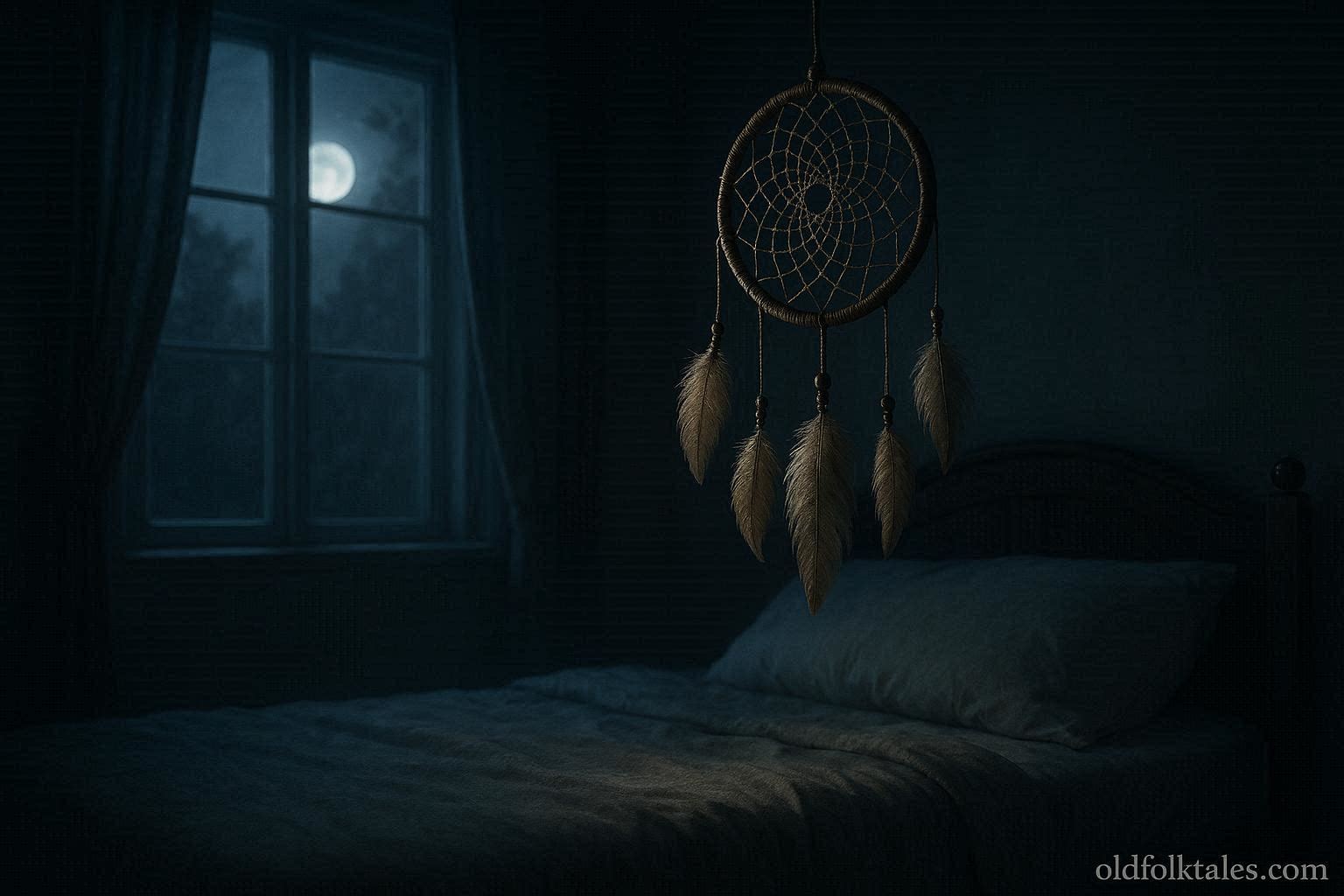
Among the ways this protection was created was through a carefully woven object, placed above the place where one rested. It was not large or overwhelming, but simple in form. A circular frame, often made from natural materials, held a web-like pattern stretched across its center. From its base, soft feathers or threads might hang, moving gently with the air.
This was the dream catching web.
It was not made without thought.
Each part carried meaning.
The circle represented continuity, the endless cycle of life and time. The web within it was designed with care, each thread placed intentionally, forming a pattern that could both hold and release. It was believed that as the night deepened and dreams began to move, this web would take on its purpose.
When a person slept beneath it, the web stood quietly above them, doing its work without sound or motion.
Good dreams, it was said, were light.
They moved easily.
They could pass through the openings in the web, traveling downward along the hanging feathers, reaching the sleeper gently. These dreams brought peace, clarity, and comfort. They settled softly, leaving the mind calm and the spirit at ease.
Encounter the strange and the unseen — from Bigfoot to regional monsters hiding in America’s forests.
Bad dreams, however, were different.
They were heavy.
Confused.
Disturbing.
These dreams did not pass through so easily. As they rose and moved toward the sleeper, they would become caught in the web, held within its woven threads. There, they remained, unable to reach the person below.
As morning came and the first light of the sun touched the web, these trapped dreams would fade. The light would clear them away, ensuring they did not return.
In this way, the dream catching web became a silent protector.
Night after night, it remained in place, filtering what came and allowing only what was good to pass through.
The making of the web was often as important as its use. It was not something created without care or understanding. Those who wove it did so with patience, often speaking quietly or holding focused thoughts as they worked. The act of weaving itself became part of the protection, as intention was placed into every thread.
Children were often given these webs to hang above their beds. Elders believed that young minds were more open, more sensitive to dreams and the unseen. The web served as a guardian, ensuring that their rest remained undisturbed by what might bring fear.
There were stories told of children who had been troubled by restless nights, waking often with unease. After the web was placed above them, their sleep became calm. The nights grew quieter. The fear that once lingered seemed to disappear, replaced by a sense of safety.
These stories were not told as proof, but as reminders.
Reminders that protection could take many forms.
That even something simple could hold meaning and purpose.
The dream catching web was not only about sleep. It reflected a deeper understanding of balance. Just as the web separated good dreams from bad, it symbolized the need to recognize what should be allowed into one’s life and what should be kept away.
It taught awareness.
Discernment.
The idea that not everything that comes toward us should be accepted without thought.
Over time, the image of the web spread beyond its original communities, becoming widely recognized. Yet within its cultural origin, it remained more than a decorative object. It continued to hold its place as a meaningful symbol, tied to tradition, identity, and belief.
In quiet rooms, where the air is still and the night stretches on, the web continues to hang above resting spaces. It moves gently, almost unnoticed, yet always present.
As sleep comes, it stands watch.
Unseen.
Unheard.
Doing what it has always been meant to do.
And when morning arrives, and light fills the room, there is a sense of calm that lingers. A feeling that the night has passed without disturbance, that rest has been complete.
The Dream Catching Web Above the Bed remains a symbol of protection not just from dreams, but from the unseen forces that can disturb peace. It shows that even in rest, there is a need for care, and that protection can exist quietly, without force or attention.
In its stillness, it carries a powerful message.
That peace is something to be guarded.
That rest is something to be protected.
And that even the smallest acts, when done with intention, can create a sense of safety that lasts through the night.
Step into America’s cultural roots — from folk healing and weather lore to seasonal celebrations.
Moral Lesson
Not everything that comes into our lives should be accepted; wisdom lies in allowing what brings peace and filtering out what brings harm.
Knowledge Check
- What is the purpose of the dream catching web?
To filter dreams, allowing good ones to pass and trapping bad ones. - Where is the web placed?
Above the sleeping area. - How do good dreams reach the sleeper?
They pass through the web and move gently downward. - What happens to bad dreams?
They become trapped in the web and disappear with morning light. - Why is intention important in making the web?
It adds meaning and strengthens its purpose as protection. - What does the web symbolize beyond dreams?
The need to filter what we allow into our lives.
Source
Adapted from materials preserved by Smithsonian Institution
Cultural Origin
Ojibwe and Indigenous traditions