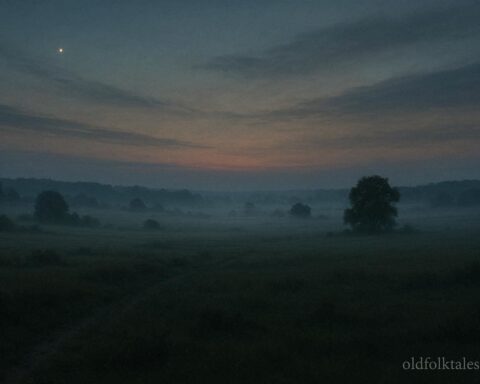
Out on the wide stretches of the western frontier, where the land seemed to roll endlessly and silence often carried farther than sound, there were times when something unfamiliar disturbed the ordinary rhythm of life. These were not always storms or passing herds, but quieter things like signs that appeared without warning and left more questions than answers.
Among these signs were the footprints.
They did not begin with noise or movement. No one saw them being made. No one heard anything pass through the land. Instead, they were discovered, as though they had simply appeared overnight.
The first account came from a pair of riders crossing a dry stretch of open ground just after sunrise. The earth was firm, marked only by the usual traces of wind and small animals. But as they moved forward, one of them slowed, noticing something unusual ahead.
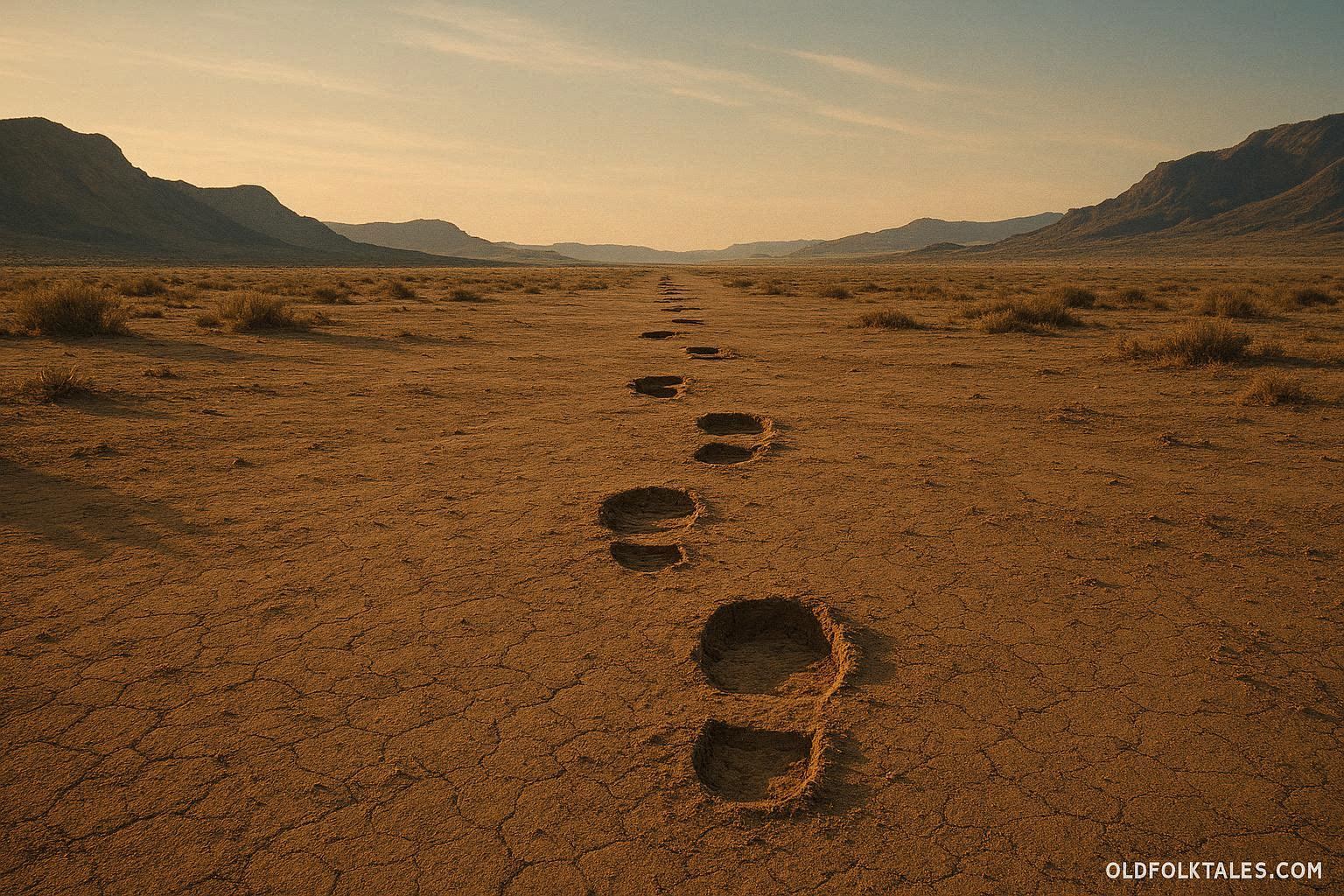
Imprinted into the ground were large tracks.
At first glance, they resembled footprints, but not like any they had seen before. Each one was deeper than expected, pressed firmly into the earth as though made by great weight. The shape was roughly human, yet far larger, stretching longer than a man’s stride could account for.
They dismounted to look closer.
The distance between each print was too wide. To follow the line of them required long steps, almost a stretch even for a grown man. Yet the ground between the prints remained undisturbed, as though whatever had made them had moved with perfect balance.
There were no signs of dragging.
No marks of hesitation.
Just a steady line of prints, moving forward across the land.
Explore the heart of America’s storytelling — from tall tales and tricksters to fireside family legends.
Word spread quickly, as it often did in places where few things went unnoticed. Others came to see for themselves. Some followed the tracks for as long as they could, tracing their path across hills, through patches of grass, and over ground that should have revealed more.
But it did not.
The prints continued in a straight line, unbroken.
They did not circle.
They did not turn.
They simply moved forward.
What made them more unsettling was where they appeared. In some places, the land was untouched for miles. No roads, no settlements, no reason for anyone to pass through. Yet there the prints were, as clear as if they had been placed there deliberately.
One story told of a group who decided to follow the tracks to their end. They began early in the day, carrying enough supplies to last until evening. For hours they walked, stepping from one print to the next, measuring the distance, comparing sizes, trying to understand what they were seeing.
But as the sun began to lower, something changed.
The prints simply stopped.
Not faded.
Not scattered.
Stopped.
One final mark pressed into the ground, and then nothing beyond it. The land ahead remained smooth and untouched, as though the maker of the tracks had taken a final step and vanished.
This ending became the most discussed part of the story. Many could imagine something large crossing the land, but the idea that it could disappear without trace unsettled even the most practical minds.
Different explanations were offered.
Some believed the prints were exaggerated tales of large animals, their shapes altered by the telling. Others suggested that shifting ground and unusual weather might have created patterns that resembled footsteps.
But these explanations did not fully satisfy those who had seen them.
They spoke of the depth of the prints.
The clarity of their shape.
The impossible distance between them.
There were also quieter interpretations. Some suggested the tracks were not meant to be understood in a physical sense. That they were signs, reminders of how little was truly known about the land, even by those who lived closest to it.
In this view, the footprints were not something to be solved, but something to be respected.
A presence without a form.
A movement without a witness.
Over time, the story became part of the wider tradition of frontier storytelling, where exaggeration and imagination were often used to describe the scale of the land itself. The vastness of the plains, the distance between places, the feeling of standing in a space that seemed to stretch beyond understanding, all of this found expression in tales like this one.
The footprints became a way of speaking about size.
About distance.
About the idea that the land held more than what could be easily explained.
Even as years passed and the frontier changed, the story remained. It was told around fires, shared between travelers, and repeated in different forms, each time holding onto the same central image.
Large prints.
Wide steps.
A path that begins without a beginning and ends without an end.
Today, the tale continues to be remembered not for what it proves, but for what it suggests. That there are moments when the ordinary shifts, when something appears that does not fit within familiar patterns.
And in those moments, people do what they have always done.
They observe.
They question.
They tell the story.
The footprints themselves may no longer be visible, worn away by time and weather. But the idea of them remains, pressed just as firmly into memory as they once were into the earth.
A reminder that not all paths are meant to be followed to their end.
And that sometimes, the mystery itself is what gives the story its lasting shape.
Click to read all American Folktales — timeless oral stories passed through generations across the United States.
Moral Lesson
Not everything in life can be fully explained, and sometimes mystery itself teaches us to remain curious and observant.
Knowledge Check
- What was unusual about the footprints?
They were very large and spaced farther apart than human steps. - Where were the footprints found?
On untouched land in the western frontier. - Did anyone see what made the prints?
No, they appeared without any witness. - What happened when people followed the tracks?
They suddenly ended without explanation. - What did some people believe about the footprints?
That they were signs or exaggerated expressions of the land’s vastness. - What lesson does the story teach?
That mystery can inspire curiosity and reflection.
Source
Adapted from materials preserved by University of Montana
Cultural Origin
Western frontier folklore