During the years of the California Gold Rush, thousands of hopeful miners poured into the western territories, driven by dreams of sudden wealth and a better life. They came from distant states, from across oceans, and from places where stories of gold sounded almost too good to be true. The land they entered was vast, unfamiliar, and often unforgiving, yet it held a promise that few could resist.
Among the many stories that emerged from that time, one stood out more than most.
It was not about a single man or a single strike of gold, but about something far less certain and far more difficult to explain.
Voices.
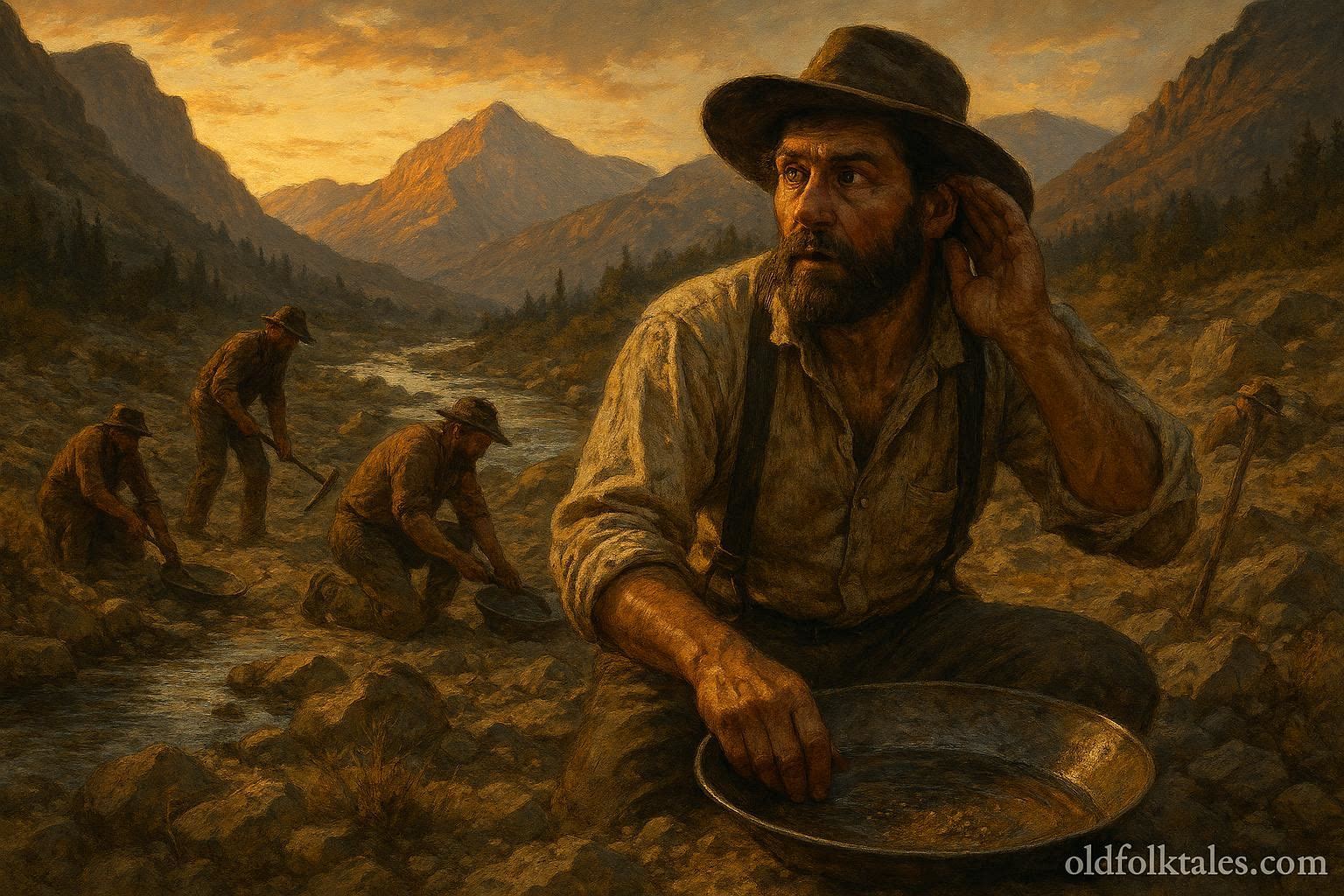
At first, the accounts were dismissed. A lone miner, exhausted from long hours of digging and panning, claimed he heard someone call his name from across the hills. When he looked, no one was there. He followed the direction of the sound out of curiosity more than belief, and after walking some distance, he came upon a narrow stream where gold shimmered clearly beneath the surface.
He told others.
Some laughed, assuming fatigue had played tricks on his mind. Others listened more carefully, noting the detail in his story and the fact that he had returned not empty-handed, but with proof.
Explore the heart of America’s storytelling — from tall tales and tricksters to fireside family legends.
Soon, more reports began to surface.
A group of miners working near a rocky slope claimed they heard faint murmurs carried through the still air. The voices were not loud, not urgent, but steady and calm, as if guiding rather than calling. They could not make out full sentences, only fragments, directions that seemed to suggest movement toward a certain place.
Curiosity overcame doubt.
They followed.
The path led them through uneven ground, across a dry patch of land where nothing seemed promising. Then, as suddenly as the voices had begun, they stopped. The miners hesitated, unsure if they had been misled. But one of them knelt and began to dig, more out of instinct than certainty.
Within moments, he struck something solid.
Gold.
Not scattered flakes, but a vein running deeper than anything they had found before. The discovery spread quickly, and with it came renewed attention to the stories of voices.
More miners began to listen.
Not openly at first. No one wanted to admit that they were relying on something they could not see or explain. But in quiet moments, especially when the land fell silent, they paid closer attention.
Some described the voices as familiar, almost like distant echoes of people they had once known. Others said they sounded like no human voice at all, steady and calm, without emotion or urgency. A few claimed the voices spoke clearly, giving precise directions that led them to hidden deposits.
Yet not everyone heard them.
This made the stories even more uncertain. Two men could stand in the same place, one hearing nothing, the other pausing as if listening to something just beyond reach. Those who heard the voices often struggled to explain why they, and not others, were able to perceive them.
Speculation grew.
Some believed the voices were the land itself, a natural force guiding those willing to listen. Others thought they were echoes of those who had come before, miners who had searched and struggled and whose presence remained in some unseen way.
There were also warnings.
Not every voice, they said, led to fortune.
A few miners followed sounds that took them far from camp, into rough terrain where no gold could be found. They returned tired, confused, and less willing to trust what they could not understand. Stories began to include caution, reminding listeners that not everything heard should be followed.
Still, the accounts continued.
One of the most repeated stories told of a miner who had nearly given up. After weeks of searching with no success, he packed his tools and prepared to leave. That night, as he sat alone, he heard a voice, clear and steady, calling him back toward a place he had already searched.
Reluctant but curious, he returned the next morning.
He dug deeper than before.
And found gold where he had once found nothing.
The story spread, not because it was unique, but because it felt familiar. Many miners had similar experiences, moments where something unseen seemed to guide their actions just enough to change the outcome.
Over time, the voices became part of the larger story of the Gold Rush.
They were not spoken of openly in every camp, but they were understood. In a land where uncertainty was constant and success was never guaranteed, the idea that something might guide a person, even slightly, was both comforting and unsettling.
Years passed, and the rush slowed.
Towns formed where camps once stood, and the land changed under the weight of those who had come seeking fortune. The voices, however, did not disappear completely. Even after the busiest years had ended, there were occasional reports from those who remained.
A sound carried on still air.
A whisper just beyond hearing.
A direction that seemed to come from nowhere.
Whether the voices were real, imagined, or something in between was never settled. There was no proof that could be measured, no explanation that satisfied everyone. Yet the stories endured, passed from miner to miner, from one generation to the next.
They became part of western folklore, not as a certainty, but as a possibility.
A reminder that in moments of quiet, when the land is still and the mind is focused, people sometimes experience things they cannot fully explain.
And in those moments, whether guided by instinct, chance, or something unseen, they may find exactly what they are looking for.
Click now to read all American Legends — heroic tales where truth and imagination meet, defining the American spirit.
Moral Lesson
Opportunity often comes when we remain attentive, but wisdom is needed to know what to follow and what to question.
Knowledge Check
- During which historical period did these stories occur?
During the California Gold Rush. - What unusual experience did miners report?
They heard voices guiding them to gold. - Did all miners hear the voices?
No, only some miners reported hearing them. - Did the voices always lead to success?
No, sometimes they led miners to nothing or into difficulty. - What did some people believe the voices were?
They believed the voices could be the land, echoes of the past, or something unseen. - What is the main idea of the story?
That not all guidance is clear, and mystery often surrounds moments of discovery.
Source
Adapted from materials preserved by California State Library
Cultural Origin
Western folklore