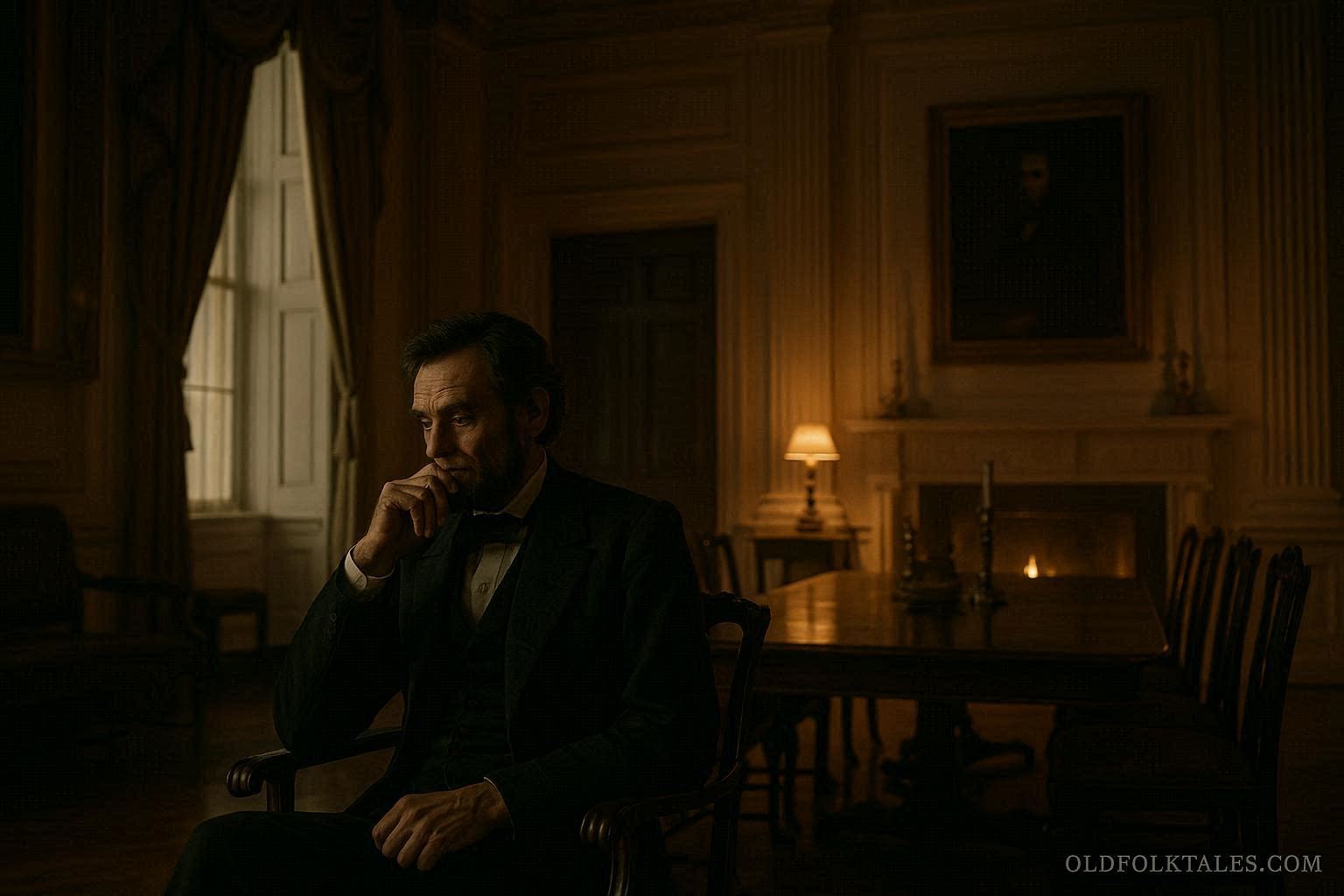
In the final days of the American Civil War, the atmosphere in Washington, D.C., carried a mix of relief and uncertainty. The conflict that had divided the nation for years was nearing its end, and many looked forward to a return to peace. Amid this moment of transition stood Abraham Lincoln, a leader whose decisions had shaped the course of the country.
During this time, a story began to circulate among those close to him.
It was not about policy or war strategy, but about a dream.
According to accounts later shared by friends and associates, Lincoln spoke of a vivid and unsettling dream that had left a strong impression on him. He described walking through the rooms of the White House, moving from one area to another in search of the source of a sound.
It was a sound of quiet mourning.
As he moved through the building, the feeling grew stronger. There was a sense of loss, of something important having already happened. Yet in the dream, no one spoke directly to him. The silence carried more weight than words.
Eventually, he entered a room where a group of people had gathered.
At the center of the room was a covered figure.
Lincoln asked who had died.
The response, as it was later recounted, was simple.
“The President.”
The dream ended there.
Encounter the strange and the unseen — from Bigfoot to regional monsters hiding in America’s forests.
When he shared the story, those who heard it did not fully understand its meaning. Dreams were not uncommon, especially during times of stress, and many assumed it reflected the pressures he had faced during the war. The responsibilities of leadership, the constant decisions, and the emotional weight of the conflict could easily shape such visions.
Lincoln himself did not present the dream as a prediction.
He spoke of it calmly, almost thoughtfully, as something that had stayed with him. Those around him noted the detail in his description, but there was no immediate sense that it pointed to a real event.
Days later, history took its course.
On April 14, 1865, Abraham Lincoln was assassinated at Ford’s Theatre. The news spread quickly, bringing shock and grief across the nation. The moment marked a turning point, not only in leadership, but in how people remembered the events surrounding him.
After his death, the story of the dream was told again.
This time, it carried a different weight.
Those who had heard Lincoln describe it began to reflect on its details. The setting, the sense of mourning, the announcement of the President’s death—all seemed to align with what had taken place. What had once been a private account became part of a larger narrative, one that connected the dream to the event itself.
The story spread beyond those who had known him personally.
It appeared in written accounts, retold in conversations, and gradually became part of American historical lore. Some viewed it as evidence of a premonition, a moment where the future had briefly revealed itself through a dream.
Others approached it differently.
They suggested that the dream could be understood in the context of Lincoln’s experiences. He had lived through years of conflict, made decisions that affected countless lives, and carried the burden of a divided nation. It was possible that his mind, processing these realities, created a symbolic representation of loss and responsibility.
In this view, the dream was not a prediction, but a reflection.
A way of expressing the pressures and uncertainties of the time.
Still, the timing of the dream, combined with its details, made it difficult to dismiss entirely. Even those who favored practical explanations acknowledged that it was unusual.
The story continued to be told, not as a confirmed event, but as a meaningful account that added depth to the understanding of Lincoln’s final days.
It also contributed to the broader way in which people remember historical figures.
Leaders are often seen not only through their actions, but through the stories that surround them. These stories, whether fully explained or not, shape how their lives are understood and remembered over time.
In the case of Abraham Lincoln, the dream became one of those stories.
It did not change the facts of history, but it added a layer of reflection, inviting people to consider the connection between experience, thought, and the unknown.
Even today, the account is discussed in both historical and cultural contexts. It is referenced in studies, mentioned in discussions of leadership, and included in collections preserved by institutions such as the Smithsonian Institution.
The interpretation remains open.
Was it a coincidence?
A product of a mind under pressure?
Or something that cannot be fully explained?
There is no single answer.
What remains is the story itself.
A quiet moment shared before a major event.
A dream remembered after it had passed.
And a reminder that history is not only made of actions and dates, but also of the experiences that surround them, sometimes leaving questions that continue long after the moment is gone.
Explore how American legends shaped the nation — from frontier heroes to Revolutionary War tales.
Moral Lesson
Moments of reflection can reveal deeper thoughts and emotions, and not everything we experience can be easily explained.
Knowledge Check
- Which historical figure is central to this story?
Abraham Lincoln. - What did Lincoln reportedly dream about?
He dreamed of a mourning scene and the death of the President. - Where was Lincoln assassinated?
At Ford’s Theatre. - How did people interpret the dream after his death?
Some saw it as a premonition, while others saw it as a reflection of stress. - Did Lincoln present the dream as a prediction?
No, he shared it calmly without claiming it was a prediction. - What is the main idea of the story?
That some experiences remain open to interpretation and add depth to historical understanding.
Source
Adapted from materials preserved by Smithsonian Institution
Cultural Origin
American historical lore