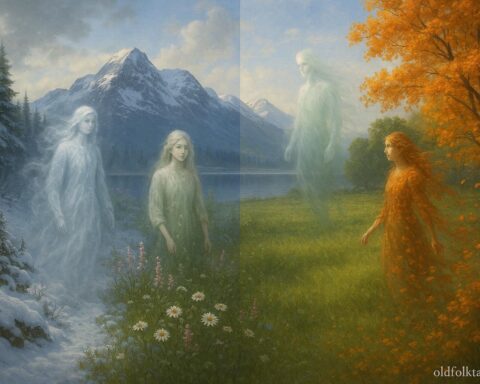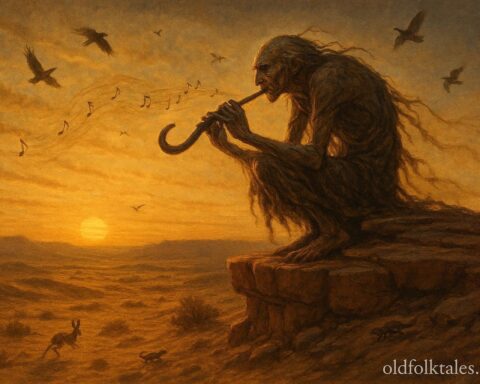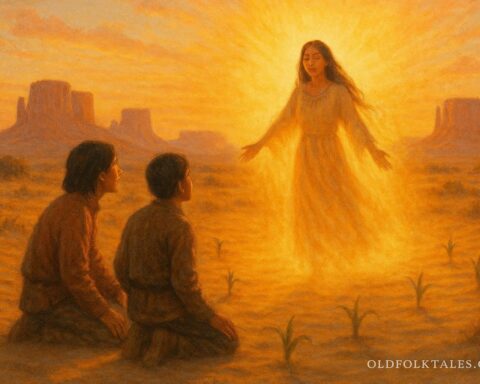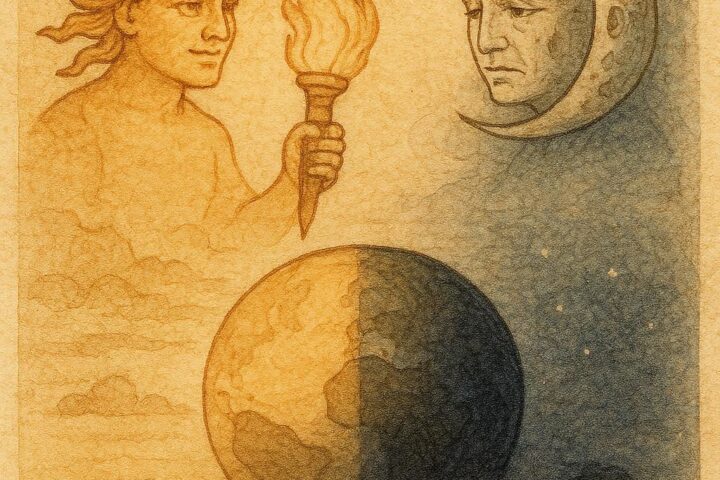
In the earliest time, before the present world took its form, existence was not fixed in one place. Life did not begin here, on the earth as it is now known. Instead, it began in a series of worlds, each one different from the last, each one shaping those who lived within it.
Among the traditions of the Hopi, it is told that humanity did not simply appear in the present world. They arrived here through a long journey, moving upward through four different worlds, each representing a stage of growth, understanding, and change.
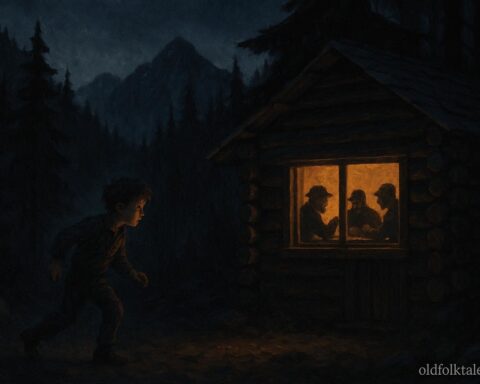
The First World was the beginning.
It was a place of simplicity, where life existed in its earliest form. The people of this world were not yet fully aware of themselves or their surroundings. They lived without clear structure, guided only by basic existence. The world itself was unstable, lacking the balance needed for life to develop fully.
In this early state, there was no clear order.
Actions carried little consequence.
Understanding had not yet taken shape.
As time passed, the beings of the First World began to lose harmony with the space they inhabited. Their actions became careless, and the balance of the world weakened. The instability grew until it could no longer sustain life in its current form.
It was then that a higher presence intervened.
The people were guided upward, leaving the First World behind and entering the Second.
Step into shadowy legends of restless spirits and ghostly travelers in American Ghost Stories.
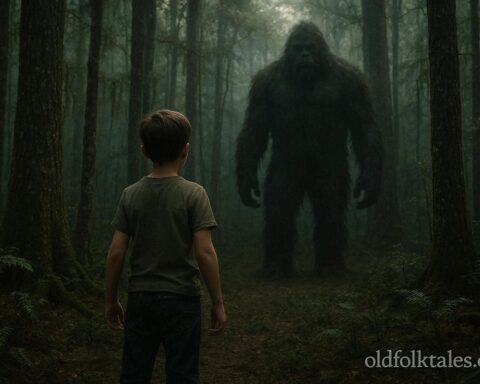
The Second World was more developed.
Here, the people had greater awareness. They could recognize one another, interact more clearly, and begin to form connections. The environment supported more structure, and life became more organized.
But with this growth came new challenges.
Differences began to appear.
Conflicts arose.
The people did not always act with respect or unity, and once again, the balance of the world began to break down. The lessons of the First World had not been fully learned.
The harmony that was needed could not be maintained.
And so, as before, the time came to move on.
The people were guided upward once again, leaving the Second World and entering the Third.
The Third World was closer to the present world.
It held greater complexity, with more defined structures and deeper relationships. The people had learned much from their previous experiences. They could communicate, organize, and build communities.
For a time, there was balance.
Life moved with purpose.
But over time, the same pattern returned.
People began to act in ways that disrupted harmony. They became distracted by their own desires, forgetting the lessons that had been carried from the worlds before. The balance of the Third World weakened, and its stability began to fail.
In some tellings, it is said that great events marked the end of this world. Changes in the environment, shifts in the land, and forces beyond control signaled that the time for transition had come once again.
But this time, the journey would not be simple.
The path to the next world required effort.
Choice.
And cooperation.
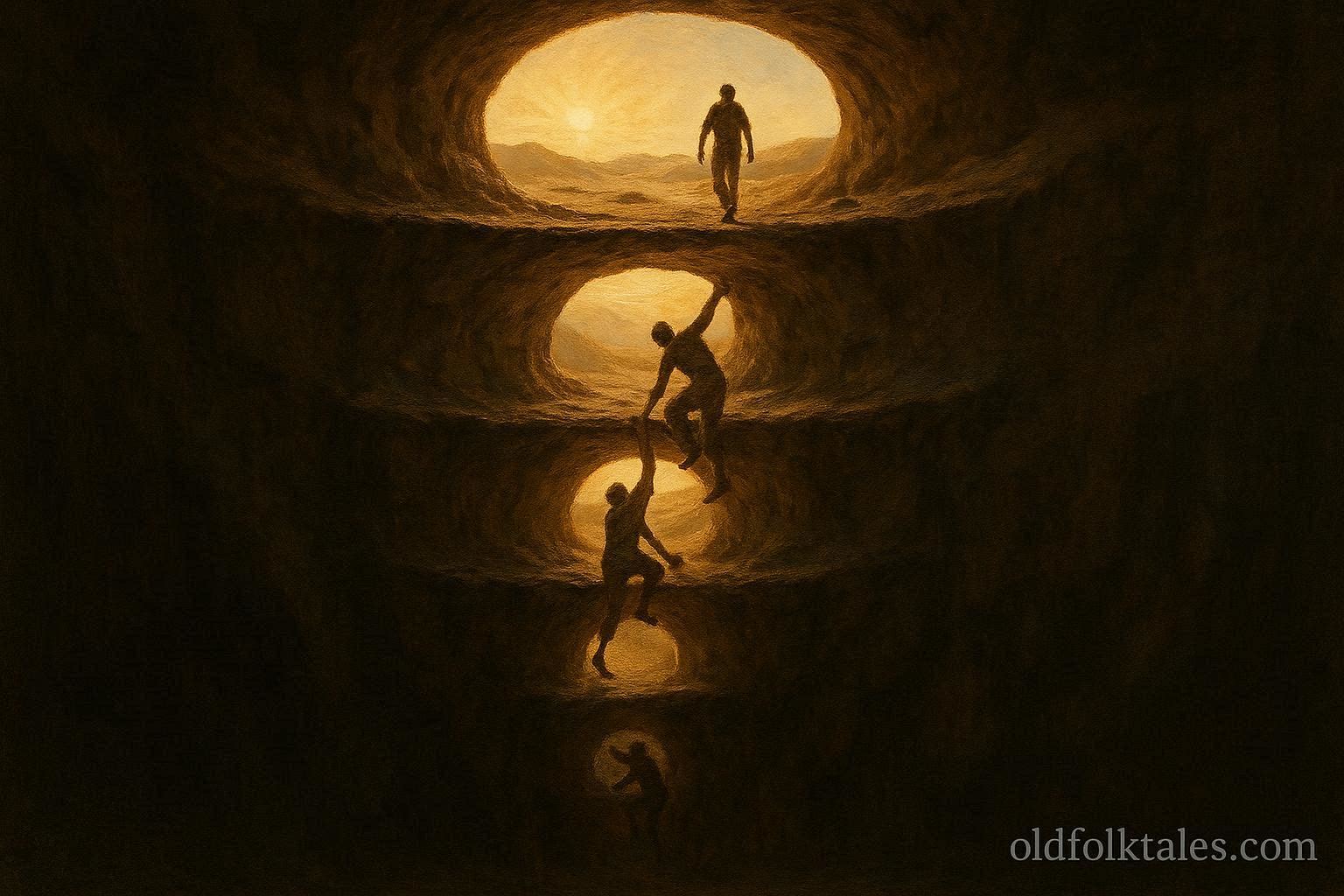
The people were shown a way upward, but they could not move all at once. They had to work together, helping one another, guiding each other through the passage that would lead to the Fourth World.
This journey was not only physical.
It was also a test of what they had learned.
Those who acted with respect, patience, and understanding were able to continue. Those who did not were left behind, unable to complete the passage.
At last, after effort and cooperation, the people emerged into the Fourth World.
This is the present world.
The one known today.
Here, the land is stable, the sky follows a pattern, and life moves in cycles that can be understood. The lessons of the previous worlds are carried within it, shaping how people live and how they relate to one another.
The journey through the four worlds is not simply a story of movement.
It is a story of growth.
Each world represents a stage of learning, where mistakes are made, lessons are gained, and progress is achieved. The final world is not perfect, but it holds the opportunity to live in balance, guided by what has been learned before.
In the teachings connected to this story, the past is never separate from the present.
The earlier worlds are remembered not as distant places, but as parts of a continuous journey. The experiences within them remain relevant, offering guidance for how to live in the current world.
The idea of emergence also reflects a deeper understanding of life.
That growth does not happen all at once.
It takes stages.
Each one building upon the last.
The movement from one world to another represents the effort required to improve, to learn, and to move forward.
Even now, the story continues to hold meaning.
The present world is not seen as the final stage without responsibility. Instead, it is a place where the lessons of the past must be remembered and applied. The balance that was lost in earlier worlds must be protected here.
The journey upward may be complete.
But the journey of understanding continues.
Explore ancient Native American creation myths and the symbolic tales that shaped America’s belief systems.
Moral Lesson
Growth comes through learning from past mistakes and working together to create balance.
Knowledge Check
- How many worlds did humans pass through?
Four worlds - What was the First World like?
Simple and without structure - Why did people leave each world?
Because balance was lost - What was needed to reach the Fourth World?
Cooperation and effort - What is the Fourth World?
The present world - What is the main idea of the story?
That growth happens through stages and learning
Source
Adapted from materials preserved by University of Arizona
Cultural Origin
Hopi