In a quiet rural community in the early years of the United States, where narrow dirt roads connected scattered homes and the nights were long and still, there lived a young woman known for her kindness and gentle spirit. She was admired by many in the village, not only for her beauty but for her trust in others and her hopeful view of the world. People often said she believed the best in everyone, even when others were more cautious.
As the seasons passed, many young men came and went, but none seemed to capture her attention for long. That changed one evening when a stranger arrived. He appeared without warning, riding into the village just as the sun was setting. His clothing was neat but unfamiliar, and his presence was calm yet distant. There was something about him that drew attention, not through loudness, but through quiet mystery.
He introduced himself politely and spoke with confidence. His voice was smooth, and his words were carefully chosen. The villagers were curious, but also cautious. Strangers were not uncommon, but something about this man felt different. Still, he showed no signs of harm, and over time, he became a familiar figure in the village.
Encounter the strange and the unseen — from Bigfoot to regional monsters hiding in America’s forests.
The young woman noticed him almost immediately. There was a sense of calm when he spoke, and his manner was respectful. He did not rush or demand attention. Instead, he allowed conversations to unfold naturally. This quiet confidence drew her in, and before long, they began to spend time together.
Their relationship developed quickly. The man spoke of distant places, of journeys and experiences that seemed far beyond the small village. He painted pictures with his words, describing landscapes and stories that filled the young woman with wonder. She listened closely, fascinated by his perspective.
Despite the growing connection, there were things about him that remained unclear. He avoided speaking about his past in detail, often changing the subject when asked direct questions. He appeared mostly in the evenings and rarely stayed long after night had fully settled. Some villagers began to whisper, unsure of his intentions.
The young woman, however, trusted him. She believed that his silence about certain things was not a sign of danger, but simply a part of who he was. Over time, their bond grew stronger, and soon, he asked her to marry him.
The proposal came quietly, without ceremony or spectacle. He spoke with sincerity, and she accepted without hesitation. The village reacted with mixed feelings. Some were happy for her, while others felt uneasy. There was something about the man that they could not fully understand.
The wedding was planned simply. There were no large celebrations, only a small gathering of close friends and family. The man insisted that after the ceremony, they would travel together to begin their new life elsewhere. He described a place where they could build a future, far from the limits of the village.
On the evening of the wedding, the sky was clear, and the air was calm. The ceremony took place without incident, and for a moment, everything felt normal. The young woman was filled with hope, ready to begin a new chapter in her life.
After the ceremony, the groom suggested they leave immediately. He explained that the journey would be easier under the cover of night. Though unusual, the young woman agreed. She trusted him completely.
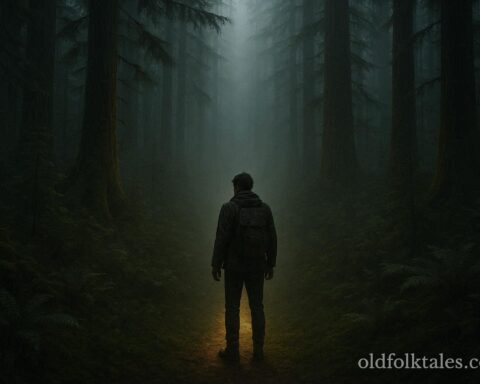
They set out together, leaving the village behind. The path they followed led away from familiar roads and into darker, less traveled areas. The forest grew thicker, and the sounds of the night became more noticeable. At first, the young woman felt only excitement, but as they moved deeper, a sense of unease began to form.
She asked questions about their destination, but the groom’s answers were vague. He reassured her, urging her to continue. His voice remained calm, but there was a distance in it that had not been there before.
As they continued, the path became more difficult. The ground was uneven, and the trees seemed to close in around them. The young woman began to feel afraid. She realized that she no longer recognized the surroundings. The familiar world had been replaced by something unknown.
At one point, she stopped walking. She turned to him and asked directly where they were going. For the first time, he did not respond immediately. When he did speak, his voice was quieter, almost distant.
Before she could ask another question, something changed.
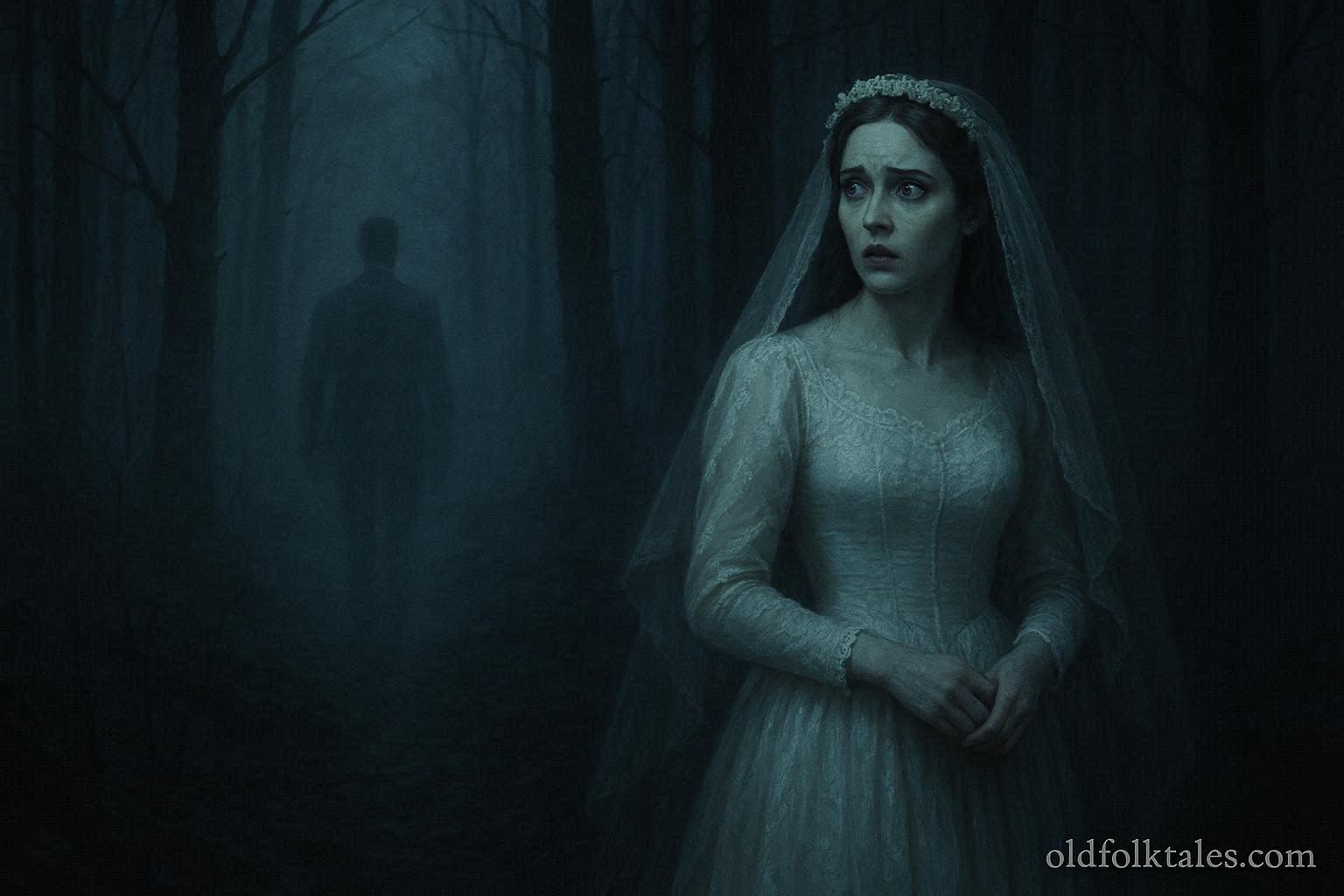
The air grew colder, and the stillness around them deepened. The groom stepped back, and in that moment, his presence seemed to fade. The young woman watched in confusion as his form became less clear, as if he were no longer fully part of the world around her.
Then, without warning, he was gone.
No sound, no movement, no sign of where he had gone. One moment he stood before her, and the next, there was nothing.
The young woman was left alone.
Fear quickly replaced confusion. She called out, hoping for an answer, but only silence returned. The forest felt overwhelming now, the darkness pressing in from all sides. She realized that she had been led far from safety, guided into a place where she did not belong.
Gathering her courage, she began to make her way back. The journey was difficult, but she relied on memory, instinct, and determination. Each step brought her closer to the familiar world she had left behind.
When she finally returned to the village, she was changed. The experience had taken away her sense of easy trust, replacing it with caution and awareness. The villagers listened as she told her story, their concerns now confirmed.
Stories like this have been preserved in collections such as those at Indiana University, where American oral traditions are studied and shared. The tale of the ghost bridegroom serves as a warning, reminding listeners that not everything is as it appears.
In the years that followed, the story spread beyond the village. It became a lesson passed down through generations, told to young people as a reminder to look beyond appearances and to trust their instincts.
The young woman continued her life, wiser and more aware. Though the experience had been frightening, it had also taught her the importance of questioning, of understanding, and of recognizing danger even when it is hidden behind calm words and familiar forms.
The mysterious groom was never seen again. Whether he had been a spirit, an illusion, or something else entirely remained unknown. But his presence left a lasting mark, not just on the young woman, but on everyone who heard the story.
And so, in quiet places and long evenings, the tale of the ghost bridegroom continued to be told, a reminder that trust must be balanced with awareness, and that not every path leads where it seems to promise.
Explore the heart of America’s storytelling — from tall tales and tricksters to fireside family legends.
Moral Lesson
Not everything that appears trustworthy is safe, and careful judgment is important.
Knowledge Check
- Who is the main character?
A young woman - Who does she meet?
A mysterious groom - What happens after the wedding?
He leads her into danger and disappears - Where does he take her?
Into a dark forest - What happens to him?
He vanishes - What is the main idea?
Be careful who you trust
Source
Indiana University
Cultural Origin
American oral folklore