Across the vast sweep of the Great Plains, where the wind never rests and carries with it the whispers of countless generations, where the horizon stretches beyond sight until earth and sky blend into a single blue infinity, the American bison roams slow, powerful, and unshaken by the passage of time or the trials that have tested its very existence.
Long ago, before fences divided the grasslands and before roads carved the prairie into squares, the land trembled beneath their hooves. The ground itself seemed to pulse with life as herds so immense they darkened the prairie for miles moved like living rivers across the continent, their deep grunts and snorts echoing through the endless grasslands like the breathing of the Earth itself. A single herd might number in the thousands, tens of thousands even their bodies pressed together in a mass of shaggy brown that flowed over hills and through valleys, stopping at rivers to drink before continuing their ancient migrations.
Click to read all American Cryptids & Monsters — creatures of mystery and fear said to inhabit America’s wild landscapes.
These were not merely animals moving across a landscape. They were the landscape living, breathing forces of nature that shaped everything around them. Where they grazed, new grasses grew. Where they wallowed in dust, creating shallow depressions in the earth, water would later collect, forming pools for other creatures. Where they walked, paths formed that other animals followed, and even people used as highways across the seemingly endless plains.
To the Native peoples of the Plains, the Lakota, Cheyenne, Blackfeet, Comanche, and dozens of other nations whose lives were woven into the fabric of the grasslands the bison was more than an animal. It was life itself, sacred and central to existence. It provided food that sustained them through harsh winters, its meat dried and stored, its bone marrow rich with fat. Its thick hide became shelter, stretched over poles to create lodges that could withstand prairie storms. Its fur was woven into warm robes and blankets. Its sinew became thread and bowstrings. Its bones were carved into tools, scrapers, and needles. Its horns became cups and ceremonial objects. Even its dung, dried in the sun, provided fuel for fires when wood was scarce.
The bison’s strength, its ability to survive blizzards that killed other creatures, to thrive in summer heat that baked the plains, to endure and persist through all seasons, symbolized the balance that must exist between people and the Earth. To hunt the bison was a sacred act, done with prayer and gratitude, taking only what was needed and using every part with respect. In this way, life continued in harmony, the great circle unbroken.
But as the years passed and the world changed, the harmony shattered. Settlers pushed westward in waves, bringing with them a different understanding of the land, one of ownership and conquest rather than kinship and balance. The bison, which had numbered in the tens of millions, perhaps fifty or sixty million strong across the continent, became targets. They were killed not just for meat or hide, but systematically, deliberately, to clear the land and to break the spirit of the Plains peoples whose entire way of life depended on the herds.
The thunder of hooves grew faint, year by year, season by season. Where once the horizon had been dark with bison, now only grass swayed. Professional hunters took down hundreds in a day, leaving carcasses to rot, taking only hides or tongues for sale to eastern markets. The railroads brought more hunters, and the great slaughter intensified. By the late 1800s, by the time people finally paused to count what remained, only a few hundred bison survived out of millions, scattered survivors of a nation’s relentless expansion, living remnants of a nearly extinct species, hiding in remote corners of a transformed land.
The plains fell silent. The great migrations ceased. The dust wallows grew over with grass. The paths faded. And the world seemed smaller, emptier, less alive without them. The Native peoples, forced onto reservations and forbidden to follow the old ways, mourned not just the loss of their sustenance but the severing of a spiritual connection that had defined their existence for thousands of years.
Then, at the edge of extinction, when it seemed the giants would be lost forever, something remarkable happened. A few people, men and women of different backgrounds refused to let them disappear into history like mere memories. Ranchers in remote areas discovered small surviving groups and protected them. Conservationists, recognizing the magnitude of what was being lost, began gathering what little remained of the species. Tribal communities, never forgetting their sacred connection, held onto small herds when they could. Together, these scattered efforts created pockets of hope.
Slowly, with careful breeding and fierce protection, the herds began to return. It was not fast, nature’s recovery never is. But year by year, calves were born, rusty-red and playful, growing into massive adults with humped shoulders and thick winter coats. The numbers climbed from hundreds to thousands, from thousands to tens of thousands. They were not as vast as before, that ancient abundance might never return but they were strong enough, numerous enough, to remind the land of its old rhythm.
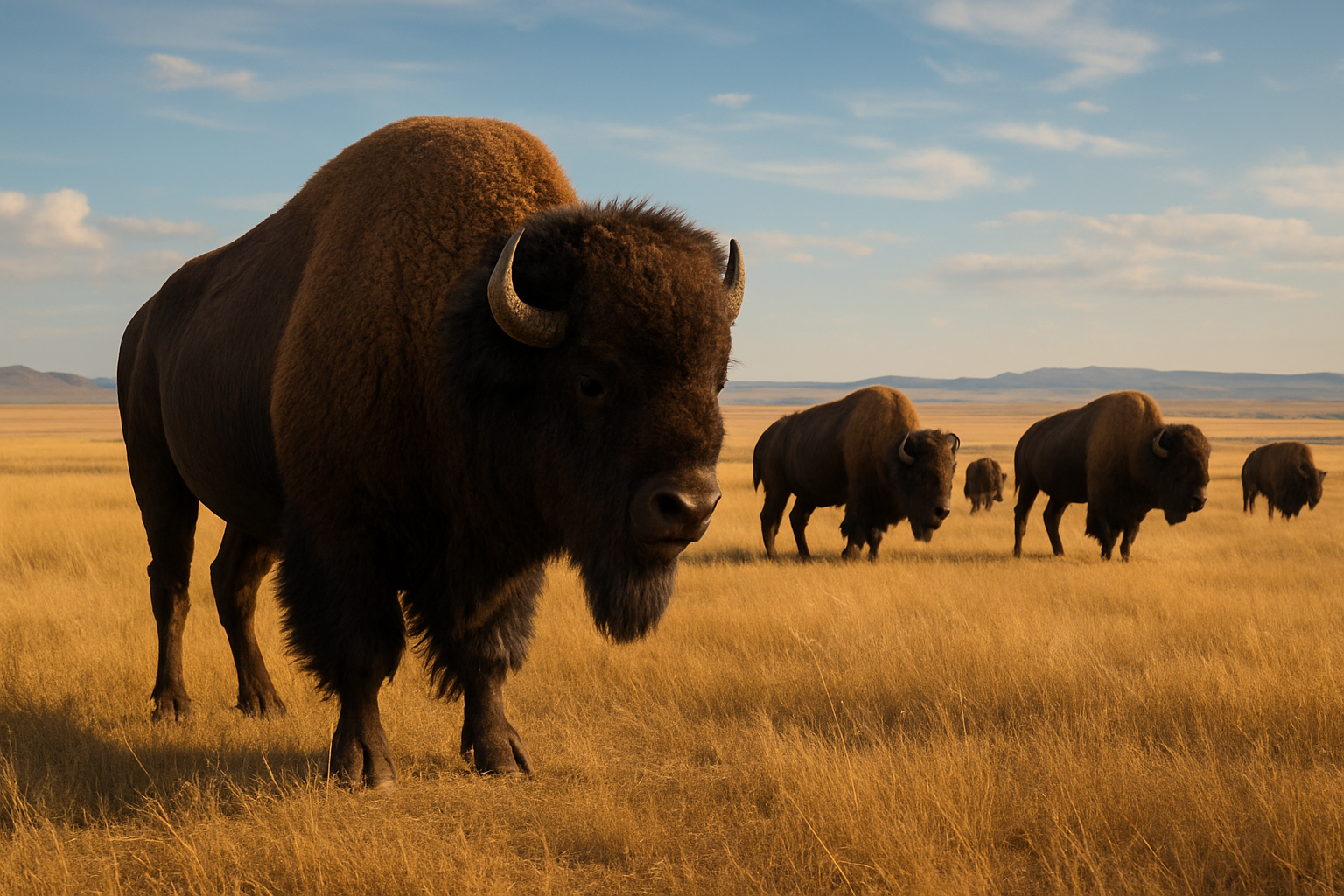
Today, when the sun dips low and turns the sky into sheets of gold and amber, when shadows stretch long across the prairie, a herd of bison moving across the golden fields is a sight that stops the heart, their shaggy coats swaying with each step, their massive shoulders rising and falling like small brown hills in motion, their dark eyes calm and knowing. They graze patiently, methodically, their broad mouths tearing at the tough prairie grasses, shaping the grasslands just as their ancestors did for millennia, keeping the ecosystem alive and balanced, creating space for wildflowers and ground birds, aerating soil with their hooves, distributing seeds across miles.
The bison’s story is one of profound resilience, a tale of near loss and quiet redemption, of coming within a breath of extinction and somehow, through a combination of human conscience and natural tenacity, stepping back from that brink. They stand as living proof that the wild spirit of America, though once nearly silenced, can endure when respect replaces conquest, when people choose preservation over profit, when we remember that we are not separate from nature but part of it.
And so, when you see them standing against the prairie wind, their heads lowered as they graze, or when you watch a herd moving slowly across rolling grassland, know that you are not just looking at animals, not merely observing wildlife. You are looking at the beating heart of the Great Plains, at the enduring memory of a wilder, freer time, at giants who survived our worst and now remind us of our best the capacity to recognize a wrong and work, slowly but surely, to make it right.
Explore Native American beings, swamp creatures, and modern cryptid sightings across the country.
The Moral of the Story
This tale teaches us that even when destruction seems complete and loss appears final, resilience and redemption remain possible through conscious effort and respect. The bison’s near-extinction and gradual return remind us that our actions have consequences both destructive and restorative and that it is never too late to choose preservation over exploitation. The story emphasizes that true wealth lies not in conquering nature but in maintaining balance with it, and that what we protect today becomes the legacy we leave tomorrow. Most powerfully, it shows that respect and care can heal even the deepest wounds, and that species and ecosystems have remarkable capacity to recover when given the chance.
Knowledge Check
Q1: What role did the American bison play in Plains Native cultures?
A: The bison was central to survival and spirituality for Plains peoples providing food, shelter, clothing, tools, and fuel. It represented life itself and symbolized the sacred balance between humans and nature. Every part was used with respect and gratitude, making the bison integral to their entire way of life.
Q2: How did bison shape the Great Plains ecosystem?
A: Bison were ecosystem engineers their grazing patterns encouraged diverse plant growth, their wallowing created water-collecting depressions, their paths became routes for other animals, and their presence supported countless other species. They maintained the health and balance of the grasslands through their natural behaviors.
Q3: What caused the near-extinction of American bison?
A: Westward expansion in the 1800s led to systematic slaughter of bison killed for hides, tongues, and sport, but also deliberately to clear land and undermine Plains Native peoples whose entire culture depended on the herds. Millions were reduced to just hundreds by the late 1800s.
Q4: Who helped save the bison from complete extinction?
A: A diverse group including ranchers who protected small surviving groups, conservationists who organized breeding programs, and tribal communities who maintained their sacred connection and preserved small herds. These combined efforts slowly brought the species back from the brink.
Q5: What does the bison’s survival symbolize in American conservation?
A: The bison represents one of conservation’s greatest success stories proof that species can recover from near-extinction when humans choose to act. It symbolizes resilience, redemption, and the possibility of healing the damage caused by exploitation when respect replaces conquest.
Q6: What spiritual significance does the bison hold in Native American traditions?
A: In Plains Native traditions, the bison is a sacred being representing abundance, strength, survival, and the interconnectedness of all life. It appears in creation stories, ceremonies, and spiritual practices as a teacher of gratitude, balance, and living in harmony with nature’s cycles.
Cultural Origin
This tale originates from the Great Plains region of the United States and Canada spanning states like Montana, Wyoming, South Dakota, Nebraska, Kansas, and Oklahoma where American bison (Bison bison) once roamed in millions. The story weaves together Native American spiritual traditions, particularly from Lakota, Cheyenne, and other Plains nations who revered the bison as sacred, with the historical reality of near-extinction in the 1800s and the remarkable 20th-century conservation efforts that brought these giants back from fewer than 1,000 individuals to over 500,000 today.