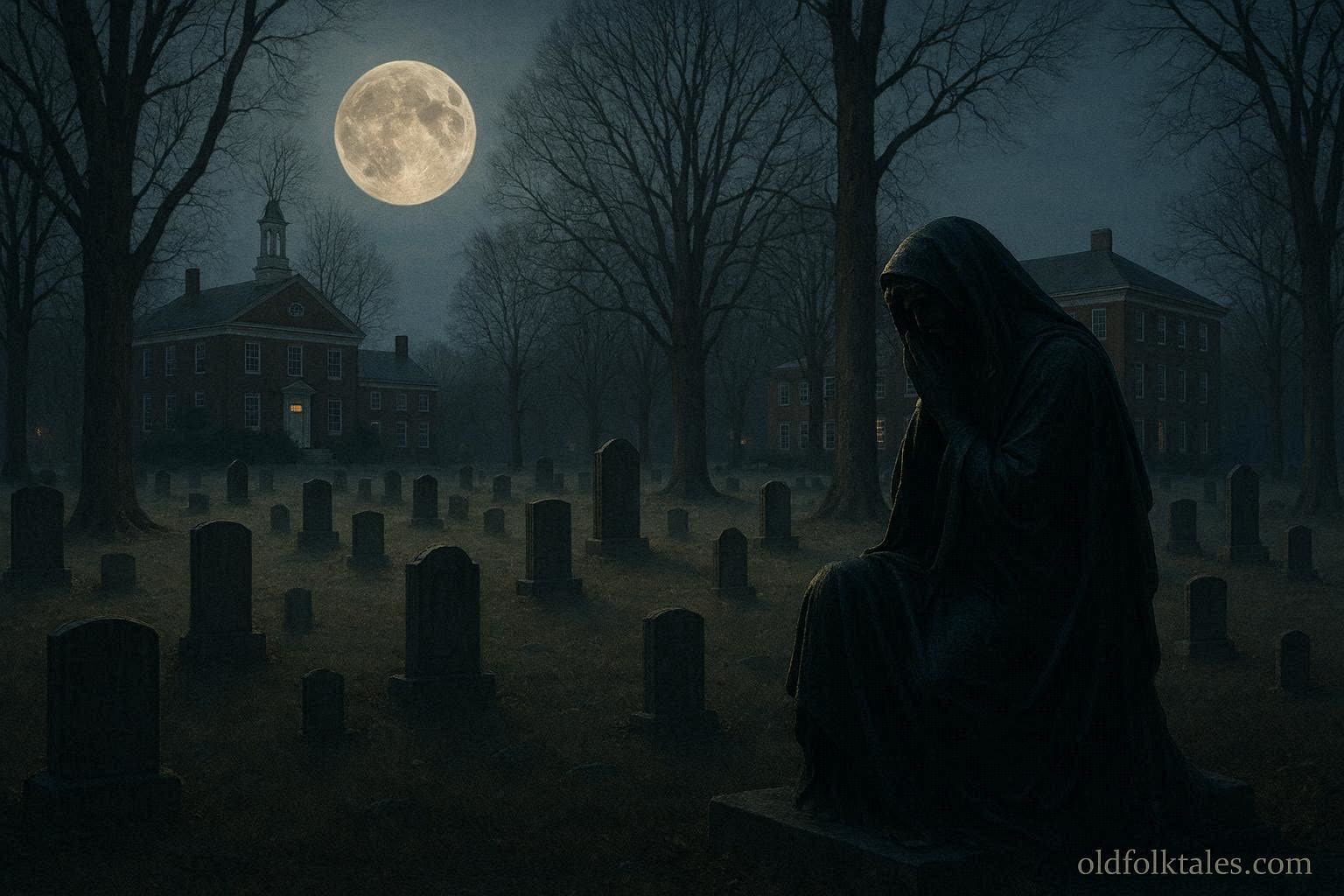
The cemetery at the edge of the University of Maryland campus appears calm during the day. Trees cast long shadows across the grass, and students sometimes pass through on quiet walks between classes. At first glance, it feels like an ordinary resting place, separated from campus life by a thin line of trees and fencing. Yet generations of students insist that something changes after dark. Among the headstones stands a statue known as Black Aggie, and its presence has shaped campus folklore for more than a century.
The statue itself is a dark bronze replica of the famous Grief statue by Augustus Saint-Gaudens. Seated, hooded, and motionless, it depicts mourning in its purest form. During daylight hours, it appears solemn but unremarkable. However, students began to notice something unsettling when visiting at night. From certain angles, the statue’s shadowed face seemed to follow movement. As lanterns and later flashlights passed by, the impression grew stronger. The belief emerged that Black Aggie watched visitors, her gaze shifting subtly as people crossed the cemetery.
Early campus stories framed the statue as a test of courage. Students dared one another to sit alone with Black Aggie after midnight or to circle the statue without looking away. Those who accepted the challenge often returned shaken. Some claimed the statue’s eyes glowed faintly. Others swore they heard whispers or felt sudden pressure in their chest. Whether imagined or amplified by fear, these experiences spread quickly through dormitories, gaining new details with each retelling.
Explore the heart of America’s storytelling — from tall tales and tricksters to fireside family legends.
The cemetery’s proximity to campus life gave the legend unusual strength. Unlike remote haunted sites, Black Aggie was accessible, familiar, and woven into daily routines. Students passed it on their way to classes, sports events, and late-night study sessions. This closeness blurred the line between the ordinary and the uncanny. The statue became a symbol of anxiety during transitional years, representing fear of failure, death, and the unknown future awaiting graduates.
As the legend evolved, rules began to form. Looking directly into the statue’s face for too long was said to bring misfortune. Sitting beneath its gaze could cause nightmares or illness. Some stories warned that couples who visited together would soon break up. Others claimed that those who mocked the legend experienced unexplained bad luck. These warnings were rarely taken seriously at first, but the accumulation of stories made even skeptics uneasy.
University administrators eventually noticed the growing attention. Reports of vandalism, trespassing, and nighttime gatherings increased. The statue became a focal point for pranks and rituals that disrupted the cemetery’s intended purpose. Out of respect for the burial site and concern for safety, the statue was eventually relocated. Yet removing Black Aggie did not erase the legend. Instead, it strengthened it. Students began to say that the statue was moved because it was too powerful to remain.
Even after relocation, stories persisted. Students claimed they could still feel the statue’s presence in the original cemetery location. Others said the legend followed Black Aggie wherever it went, attaching itself to the idea rather than the object. The tale adapted to new settings, appearing in orientation stories, campus tours, and late-night conversations. Each generation reshaped it, adding modern anxieties to an old foundation.
Folklorists studying campus legends note that stories like Black Aggie thrive in environments of transition. Universities are places where young adults confront independence, mortality, and uncertainty for the first time. Cemetery legends offer a way to externalize these fears. By attributing anxiety to a watching statue, students find a shared language for feelings they struggle to articulate. The legend becomes a coping mechanism as much as a scare story.
Black Aggie’s vigil also reflects changing attitudes toward death. In earlier generations, cemeteries were familiar spaces integrated into daily life. Over time, they became distant and uncomfortable. The statue embodied this shift, standing as a reminder of mortality in a setting dedicated to youth and ambition. The tension between these themes gave the legend emotional power beyond simple fright.
Today, the story of Black Aggie remains part of University of Maryland culture. Alumni recall it fondly, sometimes with embarrassment, sometimes with genuine unease. New students hear the tale and feel the same pull to test it for themselves. The statue no longer needs to watch physically. The story itself performs that role, observing each new generation as it confronts fear, curiosity, and belief.
Click now to read all American Legends — heroic tales where truth and imagination meet, defining the American spirit.
Moral Lesson
Legends endure when they give form to unspoken fears, reminding communities to respect both history and the emotional landscapes of youth.
Knowledge Check
- What is Black Aggie modeled after?
Answer: A replica of the Grief statue by Augustus Saint-Gaudens - Where did the legend originate?
Answer: A cemetery near the University of Maryland campus - What behavior was believed to bring misfortune?
Answer: Staring directly into the statue’s face or mocking the legend - Why was the statue relocated?
Answer: Due to safety concerns, vandalism, and respect for the cemetery - Why did the legend persist after relocation?
Answer: The story attached to the idea of Black Aggie rather than the statue itself - What does the legend symbolize for students?
Answer: Anxiety, transition, mortality, and fear of the unknown
Source
Adapted from University of Maryland folklore and student culture archives
Cultural Origin
College Park, Maryland