Along the Outer Banks, night carries memory as surely as it carries wind. The ocean never truly sleeps there. Even in calm weather, waves breathe against the shore, pulling sand back and forth in a rhythm older than settlement. It is in this restless landscape that light has always mattered more than walls.
Before modern navigation, watchtowers rose along the coast. They were simple structures, built for height rather than comfort. From their platforms, watchers scanned the horizon for sails in distress, enemy vessels, or sudden weather shifts. A single flame lifted high could mean the difference between rescue and loss.
One such tower once stood near Cape Hatteras.
It collapsed long ago. Storms weakened its frame. Salt corroded its fastenings. Eventually, it fell, leaving only scattered stone and memory behind. Maps erased it. Records faded. Yet the light never fully disappeared.
Discover chilling ghost tales and haunted places that echo through America’s towns and countryside.
Fishermen were the first to speak of it.
They told of nights when the sea turned uneasy long before clouds gathered. When wind carried a sharp edge. When the horizon felt crowded even though it was empty. On those nights, a flame appeared where no structure stood.
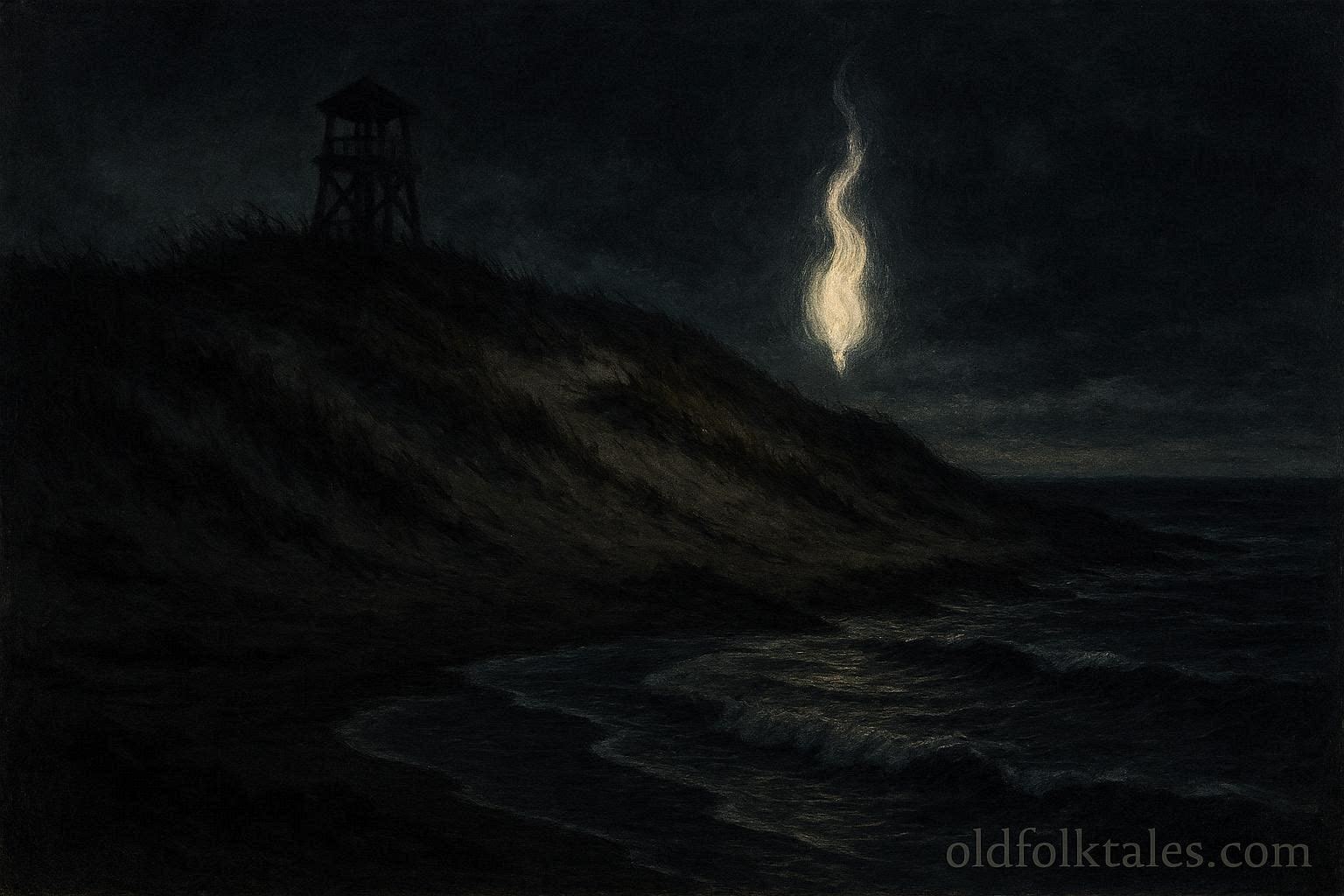
High above the dunes, a fire burned steadily.
It did not flicker wildly. It did not cast sparks. It burned with purpose, contained and unwavering, as though lifted by invisible hands to a familiar height. Those who saw it felt an immediate recognition, even if they could not explain why.
The fire never illuminated a tower.
It simply hung in the air, marking a place that once mattered.
Sailors learned to trust it. When the flame appeared, they delayed departure. They secured vessels more tightly. They warned others. Storms followed with such consistency that ignoring the light came to be seen as reckless.
Shipwrecks were avoided.
When ships were lost despite the warning, survivors later spoke of seeing the flame too late, already committed to open water. They remembered it not with fear, but regret.
The fire never saved everyone.
But it saved enough to earn respect.
Attempts were made to explain it. Some blamed marsh gas. Others claimed distant lighthouse reflections distorted by fog. Yet the light appeared before storms, not during them. It burned even on clear nights when no beacon shone nearby. And it rose to the exact height where the watchtower platform once stood.
Old charts confirmed the alignment.
Local families passed the story carefully, treating it less as a ghost tale and more as coastal knowledge. Children were taught that light did not always come from buildings. Sometimes it came from memory doing its job.
The watchtower had been staffed by men whose names no longer survived. Their duty was simple and unforgiving. Watch. Signal. Stay awake when others slept. Their work offered little recognition and constant danger. Storms took them as easily as they took ships.
Legend holds that during a violent hurricane, the tower’s final watchman remained at his post too long. Determined to warn others, he refused to abandon the flame. The structure failed beneath him, but the fire remained lit long enough to signal danger to the shore.
Whether he survived is unclear.
What endured was the light.
Those who witness it describe a deep stillness that accompanies its appearance. Birds fall silent. Wind pauses briefly, as if acknowledging the signal. The ocean seems to draw a breath.
Then weather follows.
Sometimes the fire burns only moments. Sometimes it lasts hours. It never spreads. It never consumes. It does not warm those who approach, nor does it scorch the air.
It is not fire meant to destroy.
It is fire meant to warn.
Modern visitors occasionally report seeing the flame while walking the beach at night. They often doubt themselves until storms arrive the next day. Cameras rarely capture it clearly. The light resists documentation, as though intended only for those present and attentive.
Locals do not chase it.
They watch. They listen. They prepare.
The legend persists because it continues to function. It serves the same purpose now as it did when the tower stood. It marks danger. It demands respect for the sea. It reminds the living that vigilance does not expire when structures fall.
Coastal landscapes change constantly. Sand shifts. Inlets open and close. Towers rise and vanish. What remains is responsibility.
The Burning Watchtower is not remembered as a tragedy.
It is remembered as a signal that refuses to go dark.
Click now to read all American Legends — heroic tales where truth and imagination meet, defining the American spirit.
Moral Lesson
Responsibility does not end when structures collapse or duties go unrecognized. Vigilance and care can persist beyond loss, guiding others even when the original guardians are gone.
Knowledge Check
- What appears where the watchtower once stood?
A steady, ghostly flame. - What does the flame signal?
Incoming storms and danger at sea. - Who first reported seeing the fire?
Local fishermen and sailors. - Why do locals respect the light rather than fear it?
Because it provides warning and protection. - When does the fire usually appear?
Before severe weather or shipwreck conditions. - What does the legend represent for coastal communities?
Enduring vigilance and responsibility.
Source
Adapted from University of North Carolina maritime folklore archives
Cultural Origin
Outer Banks coastal communities